Silent Running





Short description
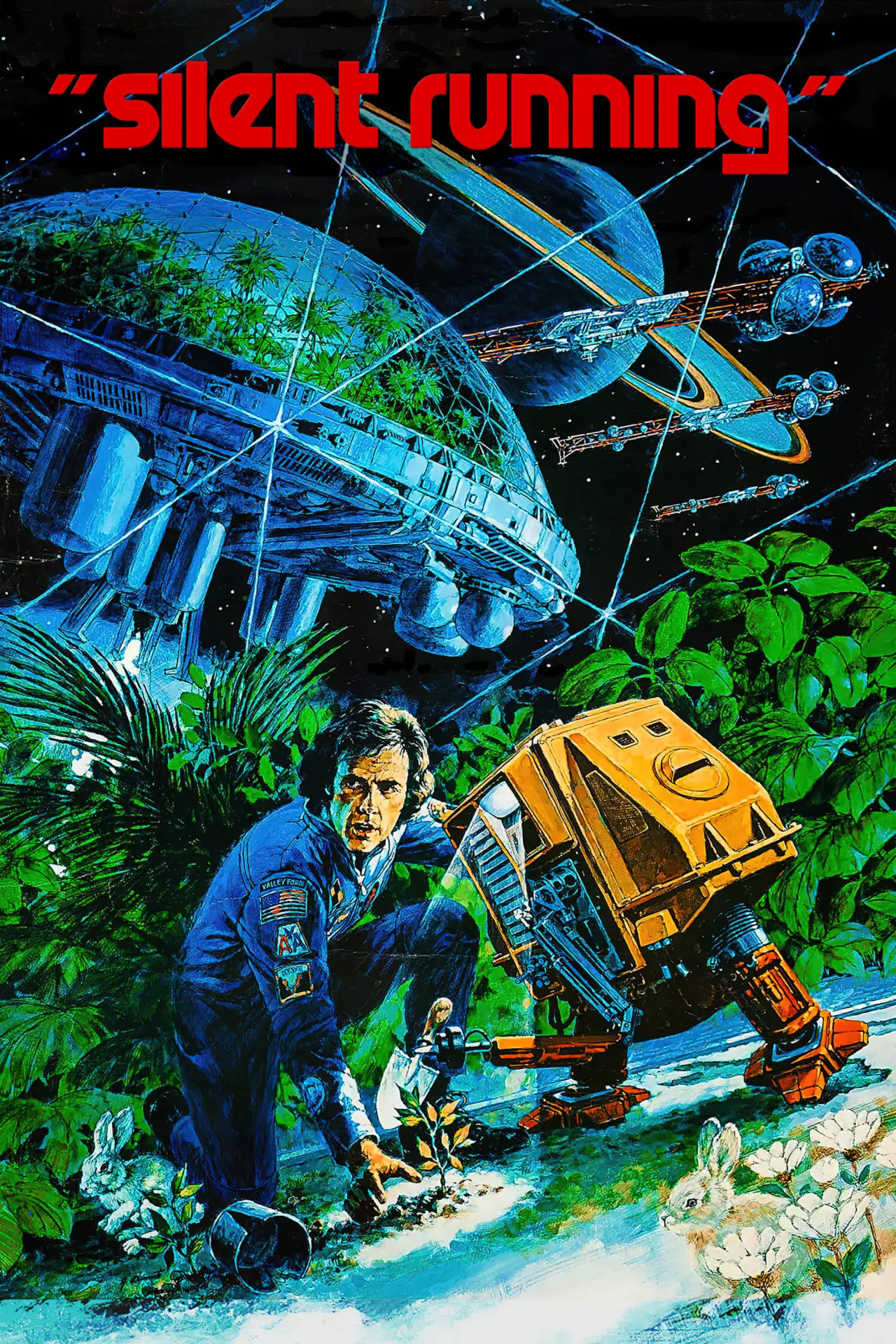
Silent Running takes place aboard the Valley Forge, a spacecraft carrying what remains of Earth's plant life after the planet's vegetation has been wiped out. The botanist Freeman Lowell tends the greenhouse domes with the help of robotic companions, but when he receives orders to jettison the domes and turn the ship to commercial work, he refuses and turns against the rest of the crew. What follows sets him apart from everyone aboard except his mechanical helpers.
The film marked the directorial debut of Douglas Trumbull, previously known for his special-effects work, and his only other credited directing effort would be Brainstorm, released in 1983. The script was written by Deric Washburn, Michael Cimino and Steven Bochco, and Bruce Dern leads the cast as Lowell, with Cliff Potts, Ron Rifkin and Jesse Vint as the other crew members and Mark Persons and Steven Brown operating the drones Dewey and Huey. Produced by Universal Pictures with Trumbull/Gruskoff Productions on a budget of about one million dollars, the film runs 89 minutes.
Numbers suggest a modest but lasting following. On IMDb it holds a critics' rating of 6.7 out of 10 from 35 reviews, a touch above the 6.4 out of 10 that roughly 660 users give it on TMDB. That gap is small: reviewers and audiences read the film in broadly similar terms, regarding it as a thoughtful, effects-driven science-fiction drama rather than a widely embraced mainstream hit.
What's left behind the scenes
- The design of the vehicles used by the crew members was conceived by the father of director Douglas Trumbull.
- Some footage of the 'Valley Forge' and its sister ships was later used in the 1978 television series 'Battlestar Galactica', where they depicted support vessels of the surviving human fleet.
- The spaceship interiors were filmed inside the 'Valley Forge' (an Essex-class American aircraft carrier from World War II, decommissioned in early 1970, which had seen action in Korea and Vietnam). Some of its sections were slightly modified and repainted to serve as film sets. After filming was completed, the aircraft carrier was sold for scrap metal.
- For the nude bathing scene, Bruce Dern had to get into cold water because the film's budget did not provide for the purchase of a water heater.
- Following the staggering success of Dennis Hopper's adventure drama 'Easy Rider' (1969), someone at Universal Studios had the idea to standardize this approach to cinema and produce low-budget, 'semi-independent' films in hopes of repeating Hopper's success. It was decided to start with five films (each with a budget of one million dollars or less) and grant their creators complete creative freedom, including final cut privilege. This led to the creation of the following films: this movie, the western 'The Getaway' (Peter Fonda, 1971), the drama 'The Last Movie' (Dennis Hopper, 1971), the musical drama 'Taking Off' (Miloš Forman, 1971), and the drama 'American Graffiti' (George Lucas, 1973).
- The Saturn storyline was originally conceived for inclusion in Stanley Kubrick's science fiction film '2001: A Space Odyssey' (1968), but the idea was abandoned due to the limitations of the special effects of that period.
- The roles of the drones (robots) were played by people with disabilities who are amputees.
- In the scene where he addresses the crew, Bruce Dern's character speaks about a girl who will never again know the simple joys of life and weeps—and those tears were real. At that moment, the actor was thinking about the accidental death of his own young daughter a few years prior.
- A nine-meter model of the 'Valley Forge' was constructed from steel, wood, and plastic. After filming was completed, the model was placed in storage; however, due to high storage costs, it was decided to dismantle and destroy it in the mid-1970s. Only a few large elements of the model survived, one of which eventually ended up in the exhibition of a non-profit pop culture museum in Seattle, Washington, USA.
- The scenes of the domes being jettisoned were based on the drop of spent stages of the Saturn V super-heavy-lift launch vehicle, which Trumbull had specifically studied. The models of the coupling sleeves were only 10 centimeters in diameter. To achieve the effect the director wanted, they were filled with mica and compressed air.
- The geodesic dome of the Missouri Botanical Garden's greenhouse was used as a prototype for the geodesic domes.
- To save money, director Douglas Trumbull hired students to create the miniature models before filming began. One of them, John Dykstra, eventually became a renowned master of visual effects.
- Three drone robots were operated by four actors with amputated limbs.









 Auditions in India
 Casting calls in USA
 Castingi w Polsce
 Кастинги в Україні

