The Castle of Cagliostro




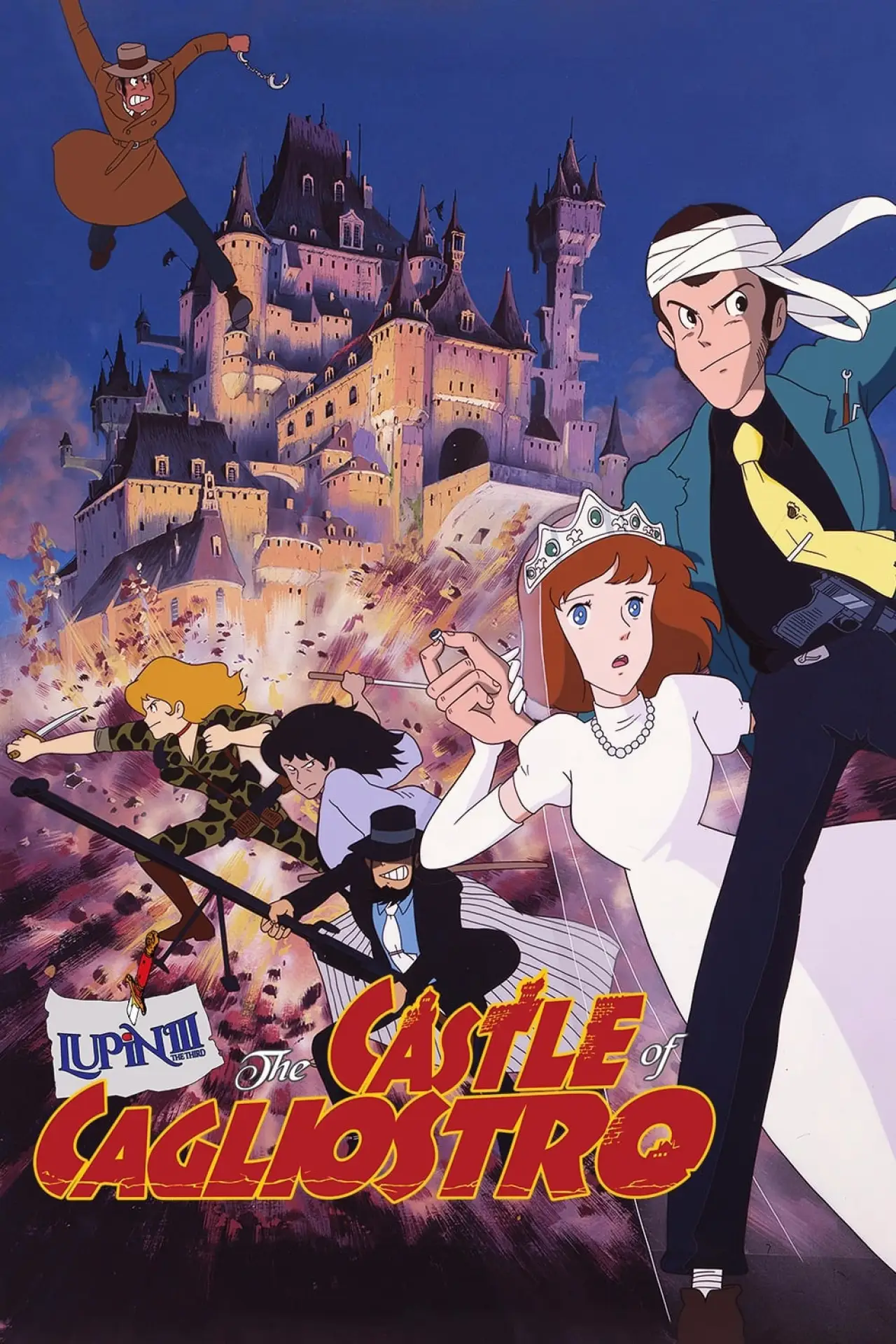
All actors and roles (10)
All team (42)
Short description
Master thief Arsène Lupin III and his partner Daisuke Jigen pull off a casino robbery, only to discover their haul is made up of counterfeit bills of extraordinary quality. The trail leads them to the tiny European duchy of Cagliostro, whose rulers have long been linked to the production of near-perfect forgeries. Lupin's interest shifts when he encounters Lady Clarisse, a young woman being forced into marriage by the ruling Count, who wants her for reasons tied to a hidden family treasure. With Jigen, the swordsman Goemon Ishikawa XIII, the pursuer Fujiko Mine, and Interpol's Inspector Zenigata all drawn into the affair, Lupin sets out to rescue Clarisse and uncover the secret of the castle.
The Castle of Cagliostro is an animated adventure film directed by Hayao Miyazaki, who also co-wrote the screenplay with Haruya Yamazaki. It was produced by Tetsuo Katayama for Tokyo Movie Shinsha and Telecom Animation Film, and it stands as the first of the sixteen films Miyazaki directed, followed chronologically by Warriors of the Wind in 1984. The voice cast includes Yasuo Yamada as Lupin, Kiyoshi Kobayashi as Jigen, Eiko Masuyama as Fujiko, Makio Inoue as Goemon, Gorō Naya as Zenigata and Sumi Shimamoto as Clarisse.
Released in 1979, the film runs 102 minutes. Its budget of around seven million dollars was not matched by its worldwide box office of roughly eight million. On IMDb it holds a rating of 7.6 from about 36,000 votes, and on TMDB a rating of 7.5 from over a thousand votes. A critics' rating of 7.5 from 21 reviews places it in close agreement with those audience scores.
What's left behind the scenes
- According to Hayao Miyazaki, he based the location and architecture of the fictional County of Cagliostro on cities in Italy in the mountains and along the banks of the Tiber.
- The creator of the Lupin III manga, Monkey Punch, did not ask permission from the copyright holders to use the name of the hero from Maurice Leblanc's novels (1864-1941), as Japanese copyright laws were more than liberal at that time. When Arsène Lupin from the anime gained popularity in North America and Europe, copyright issues began to arise. Therefore, in English translations, the hero is called either Wolk (as "lupine" is translated) or Rupan (as the word is pronounced in Japanese).
- The manga "Lupin III" is based on a series of novels by French writer Maurice Leblanc about the gentleman thief Arsène Lupin. It is claimed that the manga's protagonist, Arsène Lupin III, is the grandson of the French Lupin. The anime film contains references to other Lupin adventures told by Leblanc: the main plotline (Lupin's attempt to save a girl named Clarissa) is borrowed from the work "The Countess of Cagliostro" (1924); "The Justice of Arsène Lupin" features counterfeit money used to destabilize the economy; and "The Lady with the Green Eyes" (1927) concerns a treasure hidden at the bottom of a lake.
- The first anime film, shown at the Cannes Film Festival, although not in competition.
Similar movies





 Auditions in India
 Casting calls in USA
 Castingi w Polsce
 Кастинги в Україні
