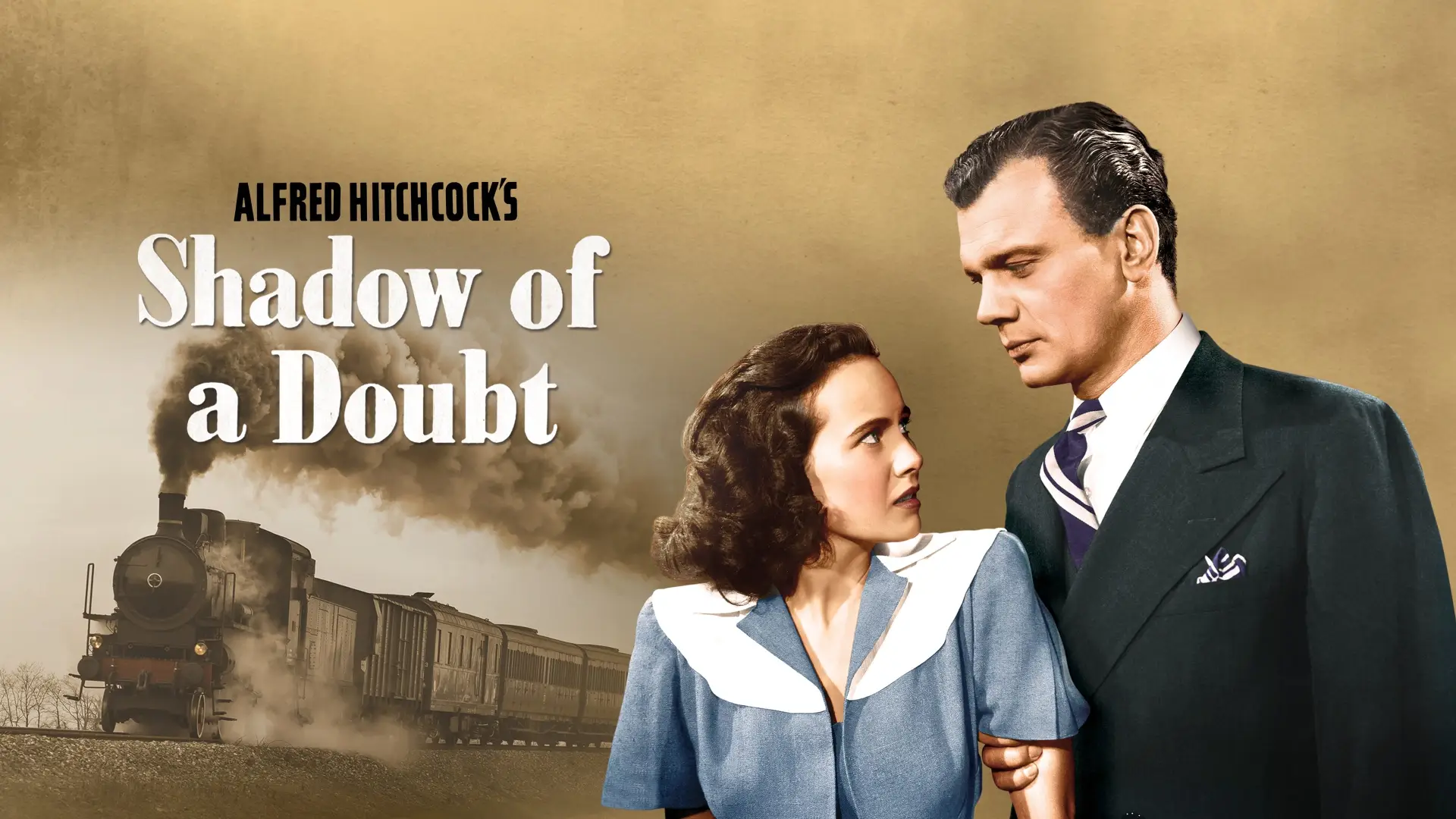
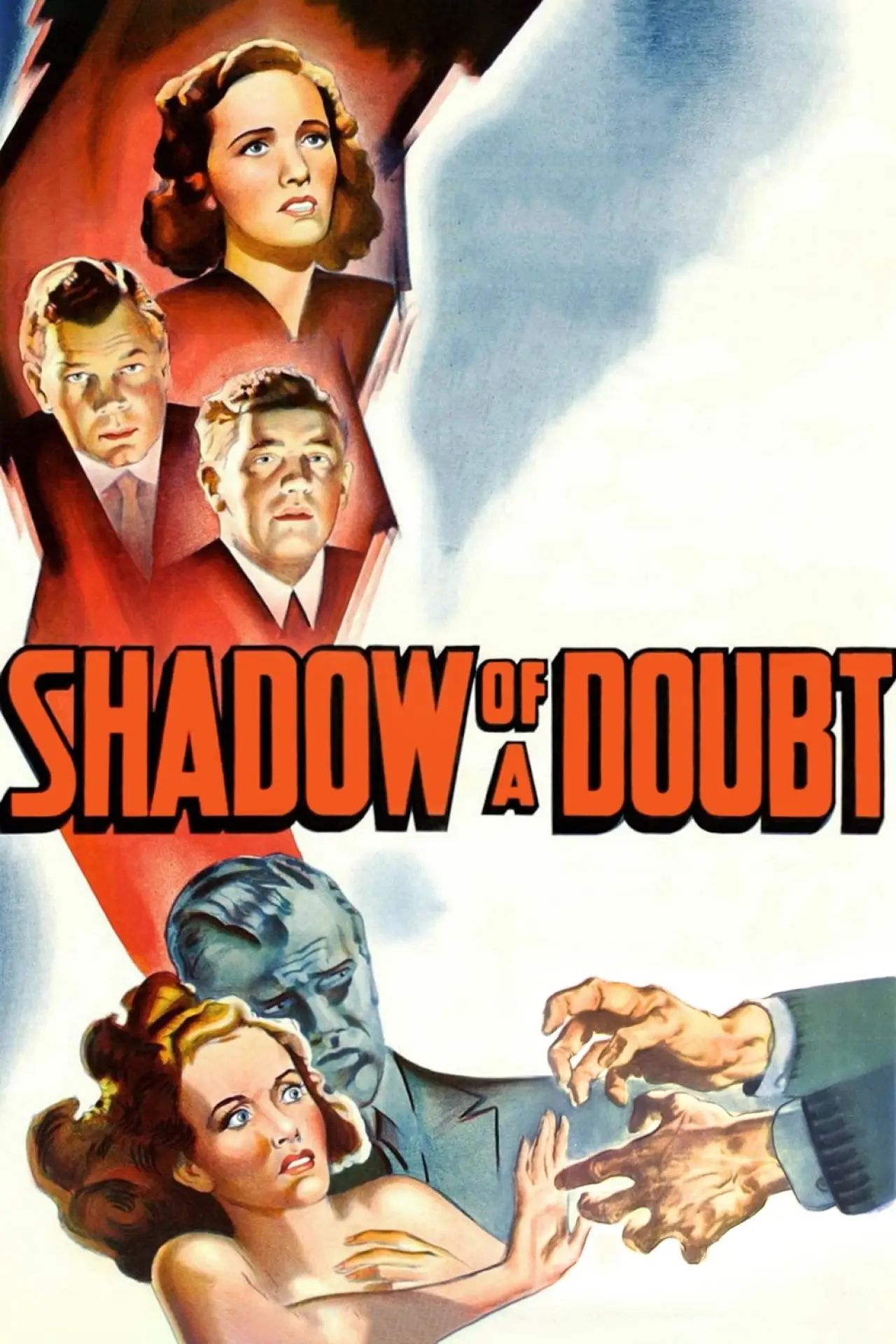
Shadow of a Doubt
What horror did her secret life hold… that made her dread this man of her dreams?



Country
Production
Budget
$0
Revenue
$0
Website
Director
Actors
Teresa Wright, Joseph Cotten, Macdonald Carey, Henry Travers, Patricia Collinge, Hume Cronyn, Wallace Ford, Edna May Wonacott, Charles Bates, Irving Bacon
All actors and roles (10)
All actors and roles (10)
Scenario
Producer
Jack H. Skirball
Operator
Joseph A. Valentine
Composer
Artist
Audition
Editing
Milton Carruth
All team (25)
All team (25)
Short description
In sleepy Santa Rosa, restless young Charlie’s world brightens when her sophisticated Uncle Charlie arrives for a long visit. But as his behavior grows increasingly strange, she begins to suspect that her beloved uncle may be hiding a terrible secret—and that danger has quietly entered her home.
What's left behind the scenes
- Director's cameo: a passenger playing cards on the train that Charles rides on at the beginning of the film; the character Hitchcock holds all the spades.
- Patricia Collinge, who played Emma Newton, wrote the "garage scene" between Charlie (Teresa Wright) and Jack (Macdonald Carey).
- William Powell could have played Uncle Charlie.
- The name "Charlie" is pronounced approximately 170 times throughout the film.
- Hitchcock wanted Joan Fontaine to play the young Charlie, but the actress was busy with other filming.
- Charles arrives in Santa Rosa on August 22nd or 23rd, 1942: a newspaper headline reads "Brazil Declares War," which occurred on August 22nd.
- The film is based on the real-life story of Earl Leonard Nelson, a serial strangler from the 1920s.
- Initially, the series was planned by a group of young and bold animators as a large-scale parody of space anime. However, it became one of the most famous space anime in history.
- This is Mari Iijima's only role in anime. Following the overwhelming success of the series and film's songs on Japanese charts, she chose a career as a pop singer.
- The popularity of the Minmay image and Mari Iijima's subsequent career had a huge impact on the formation of the modern Japanese pop scene. Previously, it was dominated by traditional national melodies unpopular with young people.
- Thornton Wilder was drafted before he had finished the screenplay. Hitchcock traveled with Wilder to his place of service by train and waited for him to finish the script. Wilder completed the screenplay at the end of the journey and used a train in its finale.
- Teresa Wright didn't even read the script before agreeing to star in the film. Director Alfred Hitchcock simply described the plot to her during a meeting, and she immediately agreed.
- Edna May Wonacott and Estelle Jewell lived in Santa Rosa, where the outdoor scenes were filmed. The townspeople also played extras, largely due to the significant distance between Santa Rosa and Hollywood, which had a preference for using only professional actors in minor roles.
- Alfred Hitchcock always preferred to work in studio sets, however, restrictions imposed due to the war on the cost of materials for building sets (the maximum cost was limited to $5,000) forced him to film on location.
- Producers sent people to Santa Rosa to find a house suitable for filming. Alfred Hitchcock gave these individuals detailed instructions regarding the characteristics of the Newton family's home. They selected a house and sent photographs to Hitchcock, who was delighted. The house was truly magnificent, although it required some cosmetic repairs, and the lawn was somewhat overgrown and neglected. Hitchcock believed that the appearance of the dwelling – solid and durable, yet gradually falling into disrepair – should suggest to viewers that anyone could be like the Newtons, that they were simply an ordinary American family in an unremarkable American small town. The director ordered the house to be rented from its owners, but when he arrived in Santa Rosa to begin filming, he experienced a genuine shock. Bursting with pride at the prospect of their home being used for a film, the owners had repainted it, tidied up the lawn, and generally 'spruced it up.' Hitchcock had to instruct his special effects team to artificially 'age' the house and the cinematographer to avoid capturing overly obvious signs of the owners' enthusiasm.
- 'Shadow of a Doubt' was a working title, but the creators were never able to come up with anything better.
- Charles kills wealthy widows. The waltz repeatedly mentioned in the film is the waltz from 'The Merry Widow'.
Similar movies
8.3/10
8.1/10
8/10
7.9/10
7.9/10
7.8/10
7.5/10
7.5/10
7.4/10
7.4/10


 Auditions in India
 Casting calls in USA
 Castingi w Polsce
 Кастинги в Україні
