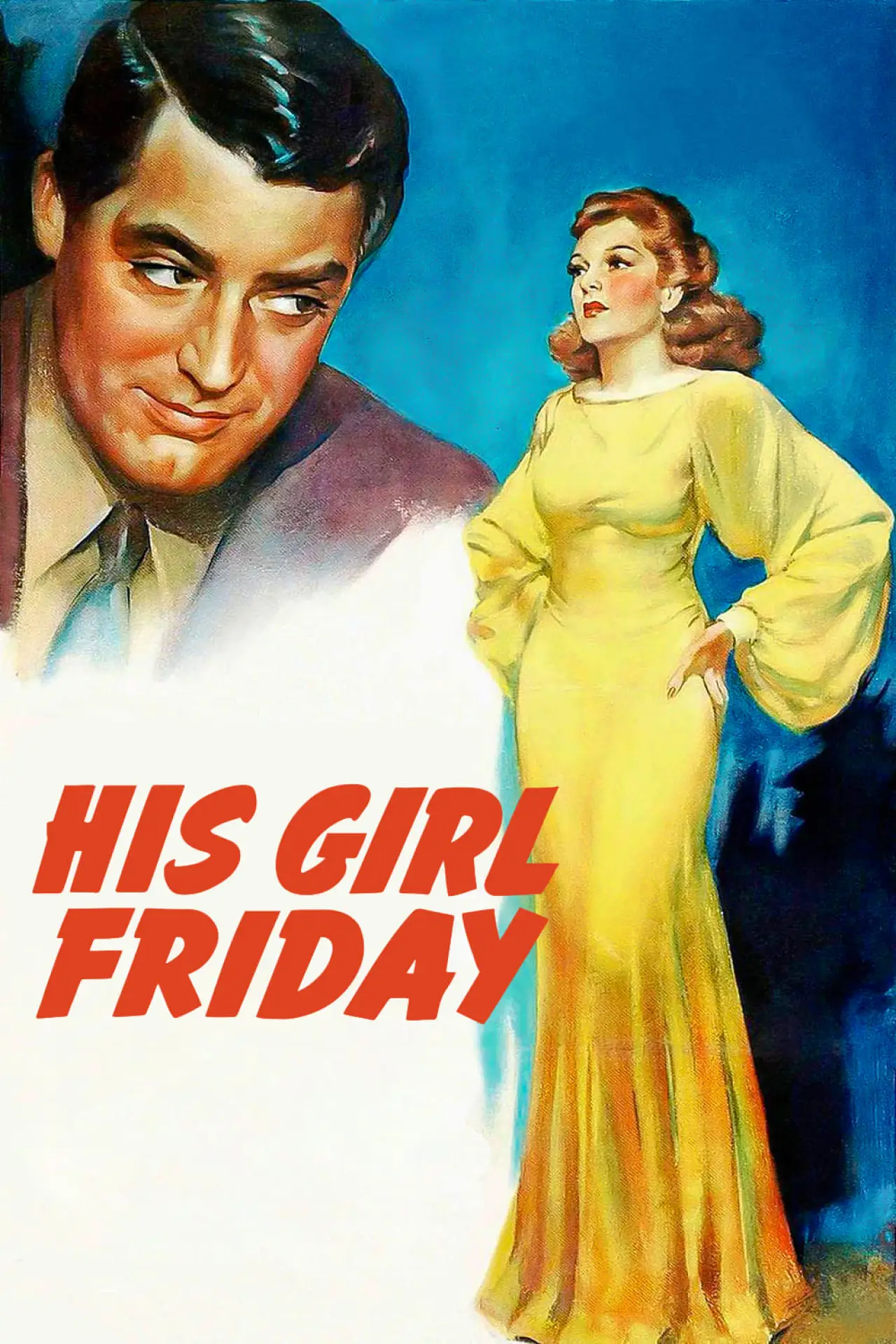
His Girl Friday
They're at each other's throats when they're not in each other's arms!



![Watch film His Girl Friday — His Girl Friday (1940) Original Trailer [HD]](https://www.acmodasi.in/amdb/images/posters/0/30/his-girl-friday-1940-Gc3RD.webp)
Country
Production
Budget
$0
Revenue
$0
Director
Actors
Cary Grant, Rosalind Russell, Ralph Bellamy, Gene Lockhart, Porter Hall, Ernest Truex, Cliff Edwards, Clarence Kolb, Roscoe Karns, Frank Jenks
All actors and roles (10)
All actors and roles (10)
Scenario
Producer
Howard Hawks, Jed Harris
Operator
Joseph Walker
Composer
Sidney Cutner
Artist
Audition
Editing
Short description
Walter Burns is an irresistibly conniving newspaper publisher desperate to woo back his paper’s star reporter, who also happens to be his estranged wife. She’s threatening to quit and settle down with a new beau, but, as Walter knows, she has a weakness: she can’t resist a juicy scoop.
What's left behind the scenes
- At the end of the film, Walter mentions a man named Archie Leach, which is Cary Grant's real name.
- It is estimated that lines in a typical film are spoken at an average rate of 90 words per minute. In Howard Hawks' (1896-1977) screwball comedies, the average rate reaches 240 words per minute.
- One of the first films – the very first being Gregory La Cava's (1892-1952) 'Stage Door' (1937) – in which characters speak over each other, before the other character has finished their line, was done to make everything look and sound more realistic. Previously, characters always let their scene partners finish speaking before starting their own line.
- Rosalind Russell (1907-1976) disliked that her character had fewer quality lines than the character played by Cary Grant (1904-1986), so with the help of her brother she enlisted the services of an advertising slogan and copywriter, who slightly altered the lines written for her character. This went unnoticed by Hawks, who allowed his actors to improvise, as well as by the crew and other actors, with the exception of Grant.
- Filming wrapped up several days later than planned. The delay was caused by the difficulty of shooting dialogue scenes where lines were spoken very quickly and had to be delivered at a specific moment to coincide with the visuals. Four days were spent filming the restaurant scene where Hildy and Bruce are invited. Initially, only two days were allocated for filming this scene.
- To record sound (and specifically, rapid exchanges of dialogue), Hawks decided to use not one microphone held to the actors on a boom, but multiple microphones. Since the microphones were not switched on simultaneously, a dedicated sound engineer would turn them on in sequence. Up to 35 microphones were used simultaneously in one scene.
- There was a lot of improvisation during filming, which seriously complicated the work of cinematographer Joseph Walker (1892-1985). It was especially difficult to film Rosalind Russell in a way that she looked perfect on screen, as Walker didn't know in advance exactly where she would be in any given scene. The actress had a prominent lower jaw, which required lighting during filming. In the end, Walker solved this problem by asking Russell's makeup artist to shade the actress's jawline, so that she could be filmed without any further issues.
- The scene in which Walter and Hildy hide the criminal in the newsroom was based on a real-life case where an editor of The New York Evening Graphic hid a fugitive criminal in the newsroom, interviewed him, wrote an article about it, waited for sales of that issue of the newspaper to begin, and only then handed the criminal over to the police.
- A loose adaptation of the play by Ben Hecht and Charles MacArthur.
- This is Quentin Tarantino's favorite film comedy.
Similar movies
8.4/10
8.4/10
8.1/10
8.1/10
8.1/10
8.1/10
8/10
7.9/10
7.9/10
7.9/10


 Auditions in India
 Casting calls in USA
 Castingi w Polsce
 Кастинги в Україні
