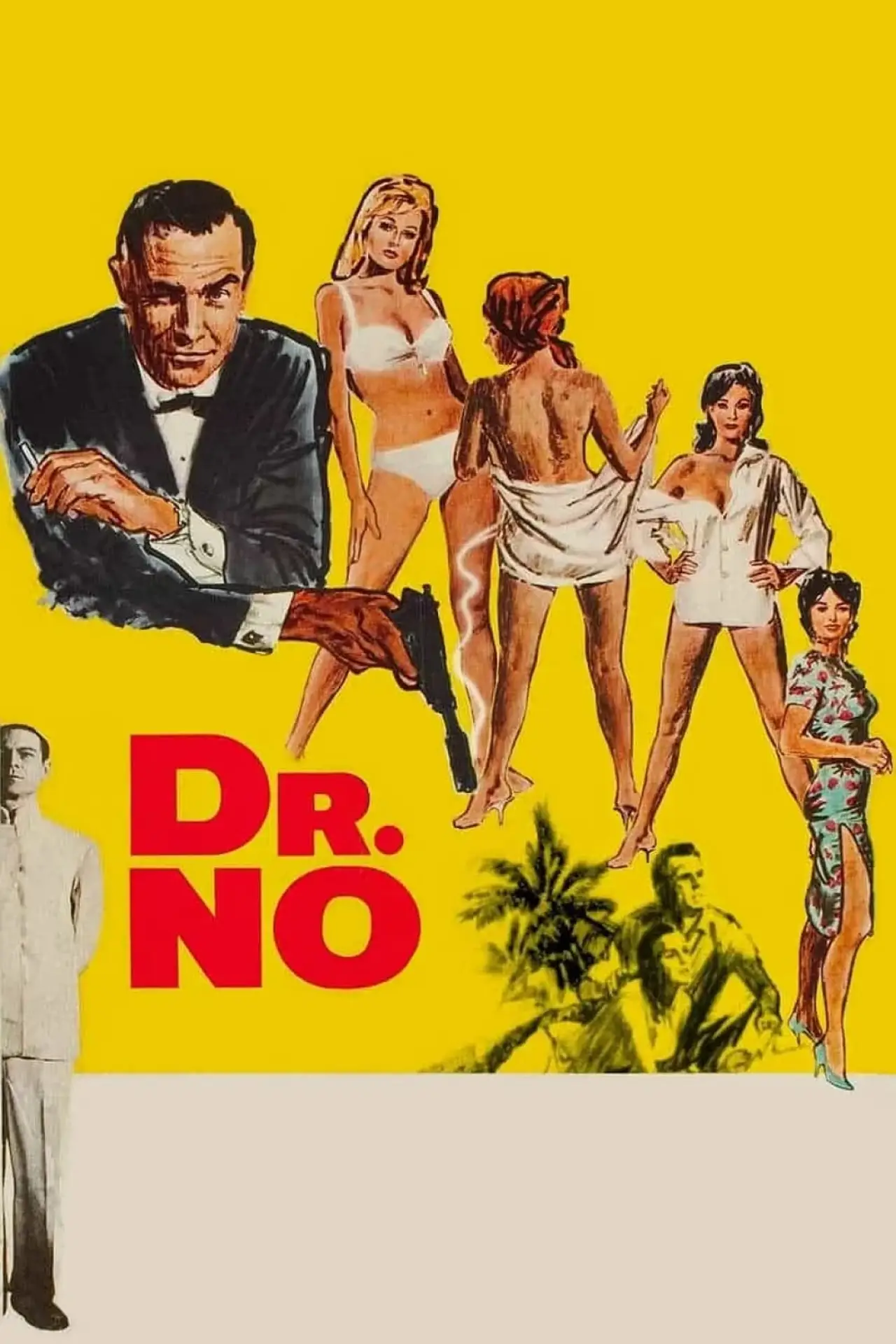
Dr. No
Now meet the most extraordinary gentleman spy in all fiction!



![Watch film Dr. No — Dr. No (1962) theatrical trailer [FTD-0008]](https://www.acmodasi.in/amdb/images/posters/e/l/dr-no-1962-Qw03J.webp)
Country
Production
Budget
$1 000 000
Revenue
$59 000 000
Website
Director
Actors
Sean Connery, Ursula Andress, Joseph Wiseman, Jack Lord, Anthony Dawson, Zena Marshall, John Kitzmiller, Eunice Gayson, Bernard Lee, Lois Maxwell
All actors and roles (10)
All actors and roles (10)
Scenario
Producer
Operator
Ted Moore
Composer
Artist
Ken Adam, Trevor Bond
Audition
James Liggat
Editing
Short description
Agent 007 battles mysterious Dr. No, a scientific genius bent on destroying the U.S. space program. As the countdown to disaster begins, Bond must go to Jamaica, where he encounters beautiful Honey Ryder, to confront a megalomaniacal villain in his massive island headquarters.
What's left behind the scenes
- The car James Bond drives in the film is a 1961 blue Sunbeam Alpine. The car is not equipped with any clever gadgets from Q, but the vehicle saves Bond's life when he is pursued by Dr. No's henchmen.
- From a budget of $1,000,000, £14,000 was spent on sets. The film's art director, Ken Adam, managed to secure an additional £6,000 for the sets, which are now considered exemplary in all respects.
- Titles artist Maurice Binder came up with the famous silhouettes inside the gun barrel in a matter of minutes, simply by placing the camera at the end of the gun barrel.
- All the female voices in the film, with the exception of Miss Moneypenny, belong to the same little-known English actress – Diane Copeland.
- In 2006, at a Christie's auction in London, James Bond's Walther PPK pistol, used by Sean Connery in the 1962 film "Dr. No," was sold for £54,000 ($106,202). This pistol became the most expensive lot at that time of all previously sold memorabilia from James Bond films.
- One of the reasons Noel Coward declined the role of Dr. No was that he would have had to wear metallic hand prosthetics in the film.
- According to a 2006 Empire magazine and Sony Pictures poll, Ursula Andress (Honey Ryder) was named the best Bond girl in the entire James Bond film series. The scene from "Dr. No" where Andress emerges from the sea waves in a white bikini, like Venus, became iconic at the time. As soon as Honey Ryder appeared before the young Sean Connery in a swimsuit, bikinis instantly became the height of fashion, and the young Scottish actor became a movie star. In 2004, British television channel Channel 4 named this scene one of the most exciting moments in world cinema.
- Wolf Mankowitz was one of the screenwriters for "Dr. No," but he disliked the final script so much that Mankowitz removed his name from the credits. He later got his revenge – he wrote the screenplay for the parody film "Casino Royale" (1967), which also starred Ursula Andress, the first Bond girl.
- One of the details of the interior of Dr. No's lair was a magnifying glass window through which one could see marine fish. The studio's film library quickly found a film with underwater footage the day before filming this scene. But the fish were filmed in close-up and appeared much larger than life-size. Then an explanation was devised: Dr. No says that the glass magnifies everything, like a lens.
- Ian Fleming, the author of the James Bond novels, very much wanted his cousin Christopher Lee to play Dr. No, but unfortunately, it didn't happen. Lee finally landed the role of the villain Scaramanga in the Bond film "The Man with the Golden Gun" in 1974. The role of Dr. No was also offered to Max von Sydow, but he turned it down.
- According to other accounts, the first scene filmed for the movie was an episode in 'M's' office, featuring Bernard Lee, Peter Burton, and Sean Connery. The scene was shot in a studio, and many of the crew, including director Terence Young, were late due to a sudden onset of inclement cold weather.
- The famous photograph of Connery holding a gun at chest level had to be reshot at the last moment. The “Walther PPK” was forgotten at the studio. Fortunately, the photographer happened to have an air pistol with him – Connery filmed with that.
- Ian Fleming was so captivated by the beauty of Ursula Andress that in his novel "On Her Majesty's Secret Service" (1963), he described the heroine Tracy Di Vicenzo (played by Diana Rigg in the film adaptation) as a girl very similar to Andress.
- Ian Fleming insisted on Roger Moore as the ideal candidate for the role of Bond, but Moore declined as he had begun filming the television series "The Saint".
- The American premiere of the film was delayed due to the tense political climate following the Cuban Missile Crisis.
- Although Moneypenny has become a symbol of Britain, the actress who played her, Lois Maxwell, is Canadian.
- Marguerite LeWars, who played the photographer Annabelle Chang in the film, worked as a flight attendant. Terence Young approached her with the simple question, "Would she like to star in a movie?" The girl said she would. Her brother-in-law, Reggie Carter, also appeared in the film, playing the role of a chauffeur – Doctor No's henchman who drove James Bond from the airport.
- Writer Ian Fleming disliked Sean Connery very much, believing the rough Scotsman would ruin his beloved creation. But after the film's release, he radically changed his mind. Fleming was so impressed with Connery's work that he gave his hero Scottish roots in his new Bond novel, 'On Her Majesty's Secret Service' (1963).
- Employees of the Japanese branch of United Artists studio misunderstood the film's title, reading it as “Dr.? No!” The Japanese printed posters with hieroglyphs meaning “We don’t need a doctor!” The mistake was discovered at the very last moment.
- The character of Miss Moneypenny was inspired by Vera Atkins, a British intelligence agent. After World War II, Atkins participated in the search for war criminals.
- The name of the armory worker who issues Bond his "Walther PPK" is Major Boothroyd. In the next film, "From Russia with Love," his role is played by Desmond Llewelyn. The person who supplies Bond with weapons, starting with "Goldfinger" (1964), will forever be known as "Q".
- Sean Connery wears a wig in all of the Bond films, starting with "Dr. No".
- Sylvia Trench, the girl Bond meets in the first film at the casino, was conceived as a recurring character throughout the "Bond" series. She reappeared in "From Russia with Love" (1963), but was then removed from the remaining scripts.
- The role of Sylvia Trench was initially offered to Lois Maxwell, who instead played Moneypenny. And Eunice Gayson was considered for the role of Moneypenny, ultimately she played Sylvia Trench.
- Ursula Andress's legendary white bikini from "Dr. No" was sold at a Christie's auction on February 14, 2001. Miss Andress decided to part with the swimsuit after accidentally discovering it in her attic. The 100% cotton bikini was sold for £40,000. It was purchased by Robert Earl to display in the window of one of the Planet Hollywood restaurants. According to Ursula Andress, this outfit brought her success. The role of the first 007 girl in "Dr. No," the actress said, gave her "freedom of role choice and financial independence."
- Documents discovered in 2006 reveal that another British actor, Richard Burton, almost played the role of James Bond. In 1959, three years before filming began on 'Dr. No,' the possibility of adapting Ian Fleming's novels was considered. Richard Burton was to play Bond in this production, and they hoped to have the renowned master of suspense, Alfred Hitchcock, direct the film.
- Since Connery was terrified of spiders, the scene with the spider in James Bond's bed was filmed using a glass partition separating the actor from the insect. However, the episode turned out unrealistic, and it was decided to reshoot the scene with Connery's stunt double, Bob Simmons. Simmons said that the scene with a tarantula crawling across James Bond's shoulder was the creepiest stunt he had ever had to perform.
- Following the release of "Dr. No" in Italy, the Vatican issued a special communiqué expressing its disagreement with the moral principles professed in the film.
- The classic casino scene, in which Agent 007 first appears, where we initially only see the faces of his card partners, and then a close-up of the protagonist appears and he introduces himself: “Bond, James Bond,” was filmed on March 2, 1962.
- A copy of the painting depicting the Duke of Wellington, by Francisco Goya, stolen in 1960 and still not found, is located in Dr. No's residence in the film. At the time of filming, the theft of this work was the greatest mystery, and every Briton had heard about it. Screenwriter Joanna Harwood suggested "attributing" this crime to Dr. No.
- Terence Young, the director of "Dr. No," also directed two other James Bond films starring Sean Connery: "From Russia with Love" (1963) and "Thunderball" (1965).
- "James Bond Beach," with an entrance fee of £3, is located directly opposite Ian Fleming's villa "Goldeneye" in the Oracabessa area.
- Although Doctor No's lair was located in Crab Key, the film's scenes were shot in various parts of Jamaica: on the beach where the famous scene featuring Ursula Andress emerging from the sea and meeting James Bond was filmed, now called "James Bond Beach", in the eastern part of Ocho Rios, and on the beaches of Laughing Waters Falls. "James Bond Beach" - Laughing Waters Beach was privately owned and belonged to Mrs. Minnie Simpson of Ocho Rios. Mrs. Simpson was a fan of Ian Fleming's novels.
- In the film, Professor Dent sends a giant venomous spider into James Bond's bed, while in the book he is given a giant centipede and receives a package of fruit filled with potassium cyanide.
- Joseph Wiseman, who played Dr. No, was the only actor portraying villains in the early James Bond films whose voice was not dubbed.
- Legends surround the creation of the iconic Bond theme that plays during the credits of the first Bond film. One thing is certain: it was composed by Monty Norman. Some say he originally wrote the melody for a musical that was never staged. According to another version, Norman heard the memorable tune from street musicians in Jamaica. However it happened, the producers asked John Barry to refine the melody, but under the agreement, he had to relinquish all copyrights. Barry decided that a bird in the hand (a fee) was worth two in the bush (glory). If only he had known that it would be his arrangement that the public would come to love. But Monty Norman, the 'original father,' never misses an opportunity to assert his rights to the famous melody. If anyone dares to call Barry the author of the Bond motif, Norman immediately sues the offender for defamation.
- The first scene in which Sean Connery starred as James Bond was an episode at Kingston Airport. He shields himself with a hat from a female photographer. The episode was filmed on January 16, 1962.
- Sean Connery was chosen for the role of James Bond after Albert R. Broccoli's wife, the producer of the Bond films, saw the young Connery in the 1959 film "Darby O'Gill and the Little People." Albert Broccoli also liked Connery in this film, and was particularly impressed by Sean Connery's fight with a rural bully in the film's climactic scene.
- The name of the casino in London where we first see James Bond is 'Le Cercle Les Ambassadeurs.' Its interiors were filmed at Pinewood Studios.
- The late director John Frankenheimer claimed in the past that Albert Broccoli offered him the role of Bond.
- When James Bond hums the song “Under The Mango Tree” in the film, it is the first and only time Agent 007 sings in the Bond series.
- The novel "Dr. No" was based on a script for the television film "Commander Jamaica", which Fleming wrote for Jamaican television. The main character there was also a secret agent, also with the rank of commander, who clashes with a certain arch-villain living on a certain island. But the project stalled, and Fleming turned the television film script into a Bond book.
- Fleming personally offered the role of Dr. No to screenwriter and actor Noël Coward ('Around the World in 80 Days,' 'Our Man in Havana'). Coward responded with a telegram: '“Dr.No”? No! No! No!’
- The famous phrase, "Bond, James Bond," was included in the American Film Institute's 2005 list of "100 Most Memorable Movie Quotes," ranking at number 22. And the quote from the Bond series, "A martini. Shaken, not stirred," ranked 90th.
- Although Sean Connery had already been approved for the role of James Bond, a competition was held for promotional purposes to find the perfect performer for the role of agent 007. Six finalists were selected, and the auditions were watched by Albert Broccoli, Harry Saltzman, and Ian Fleming. The winner was 28-year-old Peter Anthony. He worked as a model and had the appearance suitable for the role of agent 007, but he had a complete lack of acting talent.
- Among other actors considered for the role of agent 007 were Cary Grant ('Charade,' 'North by Northwest'), David Niven ('The Pink Panther'), Trevor Howard ('Ludwig'), and Rex Harrison ('My Fair Lady,' 'Cleopatra').
- The film's budget was only $1 million, but when $100,000 was overspent, 'United Artists' studio considered shutting down the project, fearing that these costs would never be recouped.
- One of the biggest challenges for the film crew was the very hot and humid weather in Jamaica, where the main filming took place.
- The male silhouette in the gun barrel of the iconic opening sequence is not Connery, but his stunt double Bob Simmons. Connery did not appear in the opening credits until 1965 – with the film 'Thunderball'.
- Originally, "Thunderball" was intended to be the first James Bond film, but legal disputes with one of the scriptwriters (Kevin McClory) led to "Dr. No" being filmed first. Another reason was that the entire film was set in one location – Jamaica – and the script only contained one large scene with special effects. This was convenient as the film had a small budget.
- Two weeks before filming began on "Dr. No," the actress for the main female role had not yet been found. Producers accidentally saw a photograph of actor John Derek with his wife Ursula Andress and immediately offered her the role, without even meeting the actress in person. At that time, Andress was not interested in working, but a family friend, actor Kirk Douglas, convinced Ursula to accept the role of Honey Ryder after reading the script.
- In the classic scene of Honey Ryder's appearance on the beach in the film, she is wearing the famous white bikini. However, in the book, the girl was wearing only a belt with a dagger sheath. In addition, her nose was broken, like a boxer's – the result of a rape.
Similar movies
8.3/10
8.2/10
8.1/10
7.7/10
7.7/10
7.6/10
7.5/10
7.5/10
7.5/10
7.4/10


 Auditions in India
 Casting calls in USA
 Castingi w Polsce
 Кастинги в Україні
