Fantasia



Short description
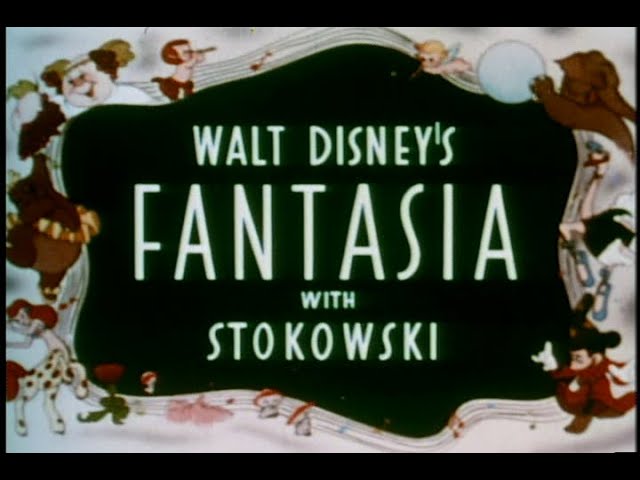
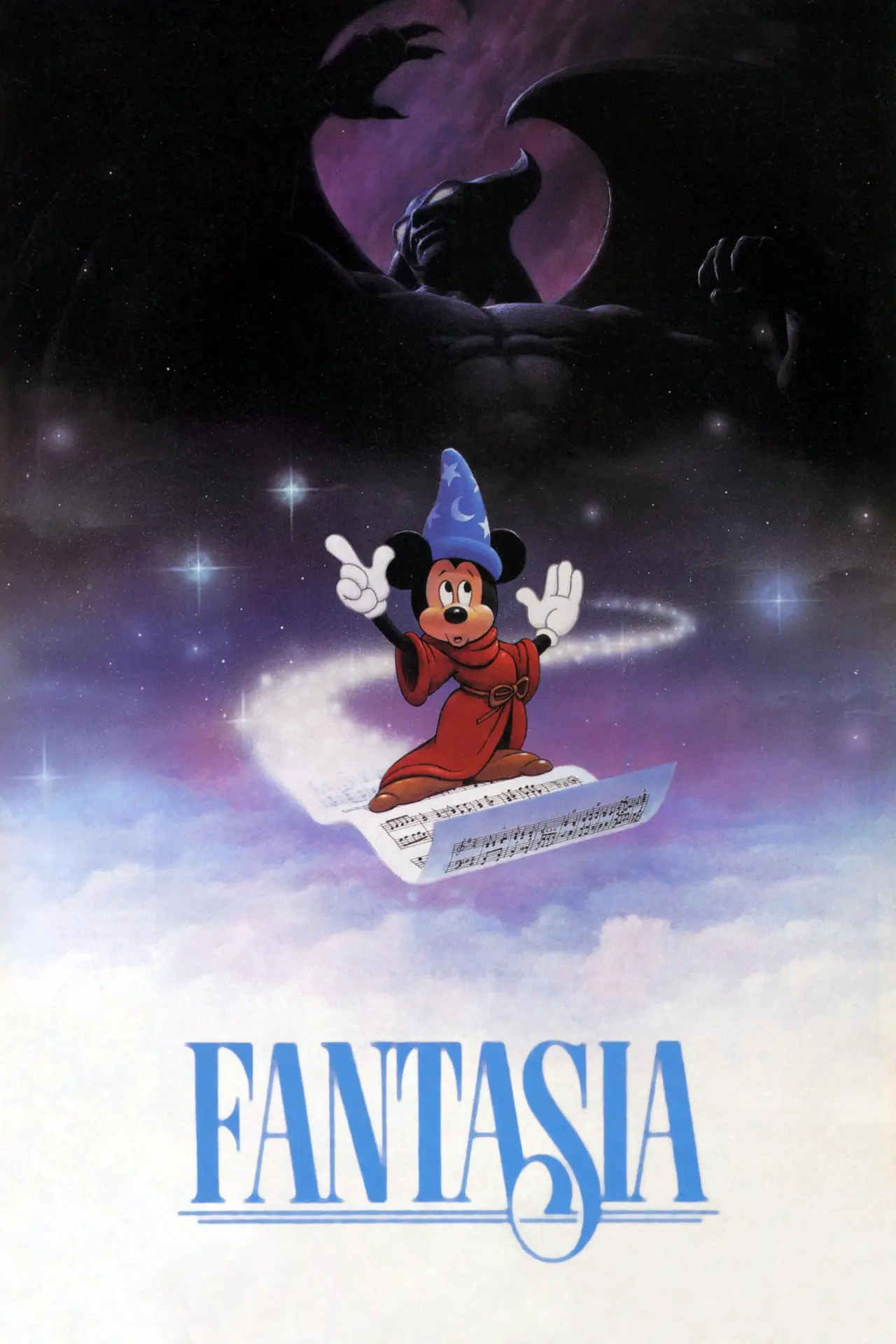
Fantasia is an animated concert film in which classical music is matched with imagery instead of a conventional plot. Its eight sequences range from abstract patterns to narrative episodes: Mickey Mouse appears as the sorcerer's apprentice who loses control of the magic he has set in motion, dinosaurs rise and vanish to Stravinsky, and hippos, ostriches and alligators dance to Ponchielli, while Mussorgsky's night on the bare mountain and Schubert's Ave Maria close the program. The music is performed by the Philadelphia Orchestra under Leopold Stokowski, and Deems Taylor provides spoken introductions between the pieces.
The film was produced by Walt Disney and directed by a large team, among them David Hand, James Algar, Samuel Armstrong, Ben Sharpsteen, Bill Roberts and Wilfred Jackson. For Hand it followed Snow White and the Seven Dwarfs and preceded Bambi; Sharpsteen and Jackson also moved on to Pinocchio the same year, and Algar would later return to the format with Fantasia 2000. It cost about two million dollars and took roughly 76 million worldwide.
Audience scores are favourable, with 7.7 out of 10 on IMDb from around 111,000 votes and 7.3 out of 10 on TMDB from some 3,400 votes. A critics' rating of 8.8 out of 10, based on 61 reviews, places it considerably higher than those audience scores.
What's left behind the scenes
- For some elements of the sorcerer's appearance in the Sorcerer's Apprentice sequence, the animators drew from details of Walt Disney's own persona—specifically, the raised eyebrow. The character's name, Yen Sid, is 'Disney' spelled backward in Latin characters.
- The cartoon was the first to use the "Dolby Stereo" stereophonic sound system.
- When "Fantasia" was released on video, "Night on Bald Mountain" was cut from the film. Upon the film's initial release in 1940, the studio was flooded with complaints from parents who claimed this segment frightened children. The episode was restored in subsequent re-releases.
- Chernobog in the "Night on Bald Mountain" segment was drawn based on actor Bela Lugosi, who served as a model. Lugosi spent several days (some sources claim it was all done on a single day, November 12, 1939) with Disney's animators, portraying the malevolent deity, whose image the animators then worked with. Bill Tytla, the animator responsible for Chernobog's appearance, was dissatisfied with Lugosi's performance and cast director Wilfred Jackson in the role of Chernobog. In other words, Jackson, not Lugosi, ultimately served as the prototype for Chernobog. Tytla was also responsible for the appearance of the wizard.
- While working on the film, for the first time in the company's history, the animators received no instructions regarding color. Walt Disney simply told them to paint everything as they saw fit.
- At the time the film was being made (1940), only one composer of those whose musical works were used in the project was still alive. That was Igor Stravinsky (1882-1971). When he was asked for permission to use the music from his ballet "The Rite of Spring" (which premiered in Paris in 1913), he suggested that Walt Disney compose an entirely new piece, but the offer was declined. Stravinsky was extremely displeased with how Stokowski handled "The Rite of Spring" (Stokowski made a new arrangement, changed the order of elements in the original structure, and omitted two elements altogether).
- Initially, the "Pastoral Symphony" segment included a scene in which black centaurs polished the hooves of white centaurs. When the film was re-released in 1969, it was decided to remove the overly grotesque depictions of the centaurs – with full, bright red lips and wild hair. This scene was absent from all re-releases until 1980. In re-releases after 1990, the scene is present, but it has been altered – only the faces of the white female centaurs are shown in close-up.
- The cartoon failed at the box office, so the planned sequel 'Fantasia-2' remained unfinished. The 'Peter and the Wolf' segment, based on the music by Sergei Prokofiev (who personally brought the score to Walt Disney's studio), became a separate short animated film.
- Initially, Walt Disney and composer Leopold Stokowski intended to spray fragrances in theaters at specific moments in the film to enhance the effect: the scent of cereus (a member of the cactus family) during the 'Moonlight' episode set to Claude Debussy's music, the scent of jasmine during the 'Waltz of the Flowers' from Tchaikovsky's 'The Nutcracker,' incense during 'Ave Maria,' and the smell of gunpowder in 'The Sorcerer's Apprentice.' This idea was abandoned due to the practical difficulty of clearing one scent from the air before spraying another.
Similar movies



 Auditions in India
 Casting calls in USA
 Castingi w Polsce
 Кастинги в Україні
