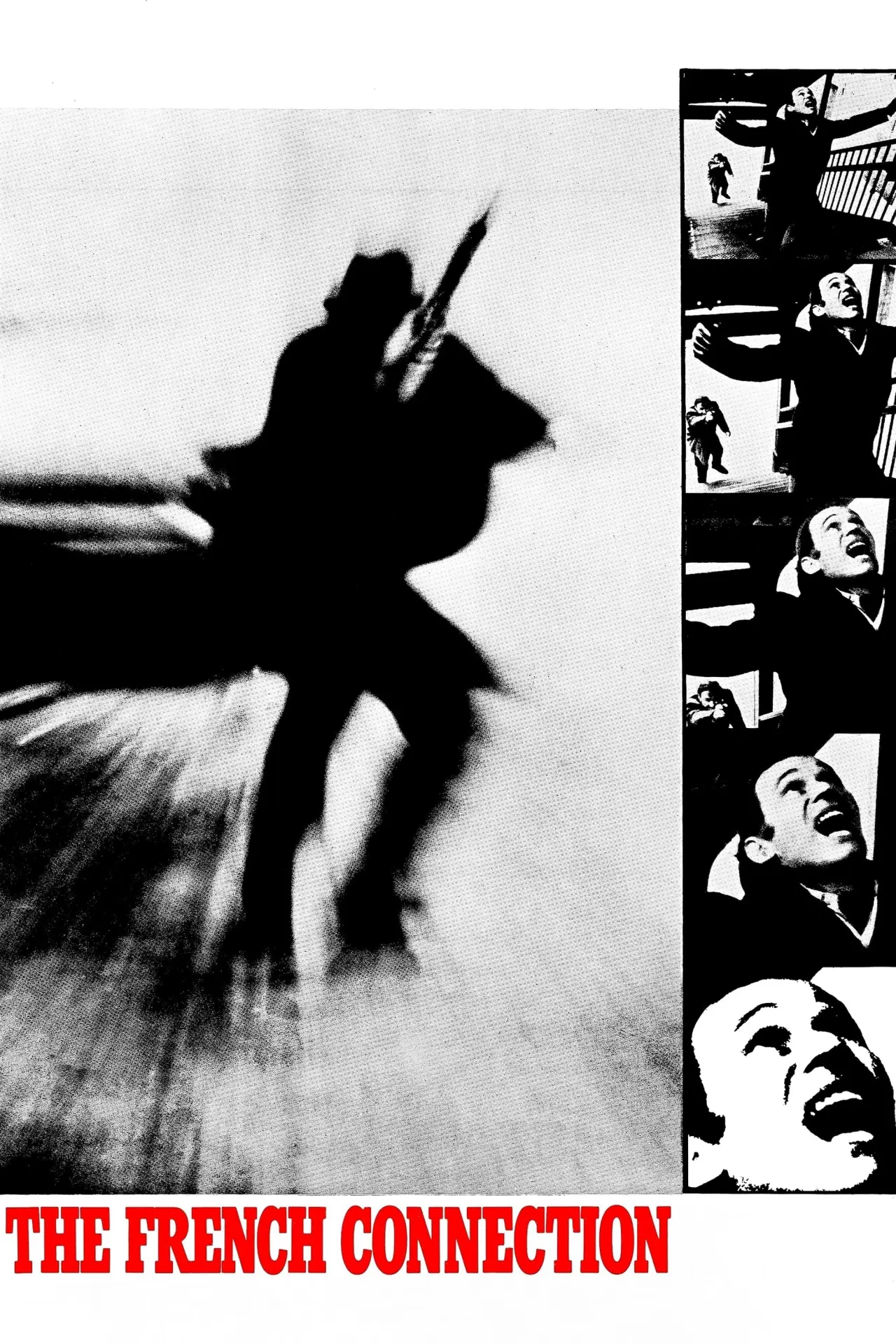
The French Connection




All actors and roles (10)
All team (42)
Short description
A New York narcotics detective, Jimmy "Popeye" Doyle, becomes convinced that a heroin shipment is being funneled into the city from France. Working with his partner Buddy Russo, he pursues the men behind the operation, including Alain Charnier, a Frenchman who has recently arrived in the United States. Their investigation moves from surveillance and phone taps to a determined manhunt as Doyle, acting largely on instinct, pushes against the limits of proper police procedure in order to break up the network.
William Friedkin directed the film, his second feature in a career that would eventually number sixteen; it followed The Boys in the Band and preceded The Exorcist. The screenplay was written by Ernest Tidyman and Friedkin, and Philip D'Antoni produced. Gene Hackman plays Doyle, with Roy Scheider as Russo, Fernando Rey as Charnier, and supporting turns from Tony Lo Bianco, Marcel Bozzuffi and Frédéric de Pasquale. It is an American production running 104 minutes.
Made for about two million dollars, the film took roughly fifty-two million worldwide, a strong return on its budget. On IMDb it holds a 7.7 rating from around 150,000 votes, and on TMDB a 7.5 from a much smaller base of voters. A critics' rating of 9 out of 10 from 93 reviews places it above both audience scores.
What's left behind the scenes
- Filming began in November 1970 and was completed in March 1971.
- Initially, Peter Boyle was chosen for the role of “Popeye” Doyle, but he turned it down because his agent believed the film would be a failure.
- The car chase scene with Popeye pursuing the hitman Nicolai has been included in film schools worldwide and is considered iconic for the further development of the “thriller” genre.
- It was the first film with an “R” rating to win an Academy Award for Best Picture since the introduction of the film association’s rating system.
- Friedkin was against casting Hackman in the lead role and envisioned Paul Newman for it, but his candidacy was rejected due to budget limitations. Jackie Gleason and New York columnist Jimmy Breslin, who had never acted before, were then considered for the role. However, by that time, Gleason had become “poison” for box office receipts after the failure of the film “Gigot” with his participation, and Breslin refused to get behind the wheel of a car in the chase scene. Steve McQueen was also considered for the lead role, but he didn’t want to star in another police film after “Bullitt.” Furthermore, his fee, like Newman’s, exceeded the film’s budget. Charles Bronson also auditioned for the role. Friedkin almost agreed to give the role to Rod Taylor (who, according to Hackman, actively sought it), also approved by the studio, before finally settling on Hackman.
- The American Film Institute has recognized Friedkin's film as one of the greatest films in history.
- The film's plot is based on real events, as well as their fictionalization by Robin Moore.
- According to William Friedkin, his decision to make the film arose during a conversation with Howard Hawks, whose daughter was living with Friedkin at the time. Friedkin asked Hawks what he thought of his films, to which Hawks bluntly replied that they were all “terrible.” In his opinion, people didn’t need stories about other people’s problems or psychological pretension: “All they need is action,” he said, and advised Friedkin to “make a good chase. Make it better than anyone else has.”
- In 2005, the film was selected for preservation in the National Film Registry of the United States as being “culturally, historically, or aesthetically significant”.
- The casting of Fernando Rey, who played the smuggler Alain Charnier, turned out to be a successful mistake. Friedkin asked his assistant to find a Spanish actor he had seen in Luis Buñuel’s French film “Belle de Jour.” Francisco Rabal played the role, but Friedkin didn’t know his name, and instead contacted Rey, who had appeared in several other Buñuel films. After Rabal was finally found, it turned out that he didn’t speak either French or English, and Rey was cast in the film. However, in an even greater irony, after the film was edited, the crew found Rey’s French unacceptable for the film. The sound engineers decided to dub his French, but retain the lines in English.
Similar movies



 Auditions in India
 Casting calls in USA
 Castingi w Polsce
 Кастинги в Україні
