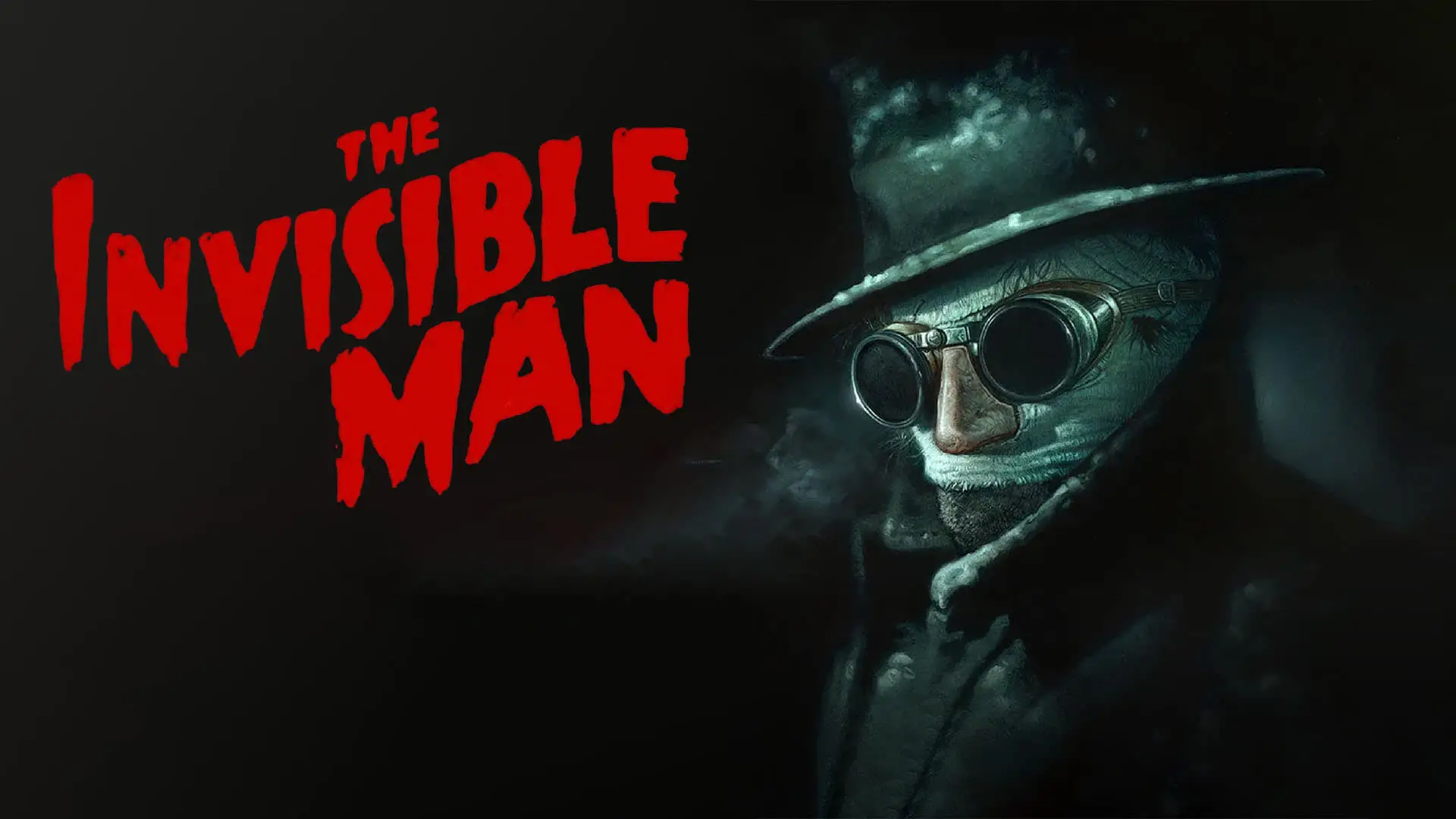
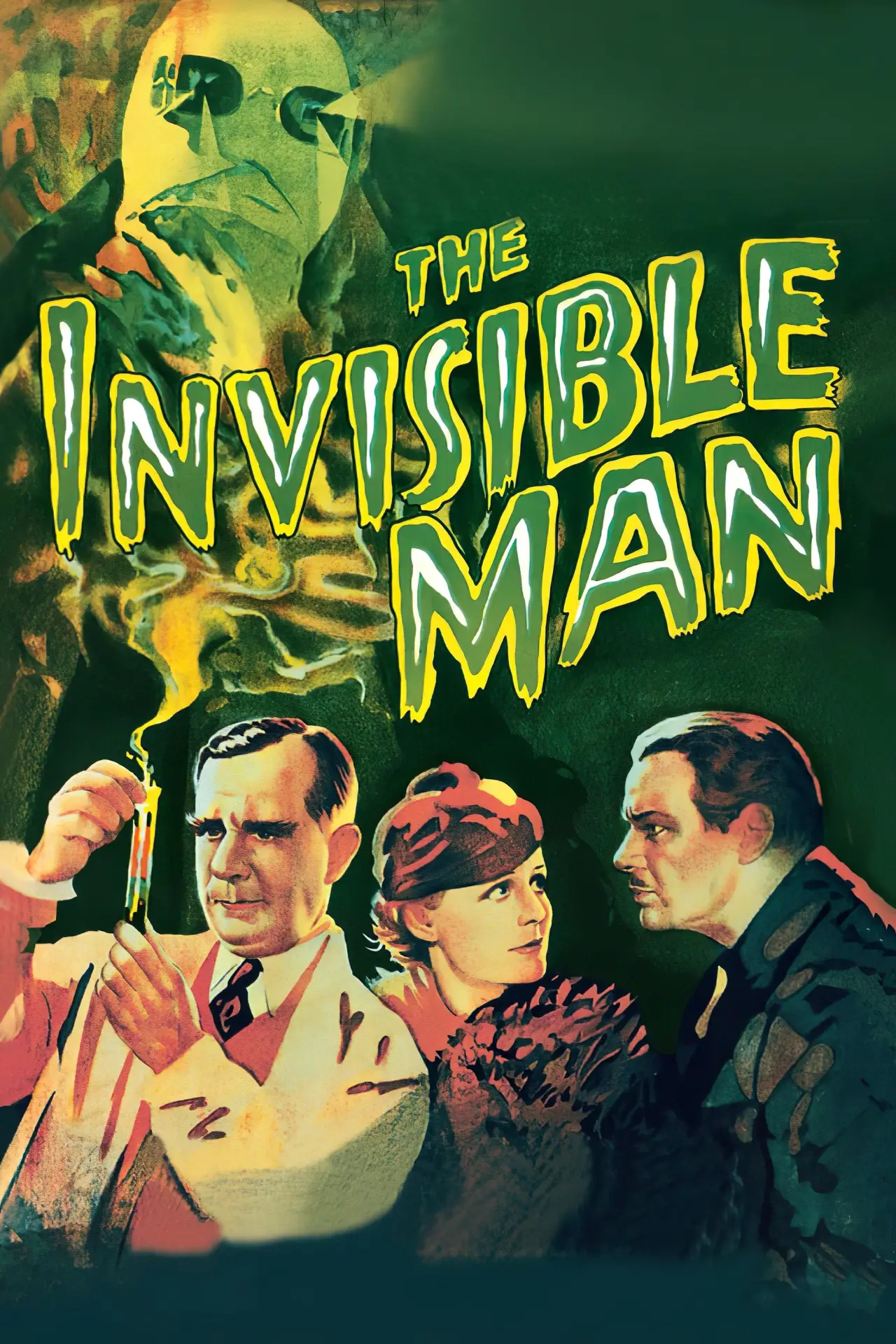
The Invisible Man



All team (31)
Short description
A scientist named Jack Griffin discovers a serum that renders human flesh invisible. He tests it on himself, but the drug also affects his mind, leaving him unable to reverse the change and increasingly violent as he searches for a way back to normal. Wrapped in bandages to conceal his condition, he takes refuge in a country inn, where his strange appearance and behavior draw unwanted attention. James Whale directed the film, which Universal Pictures released in late 1933, and it sits between Frankenstein and Bride of Frankenstein in his filmography. The screenplay was written by R.C. Sherriff, Philip Wylie and Preston Sturges, with Carl Laemmle Jr. producing. Claude Rains plays Griffin, his first major screen role, appearing largely through voice and bandaged silhouette. Gloria Stuart, William Harrigan, Henry Travers, Una O'Connor and Forrester Harvey round out the credited cast of 42.
The film runs 71 minutes and was adapted from H. G. Wells's 1897 novel, the story of a researcher whose experiment costs him his stability and eventually his life. Its ratings are consistent across audiences and critics: 7.6 out of 10 on IMDb from about 44,000 votes, 7.5 out of 10 on TMDB from roughly 1,000 votes, and 8.5 out of 10 from 59 critics' reviews, so professional reviewers rate it somewhat higher than general viewers do. Together with Whale's other horror work of the period, it belongs to Universal's classic horror cycle, and its sustained approval decades after release reflects its standing among early sound-era genre films.
What's left behind the scenes
- The film is based on the eponymous novella by H.G. Wells.
- Boris Karloff could have gotten the role of the Invisible Man.
- In 2008, the film was added to the U.S. National Film Registry.
- To achieve the effect of Claude Rains' invisibility, when his character removes the bandages, director James Whale instructed him to dress in a black velvet suit, and he was filmed against a similar background.
- Initially, “Universal Pictures” intended to cast Boris Karloff in the role of the Invisible Man. Rumor has it that the actor himself refused the role because he wouldn't be visible in it. In reality, however, it was due to his quarrel with director James Whale, who decided he needed someone else for the role. In the next room, Claude Rains was auditioning; Whale listened to him and decided he was suitable for the part. Producer Carl Laemmle Jr. doubted this, as Rains was practically unknown to audiences and had never acted in a sound film. In fact, his filmography at that time consisted of only one silent film (“Build Your Own House” from 1920 by Fred Goodwin). Laemmle Jr. suggested Whale take Colin Clive for the role. He approached Clive, but pleaded with him to refuse. The actor obliged, and during the filming of “The Invisible Man” went on vacation.
- Gloria Stuart disliked working with Claude Rains. She stated that he took up all the space in front of the camera during joint scenes, forcing her to step aside. Wayle even had to have a conversation with Rains about this.
- When R.S. Sherriff arrived in Hollywood to work on the screenplay, he asked staff at "Universal Pictures" for a copy of the Wells novel, but they didn’t have one. They only had 14 different script versions, including one set in Tsarist Russia and another taking place on Mars. Sherriff found the novel in a second-hand bookstore, read it, and decided it could be filmed as is, without further adaptation. As a result, he wrote a screenplay that – unlike the films "Dracula" (Tod Browning and Karl Freund, 1931) and "Frankenstein" (James Whale, 1931) – was quite close to the literary source, which was good because Wells had specifically stipulated his right to review and approve the plot of any future adaptation when selling the film rights.
Similar movies


 Auditions in India
 Casting calls in USA
 Castingi w Polsce
 Кастинги в Україні
