Porco Rosso


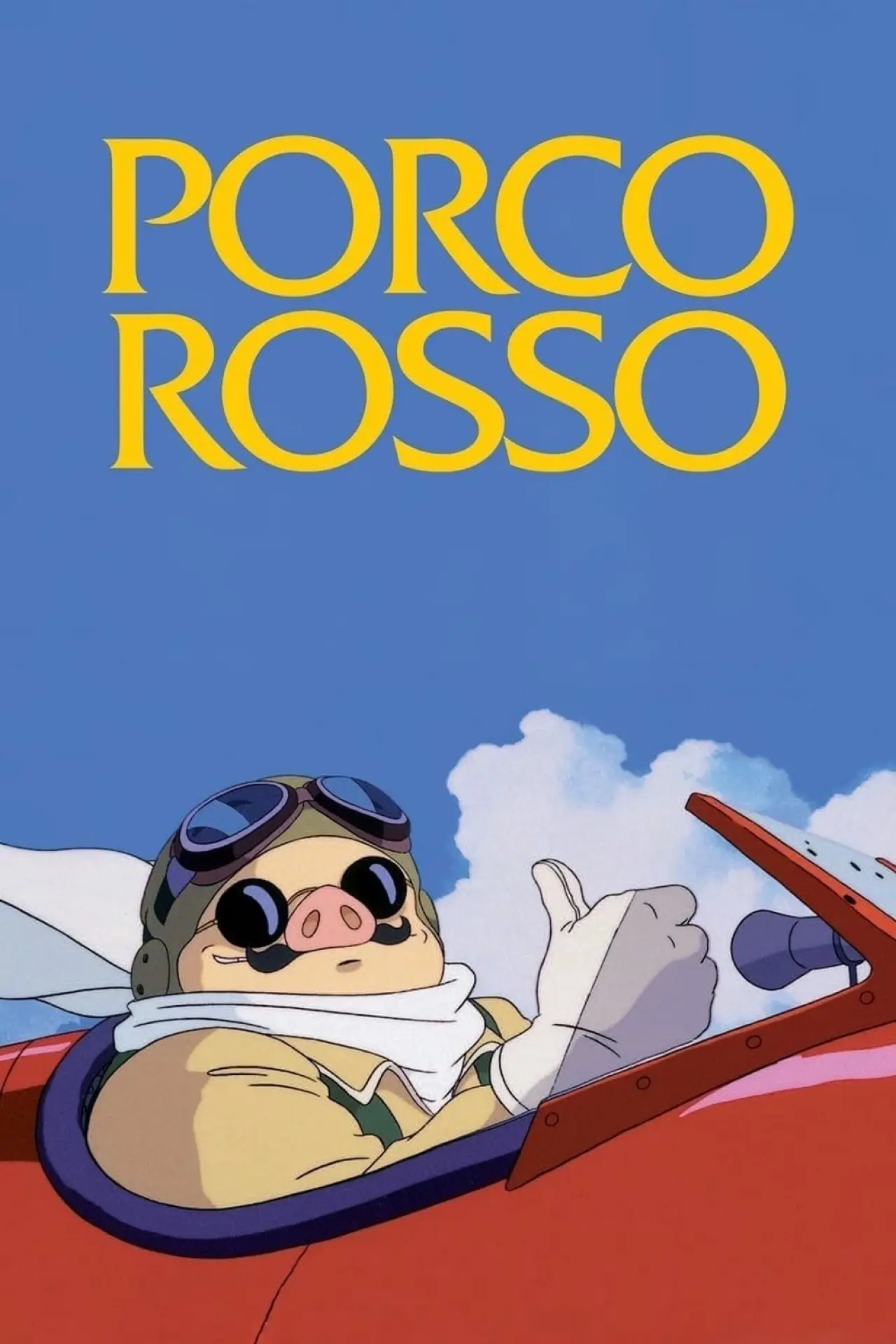











Short description
Set in interwar Italy, Porco Rosso follows a veteran pilot of the First World War who now flies a red seaplane over the Adriatic. He has been left with the face of a pig, and he earns a living as a bounty hunter, clearing the skies of the air pirates who raid ships and yachts. When the pirates bring in an American ace to settle the score, the pilot must repair and refit his aircraft for a duel, a job that falls to a young mechanic who insists on coming along. His old friend Gina, a hotel singer, remains a constant presence on the shore.
Hayao Miyazaki wrote the screenplay and directed the film, the sixth of the sixteen features he has directed in chronological order, following Kiki's Delivery Service. Shūichirō Moriyama voices the title pilot, with Tokiko Kato as Gina, Akemi Okamura as the mechanic Fio, and Akio Otsuka as the American flyer. Studio Ghibli produced it with Toho and other partners.
Made on a budget of nine million dollars, the film was released in Japan in the summer of 1992 and runs 93 minutes. Audiences rate it highly: 7.7 out of ten on IMDb from a large body of votes, and 7.8 out of ten on TMDB, while a smaller set of critics' reviews gives it 8.3 out of ten.
What's left behind the scenes
- Much of the events in "Porco Rosso" are based on real events and real people. The exception, of course, is the "pigheadedness" of Marco Pagot.
- The pirate gang "Mamma Aiuto" translates from Italian as "Mommy, help!".
- At the beginning of the film, titles are shown in the following languages: Japanese, Italian, Korean, English, Chinese, Spanish, Arabic, Russian, French, and German.
- Marco Pagott is a real person, an Italian animator and a good friend of Miyazaki. Marco’s main rival, Donald Curtis, is named after Glenn Curtiss, one of the pioneers of American and world aviation.
- Initially, the film was to be set in one of the most beautiful cities on the Adriatic coast – Dubrovnik, Croatia, founded by the Romans. However, the Croatian and Yugoslav Wars began in 1991, and Serbian artillery practically wiped Dubrovnik off the face of the earth. Therefore, the film's action was moved to an unnamed island in the Adriatic. Specifically, the destruction of Dubrovnik prompted Miyazaki to make the film more serious.
- Tokiko Kato, who voiced Gina, Porco's former lover, in the film, is a famous Japanese singer.
- The film was based on Miyazaki's manga 'Hikoutei Jidai' (The Age of Hydroplanes) [1990]. However, the manga contained almost no mention of fascists or the love story between Porco and Gina.
- ‘Porco Rosso’ was originally planned as a 30-45 minute film for screening on board aircraft of ‘Japan Airlines’.
- In the film, Marco Pagot travels to Milan to assemble an airplane and discovers that only women are working at the factory. When he asks why, he is told that all the men have gone to work due to the ‘Great Depression’. In reality, preparations for military and colonial expansion allowed Italy to exit the ‘Great Depression’ of the 1930s with minimal losses.
- The Japanese title of the film translates as ‘Crimson Pig’. However, Miyazaki recommended that foreign translators use the Italian version of the title. Crimson is the color of Porco’s seaplane.
- Porco transforms into a pig specifically because Miyazaki himself adores pigs. He likes to depict himself as a pig and believes that “every man, upon reaching middle age, turns into a pig.”
- The seaplanes featured in the film actually existed, although Miyazaki slightly modified the design of most of them. Schneider Trophy seaplane races also existed. What didn’t exist was an “industry” of air piracy (although individual instances of such things are known in the history of aeronautics).
- In the French dub of the film, the role of Porco was voiced by the French actor Jean Reno. In the film that made him famous, “Léon” (1994), Reno’s character says, “Pigs are better than people.”
- The scene with the deceased pilots is borrowed from Roald Dahl’s story “They Never Grow Old.”
- The original mentions an engine from a “Folgore,” but at the time of the film’s events, neither that aircraft nor the engine could have existed.











 Auditions in India
 Casting calls in USA
 Castingi w Polsce
 Кастинги в Україні

