Ivanhoe



![Watch film Ivanhoe — Ivanhoe (1952) Original Trailer [FHD]](https://www.acmodasi.in/amdb/images/movie/w1920/2/61/ivanhoe-1952-358039.webp)
All actors and roles (10)
All team (17)
Short description
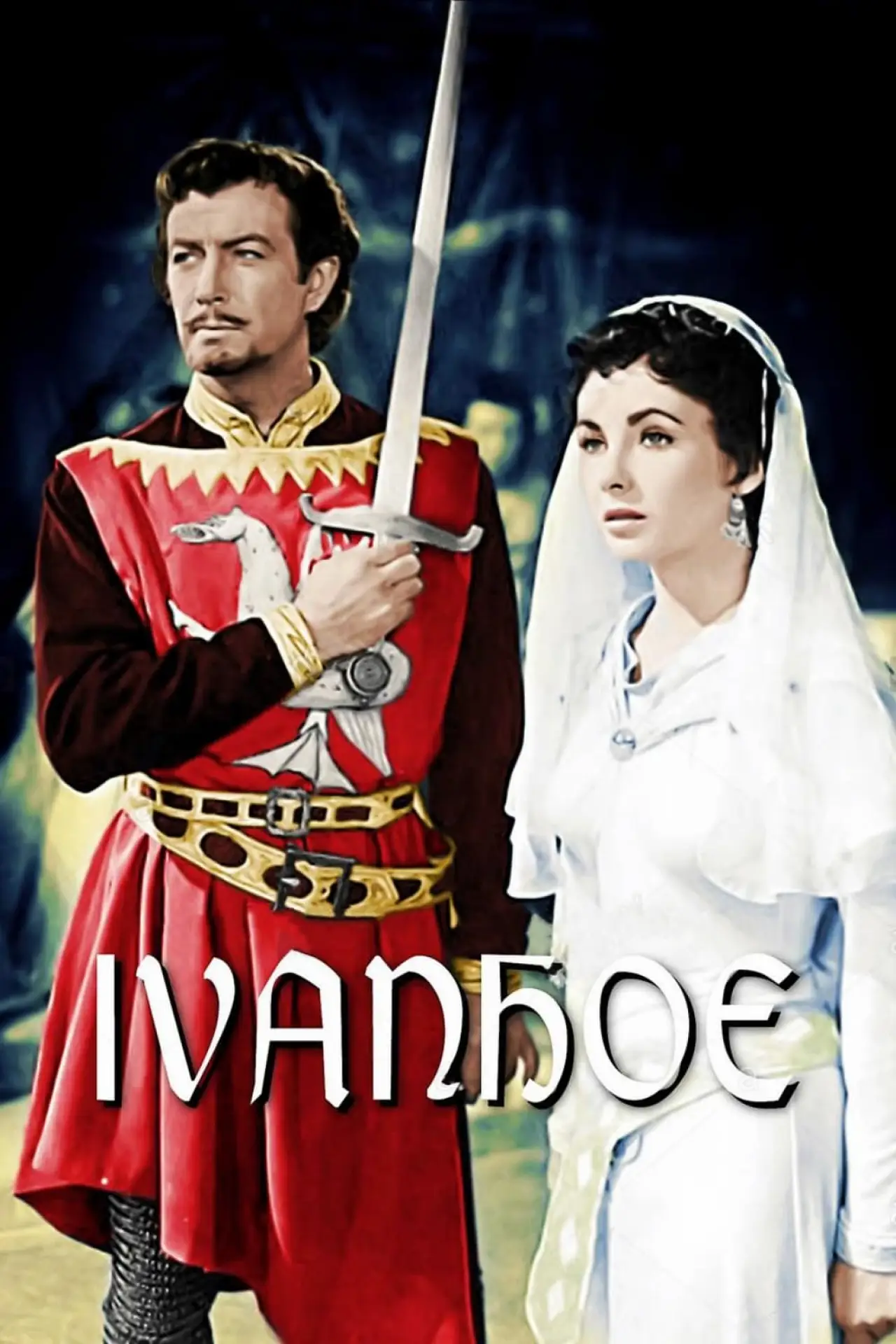
Set in twelfth-century England, this adventure follows the Saxon knight Wilfred of Ivanhoe as he returns from the Third Crusade. King Richard the Lionheart has been taken prisoner in Austria, and the ransom demanded is beyond reach. Richard's brother, Prince John, who rules in his absence, shows little interest in paying it, since the king's continued captivity serves his own ambition. Ivanhoe sets out to raise the money himself, aided by Robin of Locksley and his men, while contending with Norman barons loyal to John, notably Sir Brian de Bois-Guilbert. The story, drawn from Walter Scott's novel, also involves Ivanhoe's attachment to Lady Rowena and the devotion of Rebecca, daughter of the wealthy Jew Isaac. A tournament at Ashby provides the setting for a decisive contest.
Richard Thorpe directed, working from a screenplay by Noel Langley and Marguerite Roberts, with Pandro S. Berman producing. Robert Taylor plays Ivanhoe, Elizabeth Taylor plays Rebecca, Joan Fontaine plays Rowena, George Sanders plays Bois-Guilbert, and Emlyn Williams plays the jester Wamba. It followed Thorpe's Vengeance Valley and preceded Knights of the Round Table, another medieval subject, in a run of films that later included Jailhouse Rock.
Made for about four million dollars, the film returned roughly eleven million worldwide, a strong result for its time. Audience scores are moderate: on IMDb it holds 6.7 from about ten thousand votes, and on TMDB 6.8 from a much smaller sample. A critics' rating of 6.1 from nineteen reviews sits close to those audience figures.
What's left behind the scenes
- Elizabeth Taylor (1932-2011) believed there had been some mistake in her casting as Rebecca. During filming, there were rumors that she might be replaced by Deborah Kerr (1921-2007), who, along with Robert Taylor (1911-1969), starred in the dramas of Merwyn LeRoy (1900-1987) and Anthony Mann (1906-1967) 'Quo Vadis?' (1951).
- At the beginning of the film, there is a scene in which Robert Taylor’s character, Sir Wilfred, searches for King Richard I the Lionheart (1157-1199), having vowed not to stop singing until he finds him. Historically, this is accurate, except it wasn't him singing, but a minstrel named Blondel. When Richard I the Lionheart was captured by Leopold V (1157-1194), Blondel began to visit all the castles, singing Richard's favorite song. (According to some sources, Richard co-wrote it.) Hearing from one castle Richard singing along, he returned to the Normans and told them where to find Richard.
- King Richard I the Lionheart was loved and revered in England, but in reality, he was French and barely spoke English. Out of ten years of ruling England, he spent no more than six months in England itself. All the rest of the time, Richard I the Lionheart spent at war, notably during the Third Crusade (1189-1192).
- Screenwriter Marguerite Roberts (1905-1989) was a member of the American Communist Party. In 1951, she was summoned to testify before the (US House of Representatives) Committee to Investigate Un-American Activities. She and her husband, John Sanford (1904-2003), refused to name other members of the party and were blacklisted. After this, MGM received special permission from the Writers Guild to remove Roberts' name from the credits.
- The film was initially conceived as an MGM project with Fredric March (1897-1957) as Sir Wilfred, Loretta Young (1913-2000) as Lady Rowena, and Gary Cooper (1901-1961) as King Richard I the Lionheart. After some changes of plans, it was decided to release the film in 1938 with Robert Taylor as Sir Wilfred, Myrna Loy (1905-1993) as Lady Rowena, and Clark Gable (1901-1960) as Richard I the Lionheart. Filming was planned in Britain, but the political situation in Europe, which ultimately escalated into World War II, led to the film being postponed. In 1946, Anniees McKenzie (1889-1962), the author of the final screenplay version, wrote a series of screenplays for Paramount Pictures recounting how Sir Wilfred returns from the crusade and collects a ransom to pay for the kidnapped Richard, but learns that Prince John (1166-1216) has usurped the throne in his absence.
Similar movies



 Auditions in India
 Casting calls in USA
 Castingi w Polsce
 Кастинги в Україні
