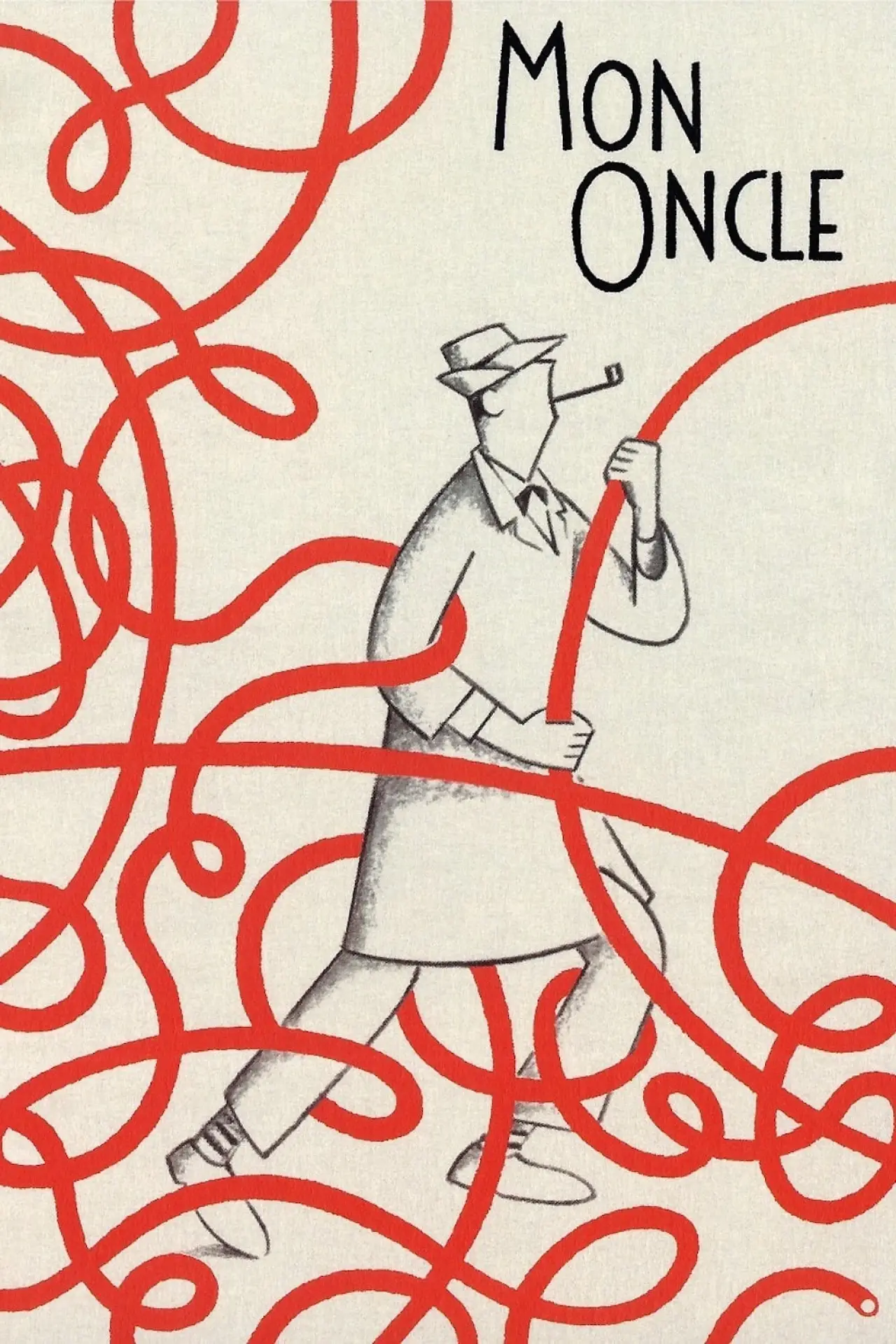
Mon Oncle




All actors and roles (10)
All team (26)
Short description
Monsieur Hulot lives contentedly in an old, lively quarter of the city, in a modest top-floor flat he has no wish to leave. His sister, married to Charles Arpel, has settled into a sleek new house in the suburbs, where everything runs by machine and nothing is left untidy. Arpel manages a plastics factory, and he and his wife view Hulot's disorderly habits as a poor influence on their young son Gérard. Their efforts to draw Hulot into their world take two forms: they try to interest him in a job at the factory, and they scheme to match him with a neighbour. Hulot visits mainly for the boy's sake, and the two escape together into the streets and playgrounds, where Gérard finds the freedom his own home denies him. The more the family pushes, the more firmly Hulot resists.
Jacques Tati directed and stars as Hulot, the character he had introduced in Monsieur Hulot's Holiday five years earlier; this is the third of the six features he directed, arriving between that film and PlayTime. He wrote the screenplay with Jacques Lagrange and Jean L'Hôte and produced with Fred Orain. Jean-Pierre Zola and Adrienne Servantie play the Arpels, with Jean-François Martial as Walter among a credited cast of twenty-one.
The film drew strong notices from critics, whose rating of 8.6/10 from thirty-three reviews sits well above its audience scores: on IMDb it holds 7.6/10 from around 26,000 votes, and on TMDB 7.4/10 from roughly 633.
What's left behind the scenes
- Having received an Oscar for "My Uncle" in the Best Foreign Film category, Jacques Tati was invited to an official reception where he was presented to the President of France, Charles de Gaulle (1890-1970). The Minister of Culture, André Malraux (1901-1976), jokingly introduced Tati as his uncle. De Gaulle, who had no idea who Tati was or what film he had made, congratulated him on his "very talented nephew," referring to Malraux – a writer, cultural theorist, hero of the French Resistance, and ideologue of the Fifth Republic.
- Once during filming, Jacques Tati (born Yakov Tatishev, 1907-1982) and some of the film crew accidentally came across a friendly and playful pack of stray dogs. Tati ordered the dogs to be filmed and then edited the footage into the plot as a transition. When filming was completed, Tati personally placed an ad in the newspaper, offering readers to take the dogs (he called them "movie stars") home. And indeed, soon all the animals found new homes.
Similar movies


 Auditions in India
 Casting calls in USA
 Castingi w Polsce
 Кастинги в Україні
