La Dolce Vita




All actors and roles (10)
All team (40)
Short description
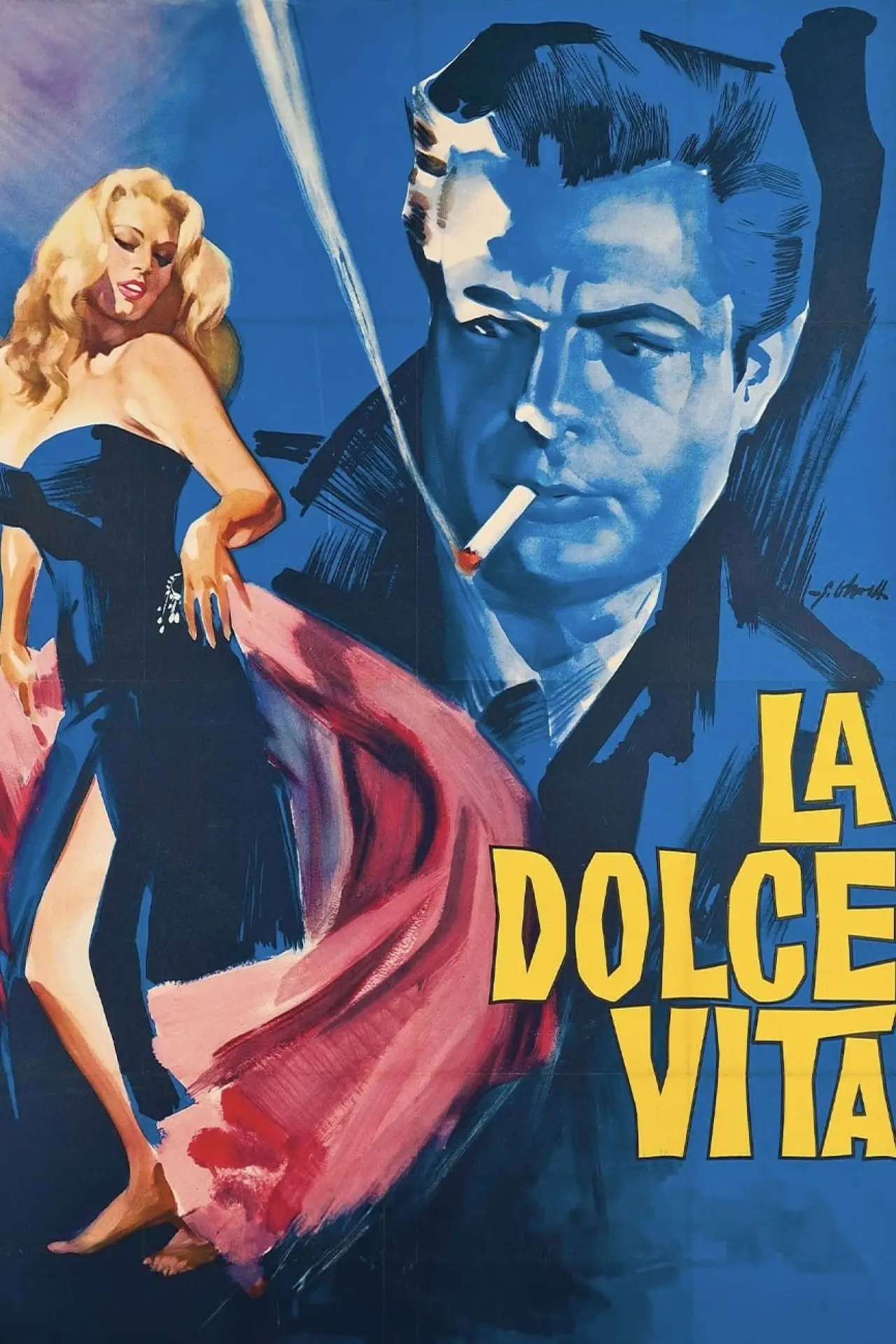
La Dolce Vita follows Marcello Rubini, a journalist in Rome who moves through the city's nightlife and high society in search of stories. He is torn between the glamour and excess of the social circles he covers and the more settled life his girlfriend wants with him, and he nurses an ambition to be taken seriously as a writer. His wanderings bring him into contact with a succession of women and with a well-known film star whose arrival in Rome becomes one of his pursuits, while the suicide of a close friend forces him to confront the emptiness he sees around him.
Federico Fellini directed and co-wrote the film with Tullio Pinelli and Ennio Flaiano, and it was produced by Giuseppe Amato and Angelo Rizzoli. It is the seventh of the twenty features Fellini directed, following Nights of Cabiria and preceding Boccaccio '70. Marcello Mastroianni plays Marcello, with Anita Ekberg as Sylvia, Anouk Aimée as Maddalena, Yvonne Furneaux as Emma, Magali Noël as Fanny and Alain Cuny as Steiner. The large production credits 173 cast members and 40 crew.
Released in 1960, the film runs 174 minutes and took about 20 million dollars worldwide. Audiences rate it 8 out of 10 on both IMDb, from some 86,000 votes, and TMDB, from around 2,080 votes, while a critics' score of 9.6 out of 10 from 77 reviews places it higher still.
What's left behind the scenes
- Producers actively pushed Paul Newman for the lead male role, but Fellini didn't want to cast an internationally famous actor. That's why he told Marcello Mastroianni: "I need you because you have an ordinary, unremarkable face."
- The final scene on the beach was inspired by the murder of model Wilma Montesi in 1953. Her body was found on a beach near Rome. The investigation revealed orgies with drugs involving members of Rome's high society. Montesi's murder remains unsolved.
- Producers actively pushed the well-known American actor Paul Newman for the lead male role, but Fellini could not cast an internationally famous actor in the part. Therefore, he told Marcello Mastroianni, "I need you because you have an ordinary, unremarkable face." This explanation shocked Marcello, but nevertheless, impressed by the rejection of Newman and the sketch the director had made of Marcello's character in the script, he agreed.
- When Federico Fellini was asked what inspired him to make this film, he replied that at the time, fashions in Rome included outfits that made women look like huge flowers. The film features similar outfits (for example, two guests at the party in the castle are dressed like this).
- During the filming of the Trevi Fountain scene, director Federico Fellini felt that the water in the fountain looked dirty. A representative from SAS (a multinational airline from Denmark, Norway and Sweden) was present on set and provided filmmakers with a fluorescent green dye (for use in the event of a plane crash into the sea – to mark the crash site so rescuers could find it). This dye was then used in the fountain.
- The artist Piero Gerardi designed sets for over 80 locations (including Via Veneto street, the dome of St. Peter's Basilica with the staircase leading up to it, and various nightclubs). In some cases, however, the film was shot on location – for example, the party in the castle was filmed in a real castle in northern Italy (servants, waiters, and guests were played by actual aristocrats). Federico Fellini combined set and location shooting depending on the script's requirements.
- The famous scene in the Trevi Fountain (Rome's largest fountain and one of its landmarks) was filmed in March, when it was still cold at night. According to director and screenwriter Federico Fellini, Anita Ekberg, who played the American film diva Sylvia, stood in the water in her dress for hours – without any problems. Marcello Mastroianni, who played the journalist Marcello, wore a wetsuit under his outerwear, but still chattered his teeth. Due to the intense cold, he drank an entire bottle of vodka and was completely drunk by the end of the shoot.
- This film is where the term "paparazzi" originated, taken from the name of the protagonist's photographer friend, Paparazzo. In Italian, "paparazzi" is a plural form.
- Upon the film's release, the Catholic Church perceived a particular episode as a parody of the idea of the Second Coming of Christ; this scene and the film as a whole were condemned by the Vatican's newspaper, *L'Osservatore Romano*, in 1960. In Spain, the film was completely banned from screening until 1975.
- This film is where the term "paparazzi" originated, derived from Paparazzo, a friend of the photographer Marcello. Incidentally, in Italian, "paparazzi" is a plural form.
- The Catholic Church perceived the corresponding scene as a parody of the idea of the Second Coming of Christ. The film was condemned by the Vatican newspaper “L'Osservatore Romano” in 1960. In Spain, the film was banned until 1975.
Similar movies


 Auditions in India
 Casting calls in USA
 Castingi w Polsce
 Кастинги в Україні
