The King's Man





Short description
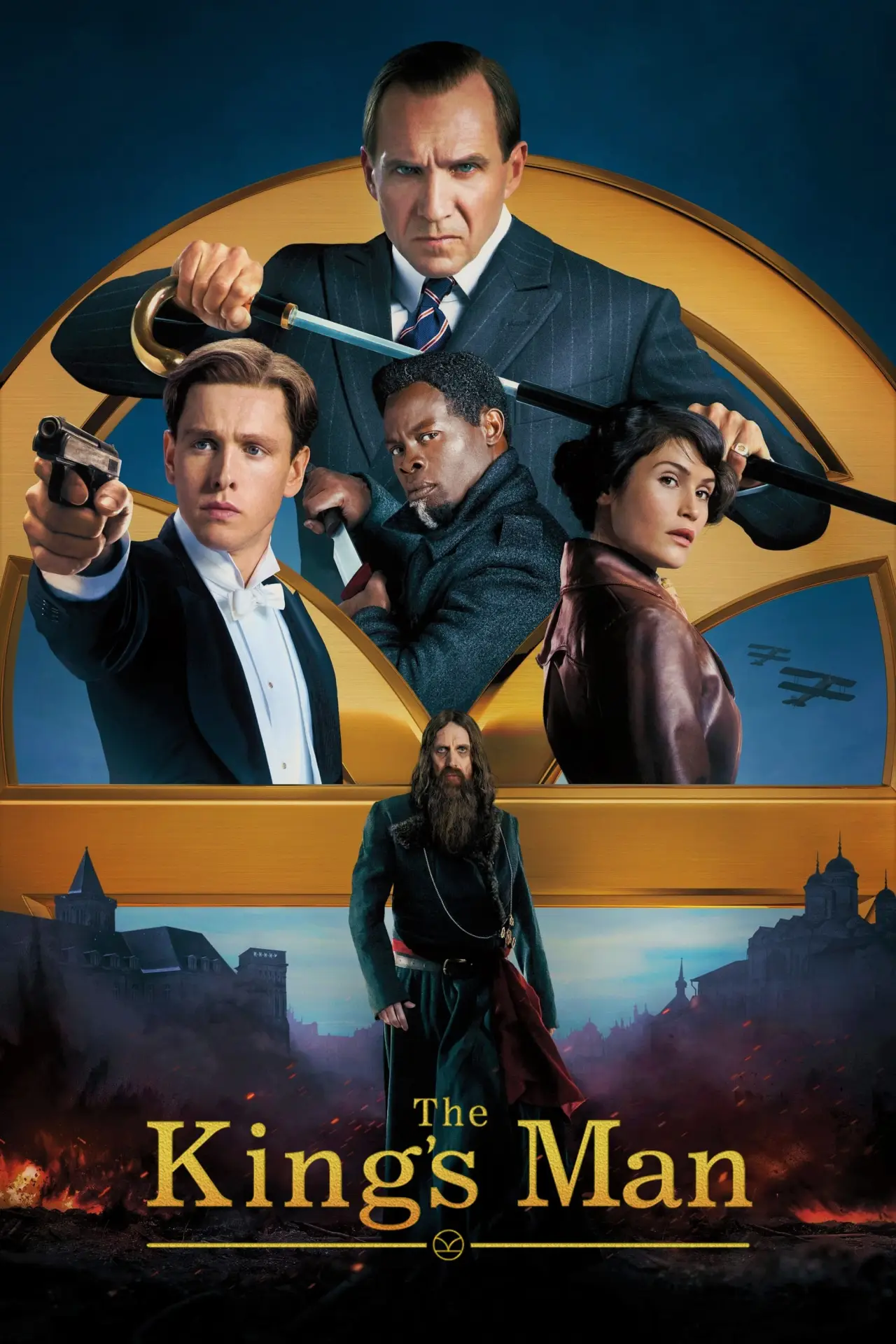
The King's Man is a period action adventure that traces the origins of a secret British spy agency. A convinced pacifist, the Duke of Oxford, loses his wife to violence during an overseas humanitarian mission and raises their son Conrad alone, determined to keep him out of harm's way. When the First World War looms, the duke draws on a private network of agents to investigate the forces pushing Europe toward conflict, while his headstrong son wants to serve his country. The two become entangled with real historical figures and a hidden conspiracy that threatens to destroy the existing world order.
Matthew Vaughn directed and co-wrote the film with Karl Gajdusek, and it is the seventh feature of his directing career, arriving after Kingsman: The Secret Service and Kingsman: The Golden Circle and before Argylle. Ralph Fiennes leads the cast as Orlando Oxford, alongside Gemma Arterton, Rhys Ifans, Matthew Goode, Tom Hollander and Harris Dickinson. Around a hundred cast members and more than a hundred crew were credited in a large-scale production.
Costing about 100 million dollars to make, the film returned roughly 126 million dollars worldwide, a modest result against its budget. On IMDb it holds a 6.7 rating from around five thousand votes, while critics were noticeably less enthusiastic, giving it 5.1 from 183 reviews, so audiences received it more warmly than reviewers did.
What's left behind the scenes
- Director and screenwriter Matthew Vaughn initially wanted to use an orchestral arrangement of the song 'Rasputin' by Boney M during the so-called Rasputin dance at the ball, but ultimately preferred Pyotr Ilyich Tchaikovsky's solemn '1812 Overture'.
- Before starting work on the trenches, the art department built a mock-up to assess all the components needed to film various scenes. The actual set was approximately 300 meters long. A team of engineers designed the German trench along the railway track to create perfect geometry and allow filming from the necessary angles.
- Rasputin's dance incorporates elements of various Georgian folk dances.
- The city of Turin plays the role of Sarajevo in the film.
- The film quite rightly states that concentration camps were a British invention, not a German one. They were first used during the Boer War of 1899–1902. The character of Emily (played by Alexandra Maria Lara), the wife of the Duke of Oxford, shares traits with Emily Hobhouse—an anti-war activist who tried to draw public attention to the horrors occurring within the barbed wire of British concentration camps.
- The working title of the film was “The Great Game.” This was the name given to the geopolitical rivalry between the British and Russian Empires for dominance in South and Central Asia in the 19th and early 20th centuries.
- The story with the telegram is historically based. Germany offered Mexico an alliance to attack the United States to prevent them from entering the war in Europe, should one break out. In return, Mexico was promised the territories of Arizona, New Mexico, and Texas, which it had lost during the Mexican-American War (1846-1848). Furthermore, as depicted in the film, the telegram was intercepted by the British, deciphered, and passed on to US President Woodrow Wilson (1856-1924). Ultimately, Mexico, which was already embroiled in a civil war, refused Germany’s offer.
- The panoramic views of the trenches accompanied by the voice-over, as well as the description of mountains of spent shell casings, were created based on actual photographs of the Battle of the Somme. In this battle—one of the largest of World War I, fought from July to November 1916—approximately 700,000 soldiers of the British and French armies and 550,000 soldiers of the German army perished. As shown in the film, entire battalions were mowed down by machine-gun fire, and over a million cartridges were fired in the first week of the battle alone.
- In one scene, Konrad tells his father that he received a white feather as a sign of cowardice, because he did not fight in the war. This was actually practiced: the “Order of the White Feather,” organized by Admiral Penrose-Fitzgerald, did indeed send white feathers to those they considered to be evading military service. This was done to help with recruitment and to promote ideas of patriotism. Sometimes, however, there were mishaps. There is a known case of a white feather being sent to a man who had already been wounded in service, and he received it on the day his bravery on the battlefield was to be celebrated with an award.









 Auditions in India
 Casting calls in USA
 Castingi w Polsce
 Кастинги в Україні

