Kon-Tiki














Short description
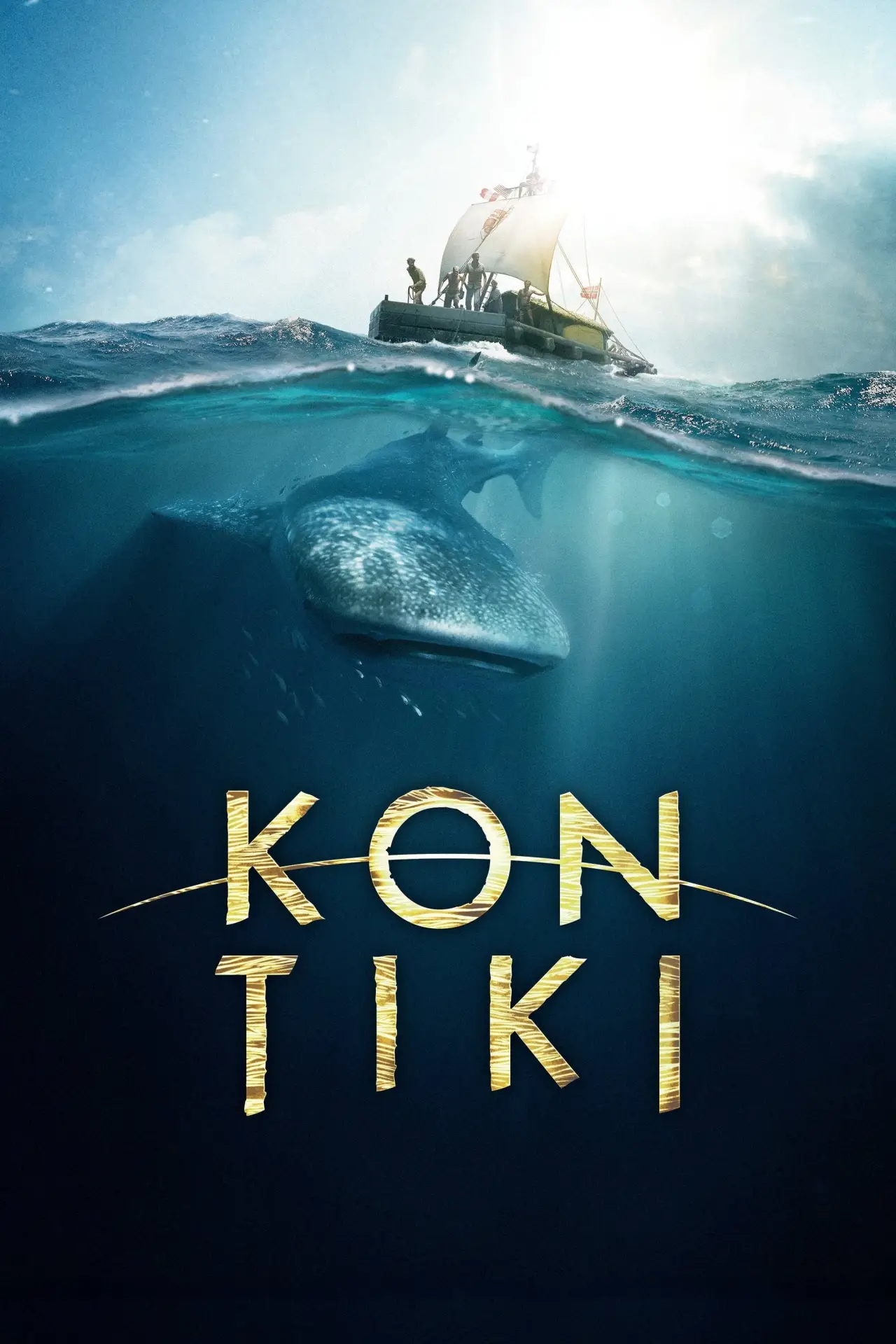
Kon-Tiki is an adventure film about the Norwegian researcher Thor Heyerdahl, who in 1947 set out to test a theory about how Polynesia was settled. He believed that people from South America could have reached the Pacific islands long before Columbus, and the only way to make his case was to attempt the journey himself. Together with a small crew, he sailed from Peru on a raft built from balsa wood in the manner of old South American craft, heading for Polynesia across roughly 8,000 kilometres of open ocean. The voyage was intended to show that such a crossing was possible, and the six men faced the dangers of the sea along the way.
Directed by Joachim Rønning and Espen Sandberg, the film was written by Petter Skavlan and produced by Jeremy Thomas and Aage Aaberge. Pål Sverre Hagen plays Heyerdahl, supported by Anders Baasmo Christiansen, Tobias Santelmann, Gustaf Skarsgård, Odd-Magnus Williamson and Jakob Oftebro. It came after the directing pair's Bandidas and Max Manus: Man of War, and preceded their later work on Pirates of the Caribbean and other large productions.
Released in 2012, the film had a budget of 17 million USD, a substantial figure for a Scandinavian production. On IMDb it holds a rating of 7.1 from around 54,000 votes, while on TMDB it stands at 6.9 from 861 votes, indicating broad approval from viewers. A critics' rating of 7 out of 10 from 81 reviews places it close to the audience scores.
What's left behind the scenes
- After the film's release, the daughter of Hermann Watzinger (1916-1986) stated in the press that her father was portrayed incorrectly in the film, and that in reality he was Thor Heyerdahl’s (1914-2002) closest partner, whom he fully trusted. In the film, however, he is depicted as a neurasthenic who is constantly afraid of everything. According to screenwriter Petter Skavlan, the problem was that the entire journey went too smoothly – without arguments or scandals aboard the 'Kon-Tiki'. The film's directors, Joachim Rønning and Espen Sandberg, apologized to Watzinger's daughter.
- During the expedition, Thor Heyerdahl and his team discovered a new species of fish.
- When the heroes encounter a whale shark, it releases air as it dives under the raft. A whale shark is a fish, and fish do not breathe like that. Only whales breathe with lungs and can release air in this manner.
- Thor Heyerdahl's grandson, Olaf, repeated his grandfather's adventure by participating in the 2006 "Tangaroa" expedition, which followed in the footsteps of Kon-Tiki on a similar raft. Another project Olaf participated in was "Plastics" – a voyage from Australia to Polynesia on a raft made of empty plastic bottles, in support of protecting the environment from plastic waste.
- It is not true that every 13th wave is larger than the others, as claimed in the film. In reality, there are no patterns regarding wave size. The original 'Kon-Tiki' documentary film (1950) states that the people on the raft simply waited for a large enough wave to carry them onto the reef.
- When the film shows the cover of a Norwegian passport, it displays the inscription 'NORGE NOREG'. This inscription only appeared in the 1970s. In 1947, only 'PASS' and 'NORGE' were present.
- Subsequently, Thor Heyerdahl provided new evidence to support his theory about the settlement of Polynesia, organizing the first full-scale archaeological excavations on Easter Island (in his book 'Aku-Aku'). He discovered that the island is still inhabited by descendants of the 'long-eared' people (who deliberately stretched their earlobes), who bear resemblance to Peruvian and island monuments. Their distinguishing feature is pale skin and red hair, atypical for the inhabitants of those regions. The 'long-eared' people inhabited Peru hundreds of years ago, but were forced to leave the continent due to aggressive neighbors. According to Heyerdahl's theory, they were the first to reach Easter Island and Polynesia, leaving their mark in the form of stone statues and fair-skinned descendants. However, despite the evidence he presented, several scientists still question his theory.
- Much of the film was shot simultaneously in two versions – in Norwegian and English – to secure international funding.
- The people on the raft did not worry about whether the ropes securing the raft would hold, unlike what is shown in the film. As described in the 1950 documentary, the balsa wood was much softer than the rope. As a result, the ropes would embed themselves in the wood, creating a protective space around them.
- One of the characters uses a counting method introduced in 1951 when compiling reports on the location of the Kon-Tiki. He uses the word 'femtifem' (fifty-five). In 1947, when the events of the film take place, he should have used 'fem-og-femti' (five and fifty). Since this method is still used today, its new format is still being discussed in Norway, and the filmmakers should have been aware of this situation.
- Filming took place in the Maldives, Malta, Norway, the USA, Bulgaria, and Thailand.
- The film's producer, Jeremy Thomas, had wanted to make it since 1996 and obtained the rights to Thor Heyerdahl's story before his death in 2002.
- The reason why Heyerdahl was so confident in the film that the raft wouldn't sink by absorbing moisture is simple, though for some reason it isn't explained to viewers. The fact is that freshly cut balsa wood logs were used to build the 'Kon-Tiki', and they still contained resin, which prevented the wood from becoming fully saturated with water.
Similar movies











 Auditions in India
 Casting calls in USA
 Castingi w Polsce
 Кастинги в Україні
