The Physician








Short description
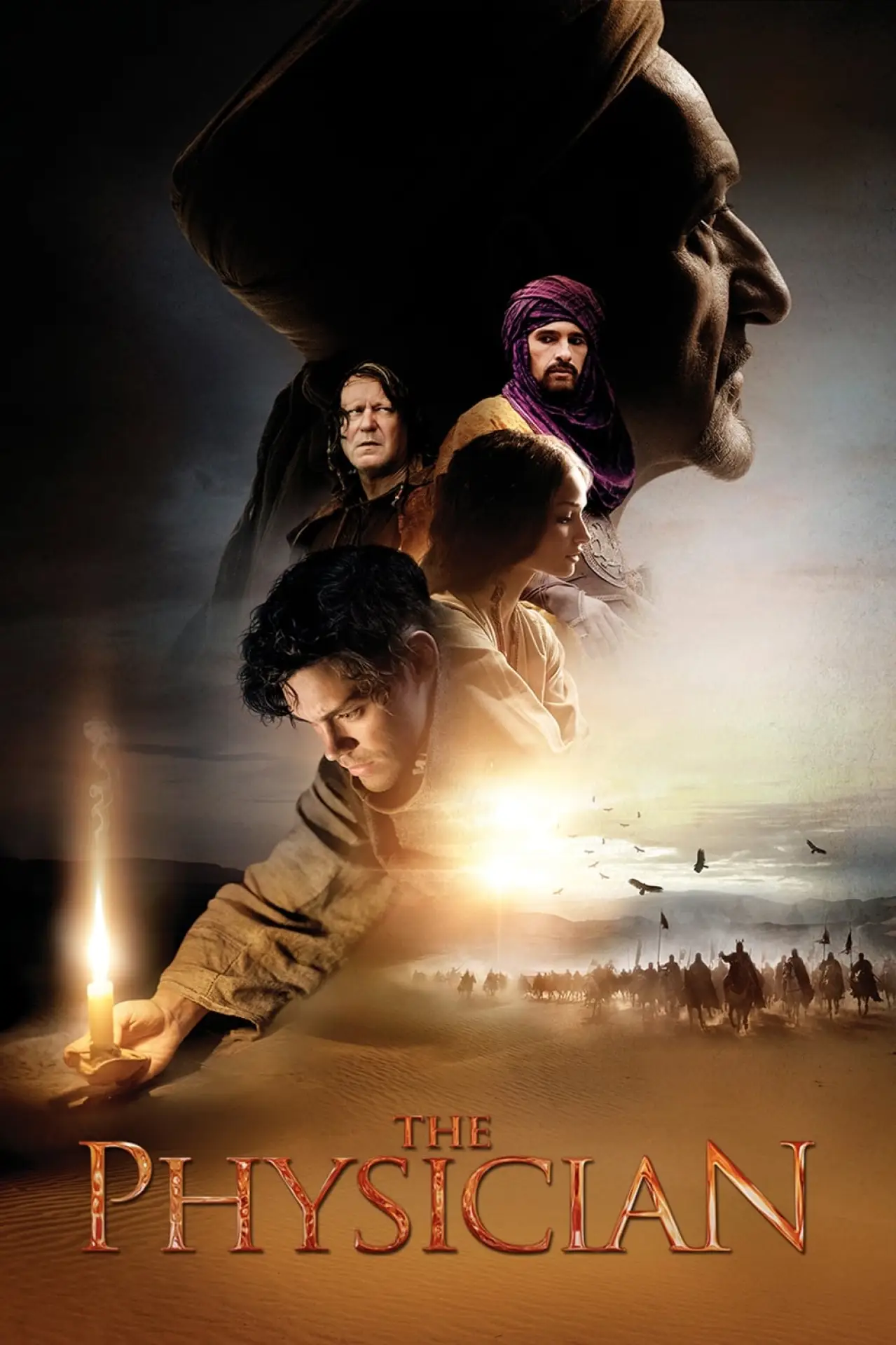
Set in eleventh-century England, The Physician follows Robert Cole, a boy whose mother dies of an illness no one can name or treat. Orphaned and determined to understand what killed her, he joins a travelling barber who practises folk healing, and later sets out for Persia to study under the celebrated physician Ibn Sina. His arrival in Isfahan places him among scholars, rulers and patients, and the knowledge he seeks carries risks in a society wary of how it is obtained.
Philipp Stölzl directed the film, his fourth feature after Baby, North Face and Erased, working from a screenplay by Jan Berger. Tom Payne plays the adult Robert, with Stellan Skarsgård as the barber, Ben Kingsley as Ibn Sina, Olivier Martinez as Shah Ala ad Daula, Emma Catherine Rigby as Rebecca and Elyas M'Barek as Karim. The production, made in Germany with UFA, ARD, ARD Degeto and Pixomondo, cost about 36 million dollars and returned roughly 54 million worldwide, a modest multiple of its budget. It has an IMDb rating of 7.2 from around 45,000 votes and a TMDB rating of 7.3 from about 1,200 votes, so viewers on both platforms rate it favourably and in close agreement. A sequel, The Physician II, followed in 2025.
What's left behind the scenes
- The film is based on the plot of the novel of the same name by American writer Noah Gordon.
- For location shooting of the film, the crew traveled to Morocco and East Germany. In the eastern part of Germany, one of the last 11th-century castles in Europe has been preserved, which was perfectly suited to depict England of that era. Morocco transforms into Persia on the cinema screens.
- The pursuit of authenticity in location shooting led to a year-long delay in production: due to unrest in Arab countries, filming scheduled for spring 2011 in Morocco had to be postponed.
- The real historical Abu Ali Ibn-Sina (Avicenna) died of a stomach ailment, which he was ultimately unable to cure.
- In the film, the barber Barber is cured of cataracts by Jewish doctors, after which he sees well again. In reality, in the Middle Ages, although cataract operations were performed, removing the clouded part of the lens with a spatula, thus opening access to light into the eyeball, it only allowed one to distinguish between light and shadow. After all, the lens itself, being destroyed, no longer performed any visual function.
- Appendectomy was first performed only in the 18th century.
- The real historical Ala al-Dawla was not a “shah,” but the emir of Isfahan, who in reality fought not the Seljuks, but the Afghans of Mahmud of Ghazni and his successor Masud I.
- In the final episodes of the film, which are set shortly after 1037 (the death of Avicenna), the walls and towers of the Tower of London are clearly visible, although they were actually built only during the reign of King Richard the Lionheart (1189–1199).
- On the streets of London, guards are visible wearing iron helmets resembling hats, which did not become widespread until much later.
- The tale of Aladdin and the magic lamp was not originally included in the collection of “One Thousand and One Nights.” It is a later Western “addition” that first appeared in a French adaptation in the early 18th century.
Similar movies









 Auditions in India
 Casting calls in USA
 Castingi w Polsce
 Кастинги в Україні
