Street Fighter






Short description
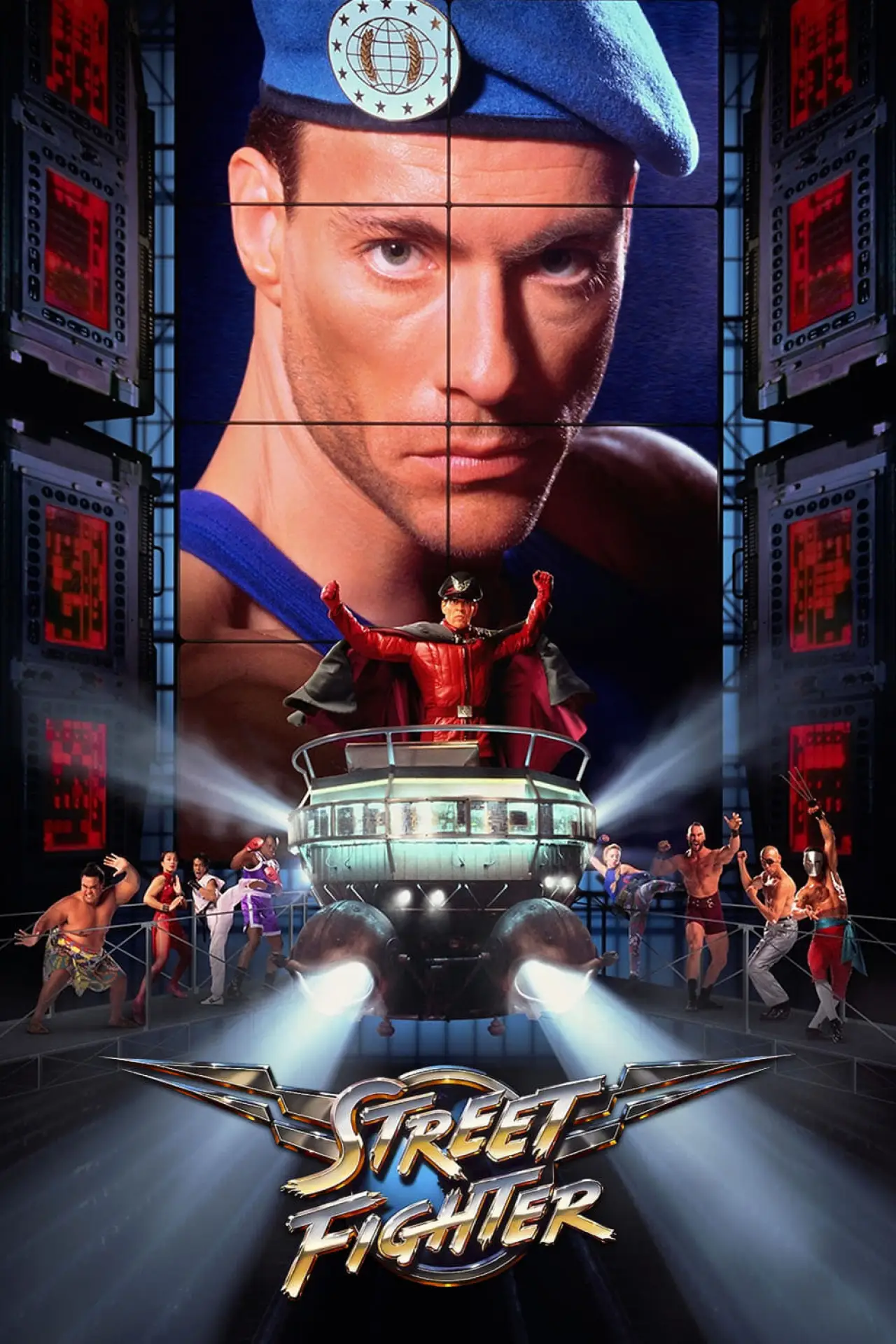
Street Fighter is an action adventure film built around a hostage crisis. A warlord named Bison holds a group of captured United Nations workers and demands a vast ransom, threatening widespread conflict if he is not paid. Colonel Guile of the allied forces leads a rescue effort, working with a small, mismatched team of martial artists and operatives to locate Bison's stronghold and free the captives. Among those drawn into the mission are Cammy, the television reporter Chun-Li Zang, and the fighters Ryu and Ken, while the arms dealer Sagat features on the opposing side. A plan to infiltrate Bison's operation takes shape, though the involvement of outsiders complicates it.
The film was directed by Steven E. de Souza, who also wrote the screenplay, with Edward R. Pressman, Kenzo Tsujimoto and Empress-Eris producing. It was made by Universal Pictures, Pressman Film, CAPCOM and Salon Films Thailand Co. Ltd., with production spanning Australia, Hong Kong, the United States, Thailand and Japan. Jean-Claude Van Damme plays Colonel Guile, Raúl Juliá plays Bison, and Kylie Minogue appears as Cammy, alongside Byron Mann, Damian Chapa and Ming-Na Wen. The cast runs to 50 credited performers and the crew to 197.
Released on 23 December 1994, the film runs 102 minutes and blends action, adventure, comedy, fantasy and thriller elements. Its budget was 35 million US dollars and it took 99 million worldwide. On IMDb it holds 4 out of 10 from 74,299 votes, and on TMDB 4.7 out of 10 from 1,694 votes, both well below the critics' rating of 3.4 out of 10 from 44 reviews.
What's left behind the scenes
- While filming in Bangkok and falling hopelessly behind schedule, Stephen E. de Souza contacted studio management to request additional time to finish the project. However, Capcom Co., Ltd. was determined to release the film for Christmas 1994 (furthermore, certain promotional and merchandise plans were tied to this date), so de Souza's request was denied. This refusal forced de Souza to make a rather controversial decision to reduce the delay. While de Souza and half of the crew worked in Australia, the other half of the creative team, led by Picerni, worked on other scenes in studio pavilions. This ended in a scandal between de Souza and Picerni when the former discovered that the latter had omitted many of Van Damme's "signature" strikes and moves from the action scenes. (Picerni believed they did not look realistic enough on screen.) Their argument nearly escalated into a fight, and Picerni seriously threatened to leave the project.
- Due to a wide variety of problems and delays, by the tenth day of filming in Thailand, the production was already six days behind the approved schedule. Every time the producers approached him with complaints about the delay, Stephen E. de Souza employed the so-called 'John Ford trick' and, to make up for lost time, simply tore a page out of the script. It was only during editing that he suddenly realized that because of this 'trick,' he had failed to film several truly important scenes, and the staging of the fight scenes was noticeably lacking; as a result, some scenes had to be shot or reshot, for which appropriate sets were constructed in Vancouver.
- Filming in Thailand was difficult at times. The days were hot with high humidity, causing many members of the crew to lose a noticeable amount of weight. This stood in sharp contrast to the filming in Australia, where the weather was pleasant and everyone regained their lost weight quite quickly. Due to the threat of a coup, military units blocked all the roads, meaning the actors and crew had to be transported to the filming location by speedboats, and upon arrival, they often found themselves soaked to the bone. The building used to represent the United Nations headquarters had a corrugated iron roof full of holes. If it rained, the sound of the drops hitting the roof was truly deafening; if it was sunny, the sunlight streamed through the holes, which also hindered filming.
- Shortly before filming began, Raúl Juliá underwent surgery (the actor had been diagnosed with stomach cancer); otherwise, he would not have lasted a year. The other project participants had no idea about this, and the filming schedule was drawn up without any consideration for the actor's physical condition. Under normal circumstances, the production would have started with Juliá's scenes and dialogue, which would have given the stunt coordinators and fight choreographers time to train the other actors before the action sequences, which were planned for the second half of the shooting period. Seeing Juliá's condition, Stephen E. de Souza realized that he should not be filmed in close-ups and that the actor needed time to recover; consequently, the schedule was changed, and all the fight scenes—or at least those in which Juliá's character was not involved—were moved to the first half of the filming period.
- In Bison's apartment, there is a painting of a frowning clown holding a bunch of balloons, wearing Bison's cap on his head. This is a reference to the famous oil painting titled 'Pogo the Clown,' painted by the serial rapist and murderer John Wayne Gacy.
- One of the film's sponsors was the Japanese corporation Capcom Co., Ltd. (one of the world's largest developers and publishers of computer games), and all aspects of the production had to be discussed with its management. It was the Japanese who insisted that the film be released in December 1994, which made the filming schedule extremely tight. Additionally, representatives of the company insisted that Jean-Claude Van Damme play the lead role, and his fee amounted to $8 million of the $35 million allocated for the film. Once Raúl Juliá was cast as Bison, almost the entire budget allocated for the actors was exhausted. Consequently, almost all other roles had to be filled by actors who were either obscure or completely unknown.
- While preparing for the role of the mad dictator Bison, Raul Julia studied the lives of various dictators and crime lords, incorporating many of their traits into his character (for example, Benito Mussolini's gestures, Joseph Stalin's mannerisms, Pablo Escobar's cunning, and Adolf Hitler's love of art).
- The attack on the dictator's base from the water was filmed in Thailand, although the script originally called for an aerial attack. The Thai government did not grant permission to use national airspace for the large number of aircraft required for filming, so corresponding changes had to be made to the script. This is mentioned by Van Damme's character: "An air attack is not feasible."
- The physical training of the actors was handled by Benny Urquidez (a world karate champion and Hollywood fight choreographer). Charlie Picerni served as the stunt coordinator, agreeing to join the project only on the condition that he be given enough time to train the actors. Stephen E. de Souza agreed; however, problems soon arose when it became clear that Urquidez was completely unfamiliar with computer games of this genre. It was only midway through filming that it became known that different characters in the movie were supposed to use different fighting styles. Then it was revealed that Raul Julia was suffering from cancer. Initially, it was planned to film the less physically demanding scenes with Julia's character first to allow the other actors time to train under Picerni, filming their scenes after Bison's. However, due to Julia's poor health, de Souza had to change the filming schedule. This is why, in some cases, actors were only coached for their fight scenes immediately before the episode began. For instance, even a few hours before filming, Byron Mann had no idea what he was in for (referring to a melee weapon fight against Jay Tavares' character), so he had to be rushed through training by a Thai stuntman. The fight was conducted with real weapons rather than props, and if Mann had not learned his movements, it could have ended very badly.
- Director and screenwriter Stephen E. de Souza distributed his fee for the film among the actors who appeared in it.
- Jean-Claude Van Damme later recounted that during filming, de Souza suffered from drug addiction, spending $10,000 a week on cocaine. In 2018, de Souza confirmed that the lead actor's drug addiction led to numerous problems and delays. Studio management hired a minder to keep an eye on Van Damme, but this person turned out to be not much better than his charge. It frequently happened that Van Damme would call in sick, leave the set, arrive late, or not show up at all; his unreliability forced de Souza to revise his plans and film scenes in which Van Damme's character was not involved.
- The film is based on the computer game “Street Fighter II” (1991, Capcom).
- Jean-Claude Van Damme turned down an offer to star in Mortal Kombat as Johnny Cage in order to make this film.
- Unlike the film, in the game Bison holds the rank of only major.
- In the film, General Bison controlled underwater mines using a control panel similar to those used to play "Street Fighter" on arcade machines.
- In the film, the United Nations is called “Allied Nations” or “Nations Allie” (instead of “United Nations”), and the helmets of the peacekeepers are labeled “AN”.
- In the film, one of Bison's henchmen mentions his work at "Microsoft".
- In the magic trick scene performed by the journalists, Chun-Li climbs into a barrel with a lid labeled "CAPCOM" (the publisher of the "Street Fighter" game series).
- Jean-Claude Van Damme insisted that the role of General Bison be offered to Ralf Möller, to make the character more colorful in the film. However, Möller surprisingly refused the lucrative offer.
- During the conflict with Byson, Sagat's bandits obtain weapons, despite having been previously arrested by Gayl's marines and having their weapons confiscated. In principle, they could have acquired the weapons on the black market, where they were located, but Vega has a knuckleduster there that he possessed before the arrest and which should also have been taken from him. At the end of the film, he uses the knuckleduster in a fight with Ryu.




 Auditions in India
 Casting calls in USA
 Castingi w Polsce
 Кастинги в Україні

