In the Mouth of Madness




All team (32)
Short description
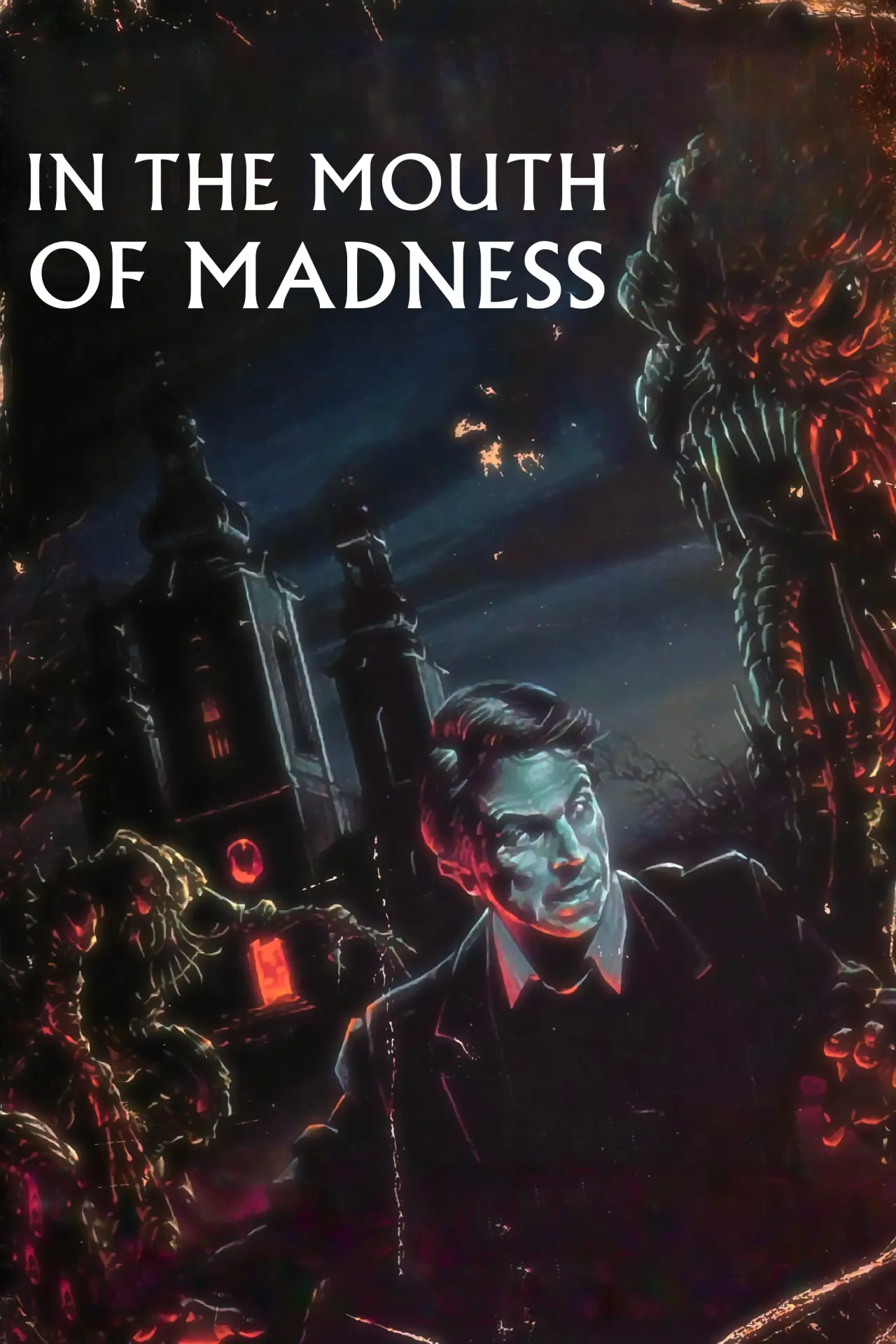
In the Mouth of Madness follows John Trent, an insurance investigator hired by a publishing house to track down Sutter Cane, a wildly popular horror novelist who has vanished. Trent suspects the disappearance may be a publicity stunt tied to the author's forthcoming book, but his search leads him toward a New England town that supposedly exists only in Cane's fiction. As he reads the novels and pieces together clues from their covers, the line between the writer's invented world and the real one becomes harder to hold, and the effect Cane's work has on his readers proves stranger than mere inspiration.
John Carpenter directed the film, the sixteenth of the twenty-two features listed in his filmography, arriving between Body Bags and Village of the Damned. Michael De Luca wrote the screenplay, Sandy King produced, and the large credited cast is led by Sam Neill as Trent, with Julie Carmen, Jürgen Prochnow, David Warner, John Glover and Bernie Casey. It was made for about eight million dollars and returned roughly nine million worldwide, a modest result.
On IMDb the film holds a 7.1 rating from around eighty-nine thousand votes, and on TMDB it sits at 7.2 from about two thousand votes, indicating a durable following. A critics' rating of 5.9 from fifty-three reviews places professional opinion below the audience scores.
What's left behind the scenes
- Throughout the film, Sutter Cane utters the phrase, “I told you, my favorite color is blue?” All the characters in the film have blue eyes in close-ups.
- The film completes John Carpenter’s “Apocalypse Trilogy,” begun with “The Thing” (1982) and “Prince of Darkness” (1987).
- The film is a tribute to H.P. Lovecraft and contains numerous references to his works. The film’s title is reminiscent of “At the Mountains of Madness,” Lovecraft’s favorite story. The film begins with a scene where the protagonist is placed in an asylum, and the subsequent narrative unfolds through his recollections – a favorite device of Lovecraft. The film also contains a reference to the “Elder Gods” – characters from the “Cthulhu Mythos” – and mentions locations and characters (such as Mrs. Pickman) from his texts. The film even features direct quotations from Lovecraft: when John Trent reads excerpts from the books of Sutter Cane.
- The character of writer Sutter Cane is a clear reference to John Carpenter’s friend Stephen King, with whom Carpenter had previously worked (“Christine” (1983)) as had screenwriter and producer Michael De Luca (“The Lawnmower Man” (1992)). “Hobb’s End” – a fictional town in Maine – is a nod to “Castle Rock,” the setting of many of King’s novels, and the very theme of the relationship between a writer and the crowd is extremely well-developed in King’s work.
- The original titles of the six books by Sutter Cane, whose covers Sam Neill's character used to create a map, are: "The Hobb's End Horror," "The Feeding," "The Whisperer in the Dark," "Something in the Cellar," "The Breathing Tunnel," and "In the Mouth of Madness."
- The 1953 film "Robot Monster," which Sam Neill's character watches near the end, is one of Carpenter's favorite monster movies from his childhood.
- When John is placed in a padded room, even without a bed, to prevent him from harming himself, the attending physician leaves a chair in it after leaving, which contradicts the rules.
- The building where scenes from the insane asylum were filmed is a water treatment plant in Toronto. It was also frequently used for scenes in other films. After September 11, 2001, the plant became a closed facility, and nothing will be filmed there anymore.
- Sam Neill, who started as a director, gave Carpenter useful advice during filming. Among other things, he advised shooting some shots in the hotel scene from above.
- "Hobb" is an archaic English word meaning "devil."
- The Slovak Greek Catholic Church of the Transfiguration was used as the location for "Black Church" in Hobb's End.
Similar movies


 Auditions in India
 Casting calls in USA
 Castingi w Polsce
 Кастинги в Україні
