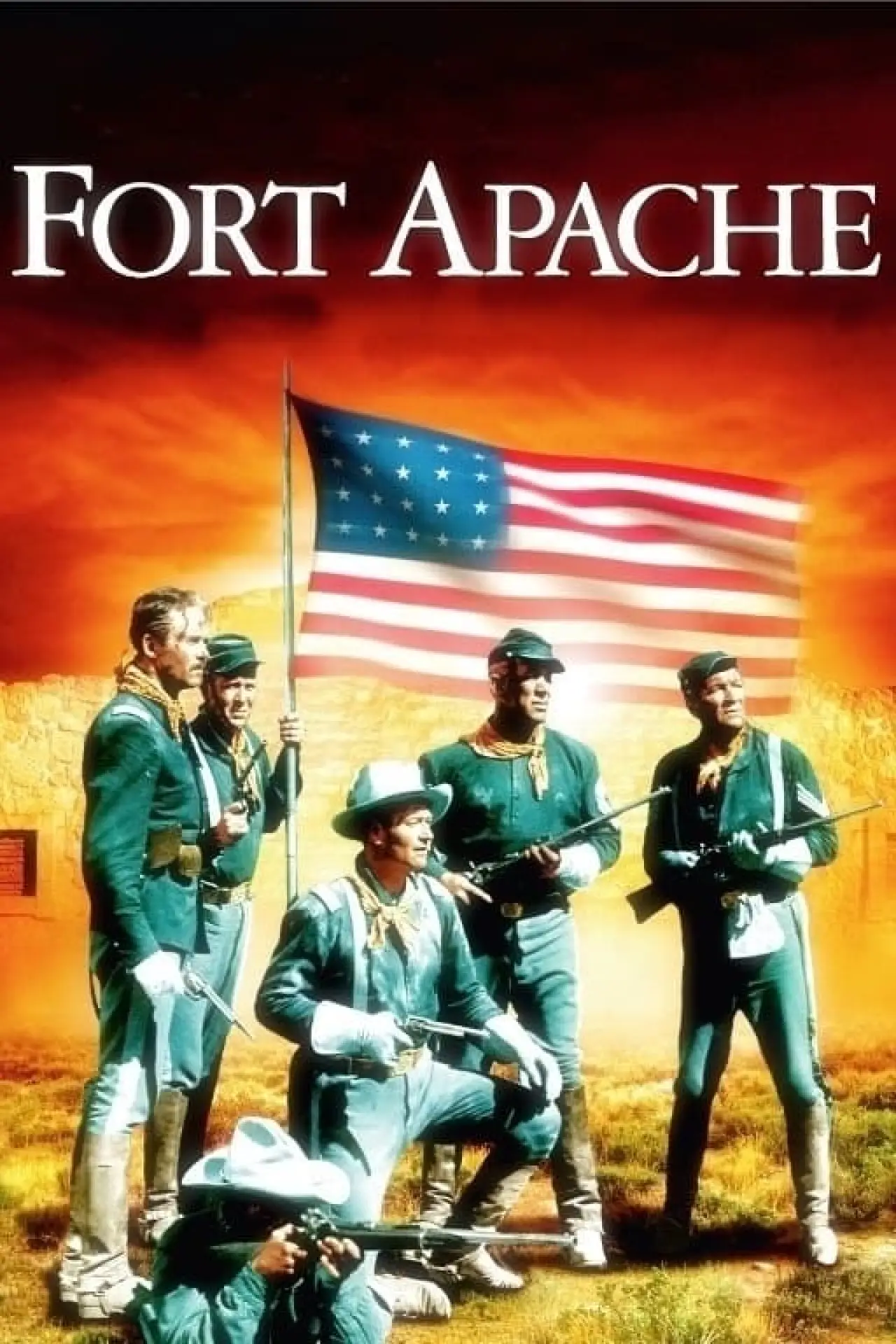
Fort Apache
John Ford's Masterpiece of the Frontier!




Country
Production
Genre
Budget
$2 500 000
Revenue
$3 000 000
Director
Actors
Scenario
Producer
Operator
Composer
Richard Hageman
Artist
Audition
Editing
Jack Murray
All team (39)
All team (39)
Short description
Owen Thursday sees his new posting to the desolate Fort Apache as a chance to claim the military honour which he believes is rightfully his. Arrogant, obsessed with military form and ultimately self-destructive, he attempts to destroy the Apache chief Cochise after luring him across the border from Mexico, against the advice of his subordinates.
What's left behind the scenes
- In addition to the black and white version, a color version of the film also exists.
- Bad weather often caused delays during filming, so John Ford found a local Navajo shaman. The director offered the Native American one hundred dollars if he could predict the weather. For several days, the forecasts came true, but one day the shaman said he could no longer predict it. When the director asked why, the Native American replied that John Wayne had taken his radio.
- Joseph Breen (1888-1965, an influential figure in American cinema, he applied the so-called Hays Code to film production) had some issues with the script. He was particularly concerned that the scene of men working with manure might be considered indecent, and he insisted that the shots of the dead soldiers be shown fleetingly and without detail. Furthermore, he insisted that the film not show a toilet, and that scenes involving drinking be minimized. In addition, Breen insisted that director John Ford (1894-1973) be in constant contact with Mel Morse, the director of the regional branch of the Society for the Prevention of Cruelty to Animals, regarding all scenes involving horses and other animals.
- By Ford's decision, Apache Indians were portrayed by Navajo Indians, as he considered them natural actors and, moreover, very reliable. Ford himself treated the Indians with respect, and they enjoyed working for him. The Indians generally liked it when filming started nearby, as it meant an opportunity for extra work. They traveled vast distances by wagon to the set and knew they could count on a decent meal on Ford's set. The film required 200 Navajo Indians to play the roles of warriors, and another 100 women and children, as well as 100 extras to portray the regular army.
- During filming, stuntman John Hudkins (1918-1997) broke his spine – a horse fell on him during the filming of a scene where a wagon with ammunition capsizes at high speed on a sharp turn (this scene remained in the film). Fortunately, Ben Johnson (1918-1996)'s intervention prevented even more serious consequences. For this, Argosy Pictures Corporation signed a seven-year contract with him, and he played significant roles under that contract. It took Hudkins a year to recover.
- Cinematographer Archie Stout (1886-1973) and John Ford used infrared black and white film (which was originally created for medical purposes and scientific research) for filming in Monument Valley. This film did not register blue color, showing it as black, which added extra drama to the image. In infrared imagery, the actors' skin looked too pale, so they had to use a lot of makeup.
- While Frank S. Nugent (1908-1965) was working on the script, John Ford went to Monument Valley to scout locations. Fully understanding the need to keep Argosy Pictures Corporation afloat, Ford spent six months planning the shooting schedule, managing to reduce the film's budget from $2.8 million to $2.1 million and finish filming in 44 days instead of the originally allocated 77 days.
Similar movies
8.2/10
7.7/10
7.7/10
7.7/10
7.6/10
7.6/10
7.5/10
7.4/10
7.2/10
7.2/10


 Auditions in India
 Casting calls in USA
 Castingi w Polsce
 Кастинги в Україні
