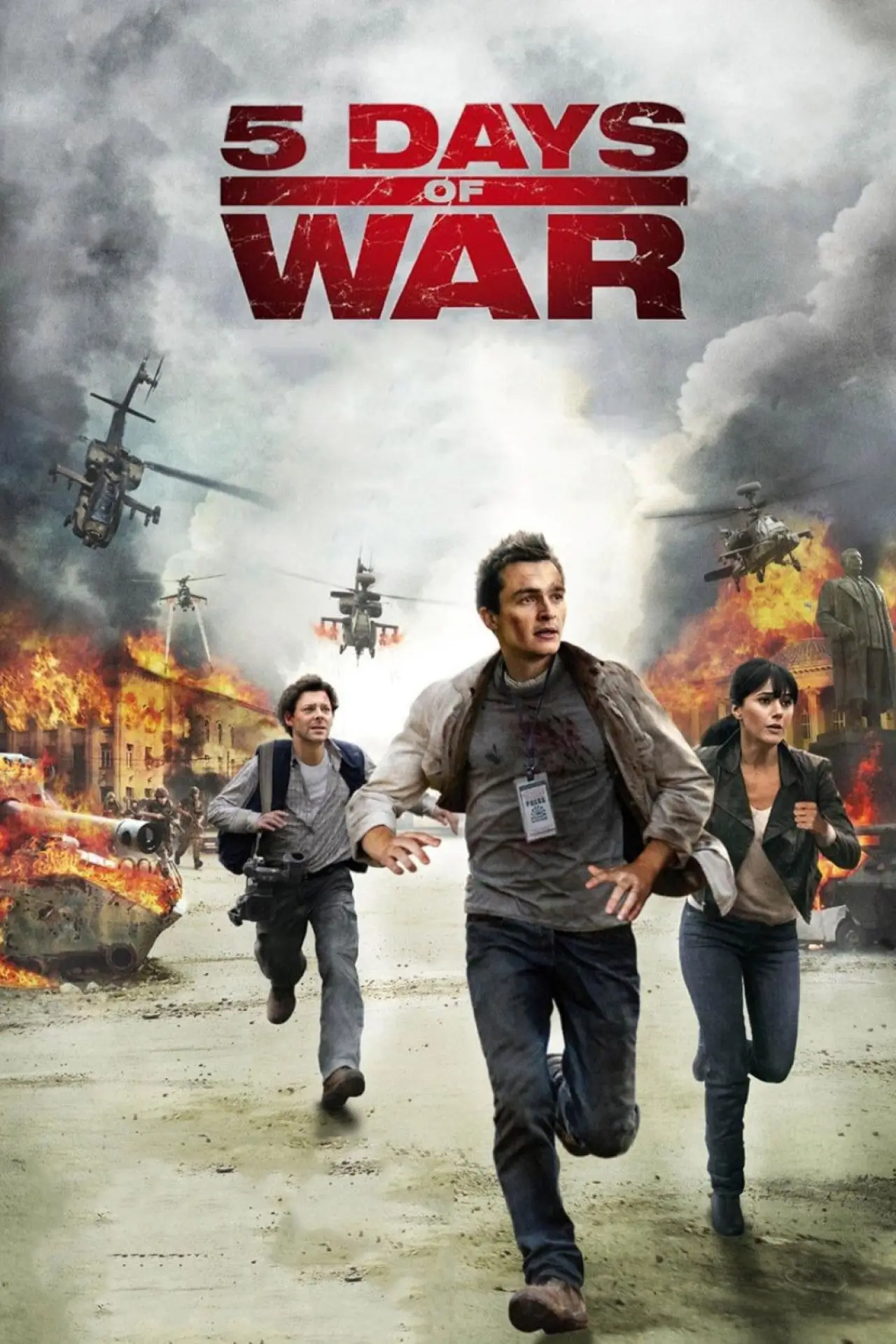
5 Days of War
Their only weapon is the truth.




Country
Production
Budget
$32 000 000
Revenue
$316 944
Director
Actors
Rupert Friend, Emmanuelle Chriqui, Richard Coyle, Heather Graham, Johnathon Schaech, Rade Šerbedžija, Andy García, Val Kilmer, Mikko Nousiainen, Mikheil Gomiashvili
All actors and roles (10)
All actors and roles (10)
Scenario
Producer
Renny Harlin, Mirza Davitaia, George Lascu, Koba Nakopia, Davit Imedashvili
Operator
Checco Varese
Composer
Artist
Marc Greville-Masson
Audition
Nancy Nayor
Editing
Brian Berdan
All team (19)
All team (19)
Short description
An American journalist and his cameraman are caught in the combat zone during the first Russian airstrikes against Georgia. Rescuing Tatia, a young Georgian schoolteacher separated from her family during the attack, the two reporters agree to help reunite her with her family in exchange for serving as their interpreter. As the three attempt to escape to safety, they witness--and document--the devastation from the full-scale crossfire and cold-blooded murder of innocent civilians.
What's left behind the scenes
- To prepare for filming, Renny Harlin, along with his friend Mikko Alanen, a screenwriter from Finland, studied reports from independent experts from the UN, EU, and Human Rights Watch, and listened to accounts from Georgian refugees, politicians, and journalists about the events of the South Ossetian conflict.
- On October 15, 2009, Jonathan Sheaк wrote on his blog about filming in Georgia. According to him, he played the role of a captain in the Georgian Armed Forces, but he had neither the appropriate training nor knowledge of the Georgian language. He also did not have a professional Georgian language teacher, so he had to memorize Georgian phrases during the filming process with the help of local Georgians involved in the film's production. According to Sheaк, Georgians often mistook him for a fellow countryman.
- Filming began on October 5, 2009, in the Tsalka region of Georgia in the Kvemo-Kartli region and near the zone of the Georgian-Ossetian conflict at a military base in Gori (Shida-Kartli region). In particular, battle scenes were filmed, involving tanks and other heavy equipment provided by the Georgian government, which significantly saved on computer graphics.
- According to Kharin, they encountered a number of problems during filming. For example, since the filming was taking place near a Russian base, they had to coordinate the use of equipment near the border with South Ossetia, as the Russian side reacted with suspicion to fighter jet flights and the passage of a tank column near the border. Another challenge for the film crew was the lack of hotels or any other rental housing, so for some time they had to sleep in cars. The team then gained access to a small dacha, which had only one bedroom, a kitchen, and a bathroom, with all necessities being delivered from other locations.
- Harline chose Peruvian Checco Vareze as the cinematographer, who, in his time, as a war photographer, had visited many hotspots around the world, from Rwanda and Bosnia to Iraq and Afghanistan, and also Chechnya during the First Chechen War. But, according to Harline, even for Vareze, who had seen war many times, the filming proved very emotional: for example, Harline claimed that during the filming of the scene of Rupert Friend’s hero saying goodbye to his wounded friend, Vareze shed quite a few tears.
- Filming lasted 36 days.
- Since the film did not have an official title at the preparation stage for filming, the project was initially referred to in early news as simply "Renny Harlin's project" or "the film about the Russo-Georgian War" (English: Untitled Renny Harlin/Georgia-Russia War Project). Then, the working title of the film in the USA was "Red August," and in Georgia – "Sakartvelo." During filming, the project was named "Georgia" (the first promotional poster was released under this title), under which it was shown in Cannes in May 2010. In late September 2010, the film was renamed "5 Days of August," and subsequently – to "5 Days of War" (initially, there was also a variant of the title "Five Days of War") for release in other countries (specifically, the USA and the UK), as August does not evoke the conflict in the South Caucasus for them. In France, the film was titled "State of War" (French: État de guerre). For release in Japan, the film's title was shortened to "5 Days" (Japanese: 5デイズ Go Deizu), which caused ridicule on some specialized Japanese websites due to the similarity of the title to common titles of films shown as part of the same offer: "Three Days" (Japanese: スリーデイズ Surī Deizu) and "4 Days" (Japanese: 4デイズ Yon Deizu).
- Renny Harlin stated that the film was based on real events (or at least a large part of it), although he acknowledged that it contained fictional events, especially since, according to him, it was a work of fiction. Nevertheless, in one interview given in late 2011, Harlin emphasized that the atrocities shown in the film by the "Russians" were actually real. When asked by a journalist why Russia did not face any punishment for this, he drew parallels with the Middle East and Africa, where mass violence and killings constantly occur, but no one cares.
- In early October 2009, information appeared that Hollywood actor Andy Garcia had been invited for one of the roles in the film. According to the unofficial version at the time, he was offered the role of the President of Georgia, despite being 11 years older than Mikheil Saakashvili. To prepare for filming, Garcia specifically trained to speak with an accent, watching recordings of Saakashvili's speeches on Youtube and taking lessons from a consultant. In November 2009, Mikheil Saakashvili, in Kyiv on the talk show “Ready to Answer” (Ukraine TV channel), joked while discussing Andy Garcia that “he gestures with his hands no less than I do. I think he’ll handle it.”
- For the role of the Cossack Daniil, Kharlin invited his longtime acquaintance, Finnish actor Mikko Nousiainen, with whom he had previously worked on the “Mannerheim” project, without any auditions. To get into the role, Nousiainen attended the gym for two months, and then, during filming in Georgia, learned to pronounce Russian phrases under the guidance of an instructor. It was the first time the actor had to speak Russian, and he simply didn’t understand a significant portion of the phrases. Temporary tattoos resembling prison tattoos were also applied to the actor to create the image.
- Kharlin stated that he cast Rupert Friend in the lead role because he wanted to puzzle the audience and deprive them of a sense of security while watching the film, and Friend was perfectly suited for this – a remarkable actor and also representing one of the “unworn names in America.”
- Russian specialists were responsible for the special effects, visual effects, and stunts for the film. Kharlin himself insisted on attracting Russian specialists, later calling it a “big political hot potato,” as he found the idea of involving Russians to film a movie in Georgia about the recent war with Russia to be a good one. An incident occurred before filming when they went to one of Georgia’s airbases. Hearing Russian speech, the Georgians inquired where the stuntmen had come from, receiving the answer “Russia.” Kharlin had to personally intervene in the brewing conflict, later explaining it by saying that the Georgians thought “it might have been a spy reconnaissance mission.” But by explaining that they were only there to tell the Georgian version of events to the world, Kharlin managed to defuse the conflict.
- Before filming, Andy Garcia met with Mikheil Saakashvili for lunch and, according to the latter, “constantly asked how to pronounce certain words.” Filming with Garcia took only two days.
- During the film's creation, the official sponsor of the project was unknown. However, even during filming, opinions arose regarding funding from the Georgian authorities. For example, Shlva Natelashvili, leader of the Laborists, told the newspaper “Alia” that Saakashvili had allocated $35 million for the film's production, a claim personally confirmed by former State Minister for Conflict Resolution Giorgi Khaindrava. And the General Secretary of the Georgian Laborist Party, Iosif Shatberashvili, claimed that Saakashvili paid $100 million to the film's creators. Subsequently, the Georgian opposition repeatedly accused the government of being the film's main sponsor. In October 2009, Russian newspapers reported that Andy Garcia would receive a fee of $500,000, and Harlin $450,000. In November 2009, Mikheil Saakashvili, in Kyiv on the talk show “Ready to Answer” (TV channel “Ukraine”), answered questions from viewers, stating in particular that the Georgian authorities did not fund the film, as they had no money to support Georgian cinema. Harlin supported this view, stating that he and his team “did not receive any money from the Georgian government.” Nevertheless, according to the official version released after the film's release, the film's production was sponsored by independent Georgian businessmen, but unofficial opinions also emerged regarding the involvement of Russian capital in the project.
Similar movies
8.4/10
8.3/10
8.2/10
8.1/10
8.1/10
8/10
8/10
7.9/10
7.7/10
7.7/10


 Auditions in India
 Casting calls in USA
 Castingi w Polsce
 Кастинги в Україні
