You Only Live Twice



![Watch film You Only Live Twice — You Only Live Twice (1967) ORIGINAL TRAILER [HD 1080p]](https://www.acmodasi.in/amdb/images/posters/8/t/you-only-live-twice-1967-cwFmd.jpg)
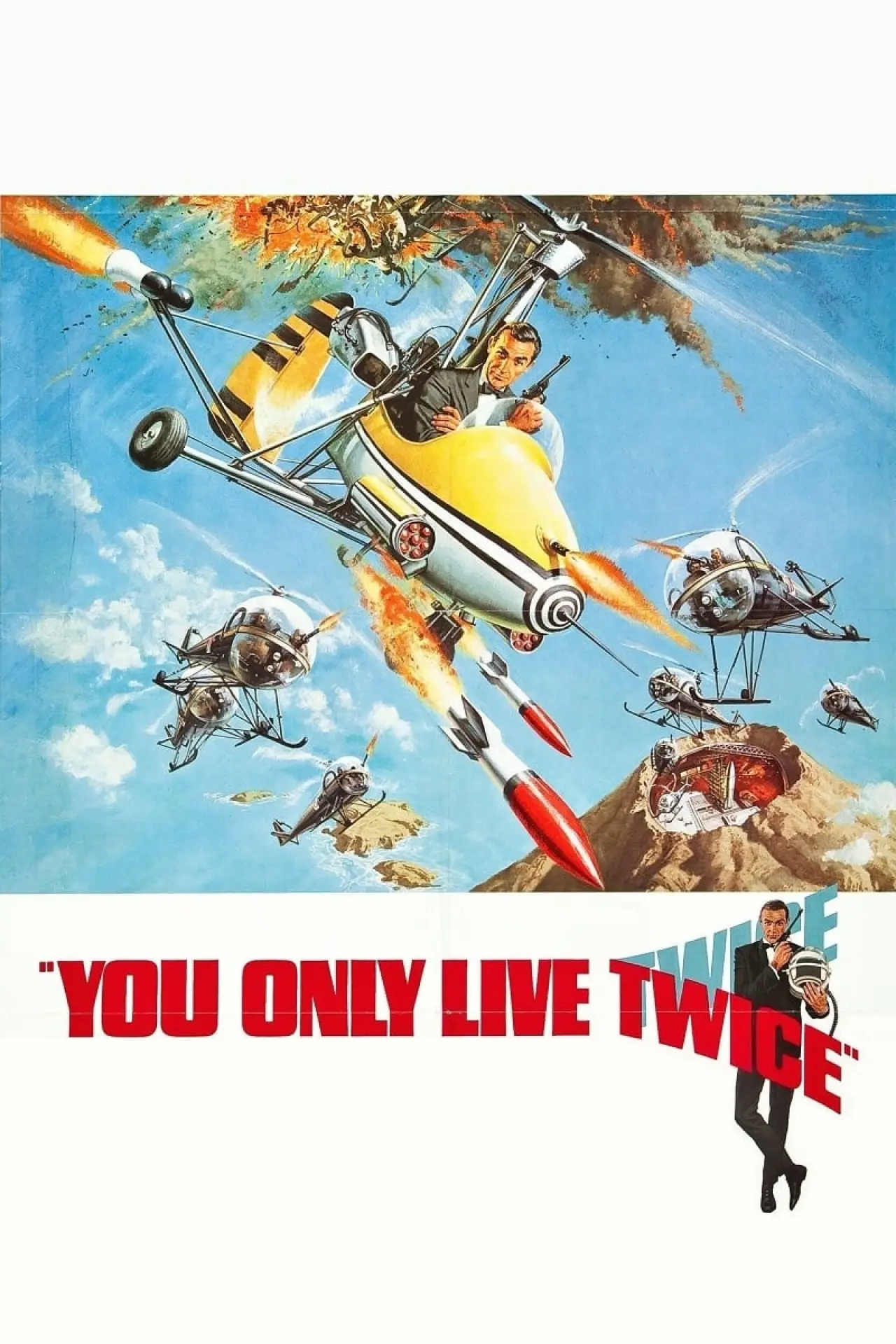
Short description
A mysterious spacecraft has begun capturing crewed capsules in orbit, one American and one Russian, and each superpower blames the other. With the world sliding toward nuclear war, James Bond is sent to Japan to find out who is really behind the abductions. There he works with Tiger Tanaka, the head of Japanese intelligence, and his agents, and the trail leads to the criminal organization SPECTRE and its leader, Ernst Stavro Blofeld.
You Only Live Twice was released in 1967 and runs 117 minutes. It is the fifth film in the James Bond series produced by EON Productions, and it was directed by Lewis Gilbert, arriving in his filmography between Alfie and The Adventurers. Sean Connery plays Bond for the fifth time. The cast also includes Akiko Wakabayashi, Mie Hama, Tetsurō Tamba, Teru Shimada and Karin Dor, with 41 credited cast members. Roald Dahl and Harold Jack Bloom wrote the screenplay, and Albert R. Broccoli and Harry Saltzman produced. It was made for about 10 million dollars and returned roughly 112 million dollars worldwide.
Audience responses to the film are moderate. On IMDb it holds 6.8 out of 10 from around 127,000 votes, and on TMDB it has 6.6 out of 10 from 2,566 votes. A critics' rating of 6.8 out of 10 from 52 reviews places professional assessments at roughly the same level as the audience scores. Gilbert later returned to the series with The Spy Who Loved Me and Moonraker.
What's left behind the scenes
- The next Bond film was supposed to be *On Her Majesty’s Secret Service*, but filming at the planned locations in Switzerland proved impossible due to an unusually cold summer, and it was decided to film *You Only Live Twice* instead.
- The launch of the Soviet rocket shown in the film was certainly not from Soviet newsreels. In fact, it is the launch of the American Titan II GLV launch vehicle, which was used to launch Gemini spacecraft into orbit. Judging by the surroundings and the palm trees in the foreground, the launch was carried out from launch complexes SLC-40 or SLC-41, located at Cape Canaveral, Florida.
- Production designer Ken Adam constructed a prop volcano crater on the grounds of Pinewood Studios. The set included a mobile helicopter landing pad, a working monitoring system, a launch pad, and a full-scale model of a rocket capable of taking off. The construction utilized 700 tons of metal structures, over 320 km of steel piping, 200 tons of plaster, 500,000 steel couplings, 8,000 sleepers for a monorail, and over 200 square meters of tarpaulin to protect the steel structures from the elements. The total cost exceeded $1 million. The set was visible from a distance of nearly 5 kilometers.
- It turned out that Mie Hama, the actress playing Kissy, couldn’t swim, and in the relevant scenes she was replaced by Sean Connery’s then-wife, actress Diane Cilento, who wore a black wig for the shoot.
- The American spacecraft shown in the film are very similar to Gemini, which actively made orbital flights in 1965-66. In particular, spacewalks were carried out as part of this program.
- A film adaptation of the novel of the same name by Ian Fleming, written in 1964.
- In this film, we see Blofeld's face for the first time.
- Before settling on a prosthetic scar across his face, Donald Pleasence suggested that his character (playing Blofeld) have a hump, a noticeable limp, a beard, or only one functioning arm. Ultimately, a disfiguring facial scar was chosen. The scar glued to his face covered one eye, and the actor found this extremely uncomfortable.
- The composite helicopter 'Little Nellie' was based on the real-life Wallis Autogyro. During filming, the helicopter was piloted by its inventor, retired aviation Lieutenant Colonel K. Wallis. Production designer Ken Adam happened to overhear a radio interview with Wallis discussing his invention and suggested incorporating this plotline into the film's script. Filming the scenes with 'Little Nellie' required 85 flights. The rocket launch scenes were filmed outside of Japan because Japanese law prohibited launching rockets from within the country.
- In the scene where Bond and his wife walk to the volcano's crater, she suddenly appears wearing shoes. Before that, they swam out of the cave, and she had no shoes on.
- Relations between Sean Connery (who played agent 007 James Bond) and the producers (Albert R. Broccoli, Harry Saltzman, Stanley Sopel, Terence Young) deteriorated to the point that he refused to act if they were present on set.
- While scouting locations in Japan, the filmmakers narrowly avoided death in a plane crash. On March 5, 1966, producers Albert R. Broccoli and Harry Saltzman, director Lewis Gilbert, cinematographer Freddie Young, and production designer Ken Adam were about to board a 'Boeing 707' flight from Tokyo to Hong Kong and then on to London, but they happened to miss the flight. The plane took off on schedule, but 25 minutes later encountered turbulence over Mount Fuji and broke apart in the air. All passengers and crew members perished.
- The film's editing was handled by Thelma Connell, who had been the editor for all of director Lewis Gilbert’s films. Her cut ran almost three hours, but it was thoroughly disliked by audiences at preview screenings, and Peter R. Hunt was asked to redo it. His version was successful, and in the next Bond film—the 1969 *On Her Majesty’s Secret Service* starring George Lazenby as Agent 007—Hunt was already working as the director.
- Nancy Sinatra became the first non-British performer of the title song in the James Bond films.
- This is the penultimate official James Bond film in Sean Connery's career.
- Before offering the role of Blofeld to Donald Pleasence, it was offered to several other actors, but all of them were busy and unable to participate in the filming. Initially, producer Harry Saltzman offered the role to Jan Werich, a Czech theater and film actor, but after just a week of filming, it was decided that his Blofeld looked too much like Santa Claus, and another actor had to be found.
- Before the credits roll, viewers see a Soviet radar station, inside which an emergency conference of representatives from the superpowers is taking place. This scene was filmed in Norway. The Norwegian army’s radar installation is still operational today.
- Charles Gray, who played Henderson, played Blofeld in the film 'Diamonds Are Forever'.
- Authentic footage of a Gemini spacecraft launch (the second American program of manned spaceflights) was used for the scenes depicting the launch of the Jupiter spacecraft. This program involved testing spacewalks, docking systems, orbital maneuvering, altitude changes, and much else necessary for the Apollo program, whose first manned flight was planned for 1968. Ironically, the name 'Gemini' ('twins' in English) in the film is given to a Soviet spacecraft, and its outlines are based on mistaken British perceptions of what the Vostok and Voskhod series of spacecraft looked like. Nothing was known about their actual appearance until 1967, when work on the film was already completed.
- In Fleming's novel, Blofeld's hideout is a castle on the coast. Production designer Ken Adam discovered that this was completely impossible: due to a fear of hurricanes, the Japanese have never built castles directly on the coast throughout history. Therefore, in the film, Blofeld's hideout is located in the crater of a supposedly extinct volcano.
- The film differs so significantly from the novel—the literary source material—because screenwriter Roald Dahl strongly disliked Ian Fleming's book itself. He considered the 1964 novel to be the worst thing Fleming had ever written, calling it a “lecture on a trip to Japan.” Dahl had only six weeks to develop the initial screenplay, and he openly admitted he had no idea what Bond would do, so he decided to make the main plotlines similar to those in Terence Young’s 1962 film *Dr. No*, scripted by Richard Maibaum, Johanna Harwood, Berkeley Mather, Young, Wolf Mankowitz, and, of course, Ian Fleming himself.
- It is said that Blofeld's white cat (played by actor Donald Pleasence as Bond's perennial enemy) was frightened by the noise on set during the filming of the finale and ran away. The animal was found only several days later. Footage of the frightened cat made it into the film – in the scene where protective shutters are closed in the bunker.
Similar movies






 Auditions in India
 Casting calls in USA
 Castingi w Polsce
 Кастинги в Україні
