The Jungle Book
The Jungle is JUMPIN'!




Country
Production
Budget
$4 000 000
Revenue
$205 843 612
Director
Actors
Bruce Reitherman, Phil Harris, Sebastian Cabot, George Sanders, Sterling Holloway, Louis Prima, J. Pat O'Malley, Clint Howard, Chad Stuart, Lord Tim Hudson
All actors and roles (10)
All actors and roles (10)
Scenario
Producer
Operator
Composer
Artist
Hal King, Eric Cleworth, Eric Larson
Audition
Editing
Tom Acosta, Norman Carlisle
All team (39)
All team (39)
Short description
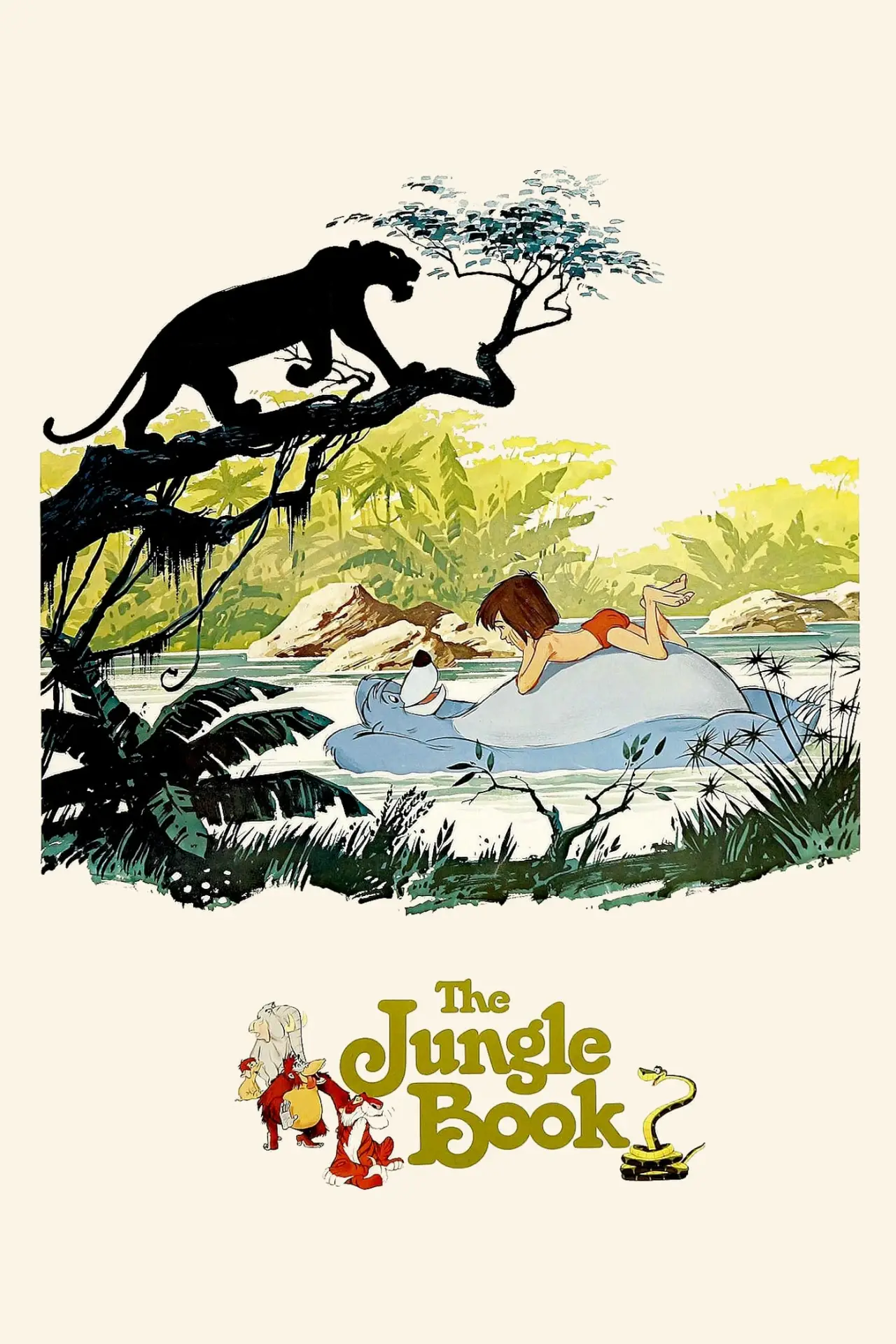
The boy Mowgli makes his way to the man-village with Bagheera, the wise panther. Along the way he meets jazzy King Louie, the hypnotic snake Kaa and the lovable, happy-go-lucky bear Baloo, who teaches Mowgli "The Bare Necessities" of life and the true meaning of friendship.
What's left behind the scenes
- This is the 19th feature-length Disney animated film and the last one that Walt Disney himself participated in. Disney died in 1966 at the age of 65 while work on the film was still underway.
- Initially, Mowgli was voiced by David Alan Bailey, but work on the film lasted three years, his voice began to change, and as a result, Mowgli in the film speaks with the voice of Bruce Reitherman.
- The last cartoon produced by the company in which Walt Disney himself participated.
- Initially, jazz singer Louis Armstrong (1901-1971) was approved to voice King Louie, but he was later replaced by Italian-American singer Louis Prima (1910-1978). Walt Disney decided that the audience might misunderstand if an African American voiced the ape leader.
- Walt Disney passed away during the production of the cartoon. Had the cartoon failed at the box office, the animation department of his studio would likely have been closed. Fortunately, that did not happen.
- While working on the background, the animators studied real jungles of India.
- The suggestion to make an animated version of Rudyard Kipling’s “The Jungle Book” was first put forward by Bill Peet. Peet worked on the screenplay for a year, but when Walt Disney rejected the proposed script, Peet left the project and resigned from the studio. Disney and Peet’s visions for the future film were too different, bringing their quarter-century professional collaboration to an end.
- Walt Disney dreamed of John Wayne voicing Baloo, but he was busy with other projects and suggested Phil Harris, his close friend, an actor and singer, instead. To a certain extent, Harris voiced Baloo imitating Wayne.
- The public and film critics’ reaction to “The Sword in the Stone” (1963) was rather restrained, and Walt Disney set out to create a film that would be a guaranteed success. He instructed his animators to disregard Rudyard Kipling’s “The Jungle Book,” as he found the storyboard of the original script too gloomy and minor. Disney put animator Larry Clemons in charge of the project, gave him “The Jungle Book,” and immediately forbade Clemons from reading it.
- As composer Richard M. Sherman later recounted, George Sanders (1906-1972), the voice of Shere Khan, categorically refused to sing the song "That's What Friends Are For." Bill Lee (1916-1980) performed the song instead.
- Initially, it was planned that the vultures would be voiced by members of "The Beatles," as the vultures were made characters in the cartoon specifically at the personal request of the group's manager, Brian Epstein, to include his wards in the plot. When Epstein presented this idea to the famous quartet themselves, John Lennon strongly opposed it and advised Epstein to suggest Elvis Presley to Disney. Regardless, the vultures were made to visually resemble members of "The Beatles."
Similar movies
8.2/10
8.2/10
8.1/10
8/10
7.6/10
7.5/10
7.3/10
7.3/10
7.2/10
7.2/10


 Auditions in India
 Casting calls in USA
 Castingi w Polsce
 Кастинги в Україні
