Apocalypto



![Watch film Apocalypto — Apocalypto - Official® Trailer [HD]](https://www.acmodasi.in/amdb/images/posters/x/w/apocalypto-2006-fkAxl.webp)
Short description
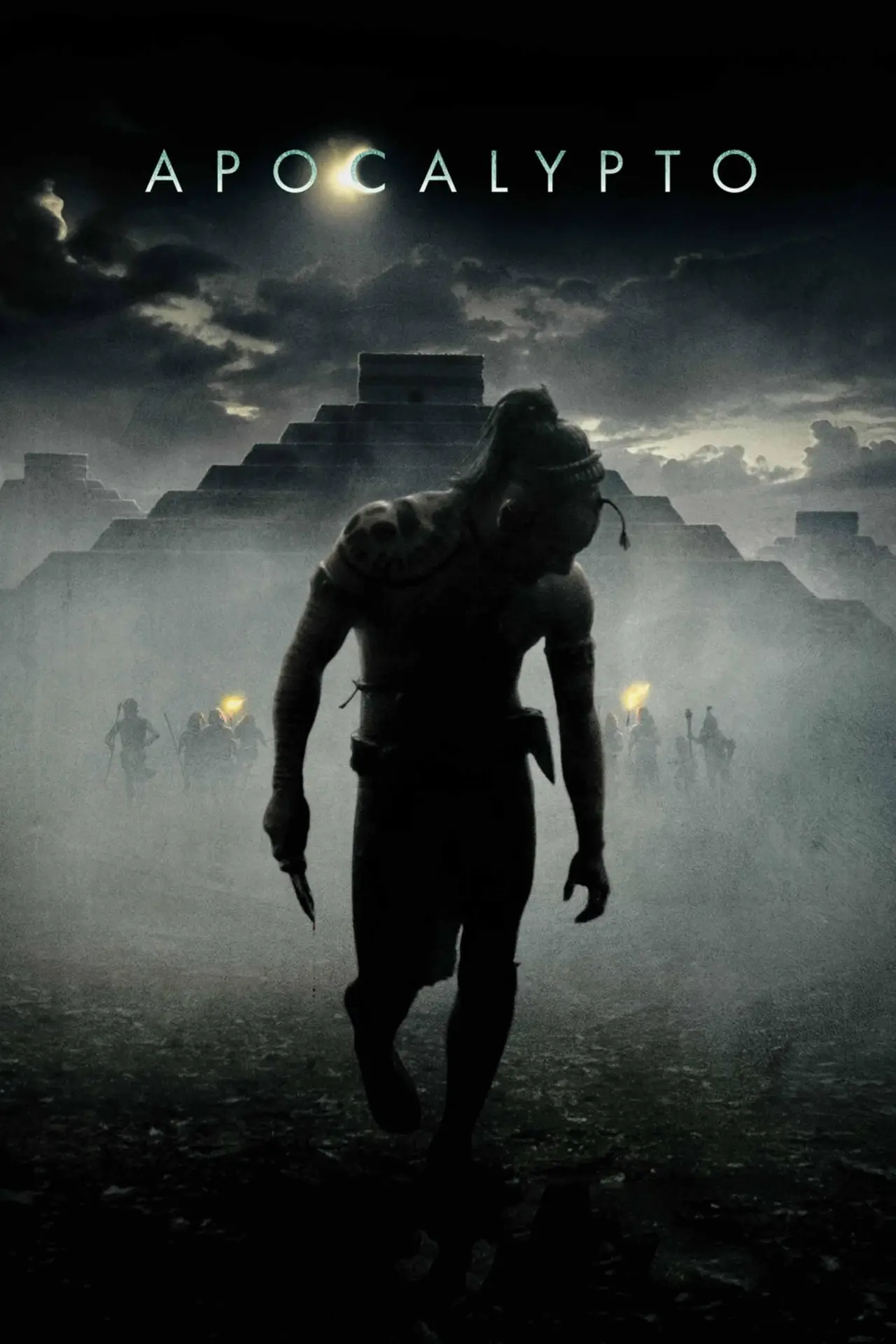
Apocalypto takes place during the decline of the Maya civilization, in a village whose peaceful daily life is shattered when an invading force attacks. Jaguar Paw, a young man and father, is captured along with other villagers and marched through the jungle to a city where a different fate awaits the prisoners. Driven by the need to get back to his wife and child, he attempts a desperate escape, pursued through unfamiliar terrain by his captors.
Mel Gibson directed and co-wrote the film with Farhad Safinia, and produced it with Bruce Davey and Sergio Miranda. It followed The Passion of the Christ in Gibson's filmography and was shot largely in the Yucatec Maya language, with a cast led by Rudy Youngblood, Raoul Max Trujillo, Gerardo Taracena, Iazua Larios, Antonio Monroy and María Isabel Díaz Lago. The production cost around 40 million dollars and grossed roughly 121 million worldwide, a solid return.
On IMDb the film holds 7.8 out of 10 from about 357,000 votes, and on TMDB 7.7 from roughly 6,700 votes, indicating a broadly favorable audience response that has held up over the years. The critics' rating of 6.6 from 199 reviews is noticeably lower, showing that reviewers were more reserved than general viewers. The action, drama and history labels reflect its mix of chase-driven action and period setting.
What's left behind the scenes
- The trailer for "Apocalypto" features many characters who do not appear in the film itself.
- During filming at the waterfall, when Jaguar Paw escapes from the hunters and jumps down, a real cow heading upstream actually ran across the waterfall. Only after a local resident swam to the cow and calmed it down did it return to the shore and continue grazing as if nothing had happened.
- The waterfall shown in the film is a real waterfall called Salto de Eyipantla in San Andrés Tuxtla.
- The film featured many animals, including the Central American tapir and the black panther. In scenes where animals are wounded, animatronics or puppets were used.
- Due to the unpredictable climate of the Mexican forests, the film crew had to take extra care to protect the digital equipment from sudden downpours. In case of extreme heat, it was wrapped in special blankets capable of reflecting high temperatures. They even had to attach thermometers to all the cameras. And during the filming of the waterfall scene, they were placed in special waterproof bags designed by Pete Romano.
- Representatives of Maya indigenous communities filed a complaint with the human rights commission of the Mexican state of Yucatan. They believe the film is “discriminatory and denigrates the history and culture of the Maya.” The complaint states, with references to historical works, that human sacrifice was very rare among the Maya and practiced only in isolated cases. The complaint also expresses dissatisfaction with the depiction of Spanish conquistadors as saviors: “It was these ‘peacekeepers’ who, with fire and sword, destroyed temples and manuscript repositories, demolished cities, threw all those who refused to accept Christianity into the flames of bonfires, and turned a free people into slaves.” Indigenous leaders also believe that the film incorrectly portrays historical details: “The director should have known that the Maya never pierced their noses, lips, or cheeks to adorn themselves with gold rods, wood, or silver wire.” Despite the protests of the elders, 'Apocalypto' was released in Mexican theaters.
- Unrelenting rains in Mexico caused the release of the film to be postponed from March 4, 2006, to December 8, 2006.
- Mel Gibson wanted the film Apocalypto to be shot against the backdrop of real buildings and did not want to rely on computer-generated imagery. Most of the stepped pyramids in the Mayan city were models built by Thomas E. Sanders.
- During casting for Mel Gibson and Farad Safinia, it was important to choose actors suitable for the created characters. Thus, Rudy Youngblood attracted Gibson with his correspondence to the mythical archetype of a hero.
- The images on the frescoes depicting the heroes' journey were taken from Mayan codices, the ruins of Bonampak (frescoes made 700 years before the film was created), and the ruins of San Bartolo (1500 years before filming).
- Although the film is set in the Postclassic period of Mayan civilization, the central pyramid is taken from the Classic period, which ended in 900 AD. Moreover, the temples are modeled on the temples of Tikal in the Classic style of the central valleys and, at the same time, decorated in the Puuc architectural style of the northwestern region of Yucatan, which became established centuries later.
- While developing the script, Safinia and Gibson traveled to Guatemala, Costa Rica, and the Yucatan Peninsula to scout filming locations and visit Mayan ruins.
- Although many of the architectural details of the Mayan city are correct, they are a mixture taken from different areas and eras. Farad Safinia stated that this was done for aesthetic reasons.
- For the waterfall jump scene, Rudy Youngblood performed the dangerous stunt himself. With the help of a safety harness, he jumped from a 15-story building in Veracruz. Later, this jump was overlaid with computer graphics onto footage of a real waterfall.
- The film was shot in Veracruz and Catemaco – one of the last places in Mexico where sections of tropical forest still remain. The film features exclusively representatives of the indigenous population of America, for most of whom this was their film debut. To find actors with the appropriate appearance, castings were held throughout Mexico, especially in Yucatan, Mexico City, and Oaxaca. Some future actors were found in other countries, including the USA and Canada. Not all of them are descendants of the Maya, but they all come from various Indian tribes, meaning they are native inhabitants of the continent.
- On the 78th minute of the film, a solar eclipse occurs on screen. During a solar eclipse, the Moon faces the Earth with its unlit side (new moon). On the 98th minute of the film, a full moon is shown. Approximately 12 hours pass between these events in the course of the film (the eclipse was during the day, the full moon rose at night). In reality, approximately two weeks (half of a synodic month – 14.765 days) should pass between a new moon and a full moon.
- The characters speak in the Yucatec Mayan dialect, and the film is shown in cinemas with subtitles. To help the actors learn the unfamiliar language they were to perform in, special consultants were included in the film crew to conduct Mayan language lessons. In addition, each actor had a player with them to constantly listen to and memorize their lines.
- The film crew included a large group of makeup artists and costume designers; they worked to give a large number of performers the appearance of Mayans. A makeup team led by Aldo Signoretti applied appliques depicting tattoos, scars, and earlobe tunnels to all actors appearing on screen daily. According to consultant Richard D. Harris: “I spent hours studying ceramics and drawings in search of tattoo images. All scarifications and tattoos, jade-inlaid teeth, objects inserted into the ears were researched. A small rod threaded through the ears and nasal septum was a completely artistic innovation. An example of the attention to detail: the tattoo depiction (a horizontal stripe with two dots above it) on Seven, the wife of Jaguar Paw, is a symbolic designation used by the Maya for the number seven.”
- Before filming began, director Mel Gibson and screenwriter Farad Safinia spent several months studying Mayan texts, including the most famous one, the “Popol Vuh.” Later, Farad Safinia noted: “We discovered that the problems considered key to Mayan civilization surprisingly resemble the difficulties our civilization faces now, especially when it comes to widespread environmental destruction, excessive consumption, and political corruption.”
- The film's title, "Apocalypto," has been incorrectly translated in Russian distribution. In fact, it is not even an English word, but a Greek verb with a range of meanings: "to reveal oneself," "to discover the truth," and so on.
- Gibson stated that they wanted to “shake up the stagnant genre of adventure action,” dominated by computer technology, ordinary stories, and minor roles, and create a chase “like a car race where you just have to flip switches.”
- Most of the prominent roles were played by descendants of the Maya Indians, who had never acted before. For example, the role of the small, sick girl who curses the hunters was given to a 7-year-old girl from a village that strongly resembled the place where the Lapu Jaguar tribe lived.
- An English armorer and weaponsmith, Simon Atherton, who had previously worked with Gibson on the film "Braveheart," was hired to research Mayan weapons and create replicas. Gibson cast Atherton as a Franciscan monk holding a cross in one of the film’s final scenes.
- In addition to the leading actors, some scenes required the participation of at least 700 extras.
- The film drew criticism from a number of Mayan scholars and archaeologists, who believed that Mayan society was presented by the director as exclusively cruel. Among other things, critics expressed the opinion that the ancient Maya were depicted as “bloodthirsty savages,” while their achievements in mathematics and astronomy were not given due attention. Furthermore, some historians and representatives of indigenous communities accused the film of distorting historical facts and racism.
- When Mel Gibson was a teenager, an older boy called him “Almost,” which deeply offended the ambitious Mel. The same element was later added to the film by director Gibson: this is how one of the hunters addresses the hero Rudy Youngblood.
- In the audio commentary for the first DVD release of the film, Safinia states that the basis of the story told by the old shaman (played by Espiridion Acosta Cache, a Mayan storyteller) was a genuine Mesoamerican story, translated into modern Yucatec Maya by a young Mayan professor, Hilario Chi Canul, who participated in setting the dialogue during filming.
Similar movies


 Auditions in India
 Casting calls in USA
 Castingi w Polsce
 Кастинги в Україні
