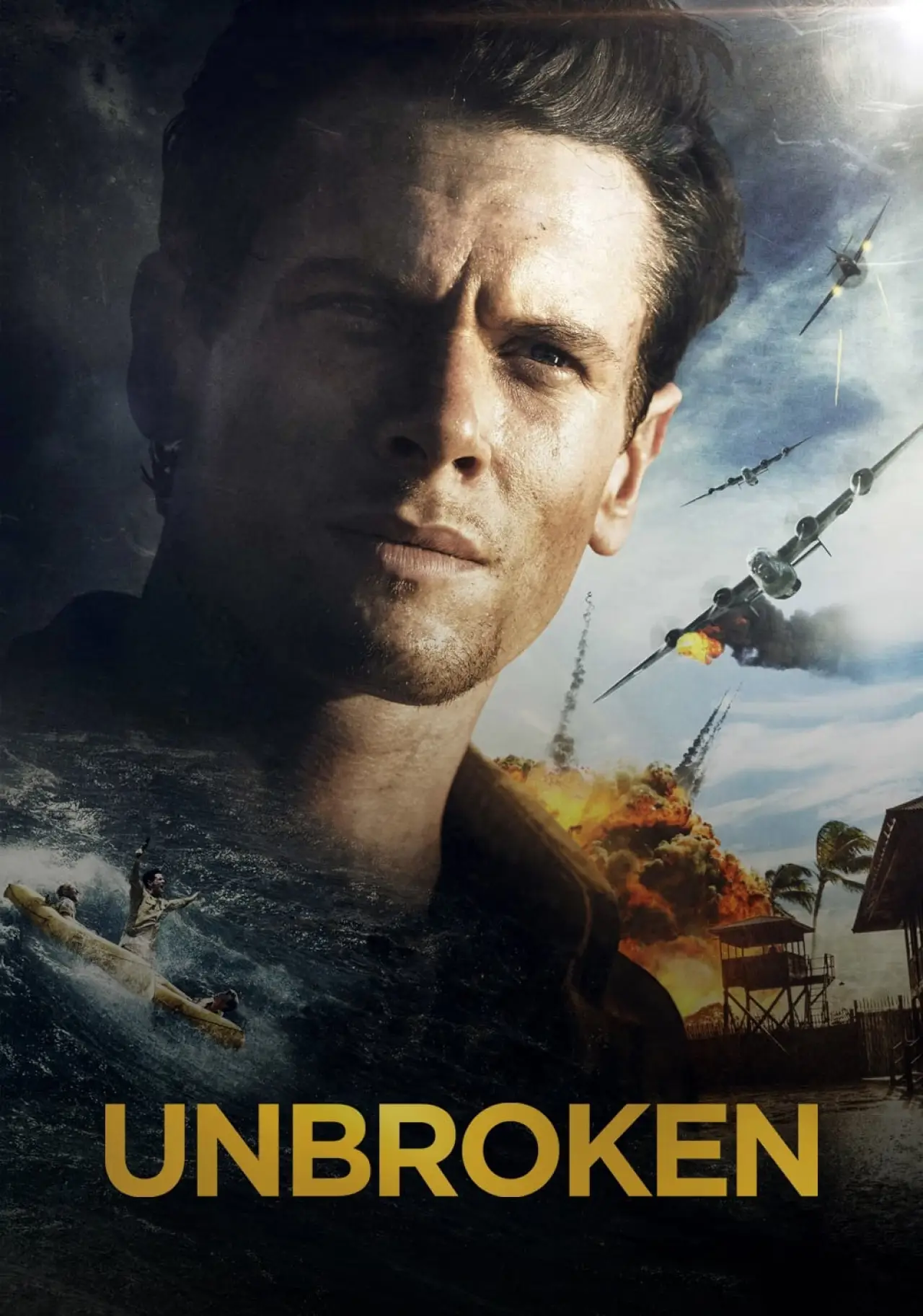
Unbroken
Survival Resilience Redemption




Country
Production
Budget
$65 000 000
Revenue
$161 459 297
Director
Actors
Jack O'Connell, Alex Russell, Domhnall Gleeson, Garrett Hedlund, MIYAVI, Finn Wittrock, Jai Courtney, Maddalena Ischiale, Vincenzo Amato, Sophie Dalah
All actors and roles (10)
All actors and roles (10)
Scenario
Producer
Operator
Composer
Artist
Jon Hutman, Erik Baker
Audition
Editing
Short description
A chronicle of the life of Louis Zamperini, an Olympic runner who was taken prisoner by Japanese forces during World War II.
What's left behind the scenes
- Universal Studios acquired the rights to the story of Louis Zamperini in 1957, hoping to make a film starring Tony Curtis. Later, Nicolas Cage became interested in the project. Ultimately, the film received the green light only after the book about Zamperini became a bestseller.
- When Zamperini and Phil are floating at sea on a raft, Phil looks at a photograph of a woman. This is a real photograph of his sweetheart, who would later become his wife. Angelina Jolie was provided with this photograph by his daughter.
- Dane DeHaan was one of the main contenders for the role of Louis Zamperini.
- Due to chickenpox, Angelina Jolie was unable to attend the film premiere.
- The film was shown on January 8, 2015, at Casina Pio IV, the main building of the Pontifical Academy of Sciences and the Pontifical Academy of Social Sciences in the Vatican. Pope Francis did not attend the screening, but later met with Angelina Jolie and Luke Zamperini, the son of the late athlete Louis Zamperini.
- Louis Zamperini passed away on July 2, 2014. Before his death, while in the hospital, he managed to watch a rough cut of the film on Angelina Jolie’s laptop.
- As stated in the end credits, the real Mutsuhiro Watanabe refused to meet with Louis Zamperini, but he agreed to give an interview for a television program on the occasion of Zamperini’s participation in the Olympic torch relay in Tokyo in 1998. During the interview, Watanabe did not express remorse for beating prisoners, but admitted that he followed not official orders, but personal feelings towards the enemy.
- Clay Zamperini, Louis Zamperini’s grandson, played an extra role as a person carrying the Olympic torch.
- An American of Italian descent, Louis Zamperini grew up in a difficult environment in 1920s America. As a teenager, he was caught stealing and participated in paid fistfights. However, he ended up not in jail, but on a stadium track, where he amazed coaches with outstanding running results. He soon entered the elite of American sports, and in 1936, as part of the American team, he competed at the Berlin Olympics, where he met Hitler and couldn't resist a prank: he stole a German flag from the Reich Chancellery.
- When the Olympic flame is carried in Japan at the end of the film, Louis Zamperini runs past the prisoner-of-war camp in Naoetsu. In reality, Zamperini was held in this camp for the longest time.
- When the prisoners of war are bathing in the river, a B-29 bomber flies overhead, and the shadow of a B-24 bomber is cast on the water.
- In the scene at the train station, you can notice a 50-star US flag hanging on the depot building. At that time, there should have been a flag from 1912 (48 stars – 8 rows, 6 columns), but the film shows a flag from 1959, which has 50 stars arranged in an offset pattern.
- The national markings on the American transport plane shown at the end of the film (1945) have a red dot in the center of the star. This red dot was removed from American aircraft in 1942 to avoid possible confusion with the red Hinomaru circle used in the markings of Japanese aircraft.
- The American plane that carries Zamperini at the end of the film is a Lockheed Electra with markings of Australian civil transport. Additionally, the nose of the plane features an inscription not authorized by regulations – Army Air Corp, while the Army Air Corp was renamed Army Air Forces in 1941.
- Despite Louis, Phil, and Mac spending a considerable amount of time at sea, they remain cleanly shaven.
- In reality, steam-powered trains never operated regular passenger service to Torrance, California. Such services were provided by Pacific Electric, but they built electric railways, and in that case, electric wires above the train should have been visible in the shot.
- A modern white dress with an 'invisible' back zipper can be spotted in the film. A girl in such a dress can be seen behind Louis while he is dining downtown in Japan. Long zippers appeared only in the 1950s, and 'invisible' zippers came into use even later.
- No parachutes are visible in any of the scenes on board the B-24 aircraft.
- The aircraft crew is flying in uniforms, when they should be in flight suits.
- In the opening scene, none of the bomber crew are equipped with a parachute harness.
- The prisoners of war mostly look disheveled, but are nevertheless cleanly shaved and neatly groomed.
- The shadow of the aircraft moves across the ground much slower than the aircraft itself flying overhead.
- The script is based on Laura Hillenbrand’s book "Unbroken: A World War II Story of Survival, Resilience, and Redemption," published in 2010.
- Miyavi (Watanabe) had to keep his distance from Jack O’Connell (Zamperini) to make it easier for him to play his character in scenes where Watanabe displayed particular cruelty towards Zamperini.
- Jack O’Connell dyed his auburn hair black to more closely resemble the character of Italian descent.
Similar movies
8.4/10
8.2/10
8.2/10
8.1/10
8.1/10

8/10

8/10

7.9/10
7.9/10
7.8/10


 Auditions in India
 Casting calls in USA
 Castingi w Polsce
 Кастинги в Україні
