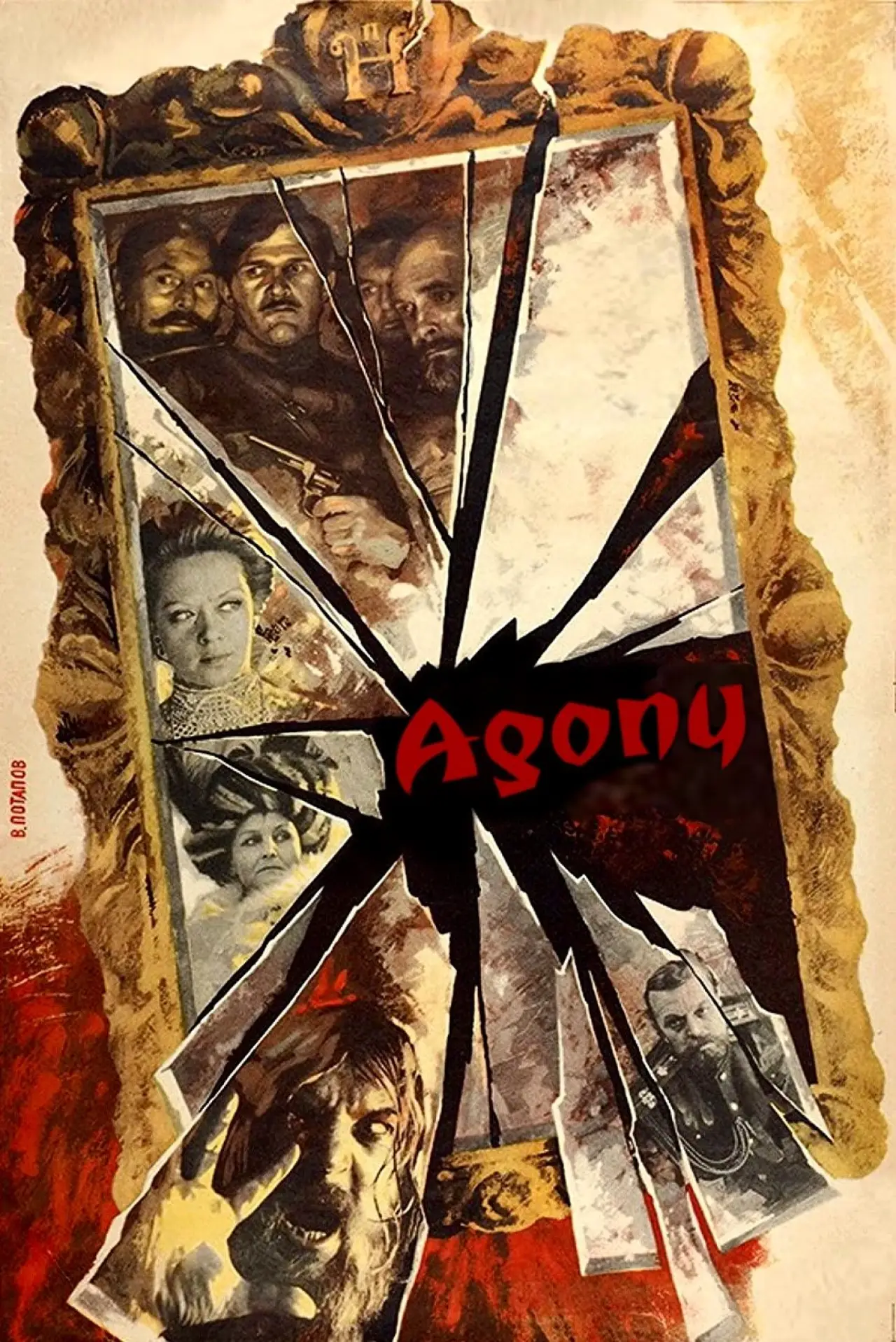
Agony: The Life and Death of Rasputin
Monk. Heretic. Messiah. Madman.
Агония (1981)


Production
Director
Scenario
Ilya Nusinov
Composer
Actors
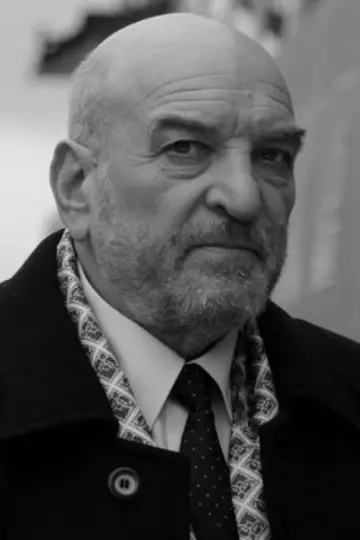
Aleksey Petrenko
Rasputin
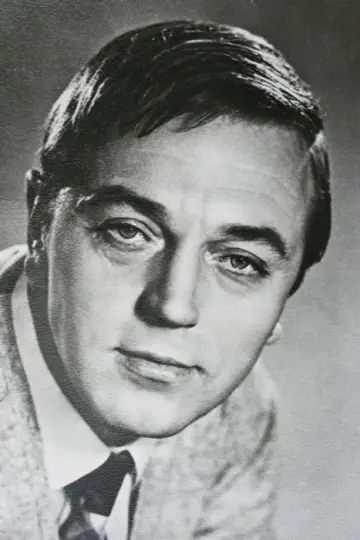
Anatoliy Romashin
Nicholas II
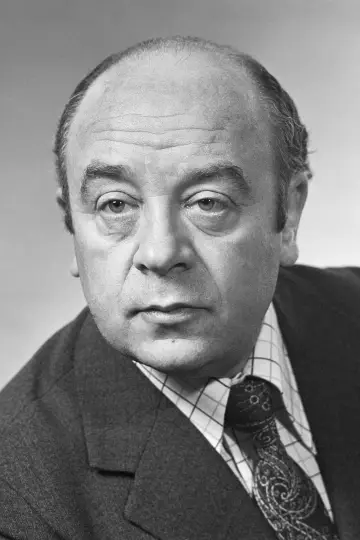
Leonid Bronevoy
Manasevich-Manuilov
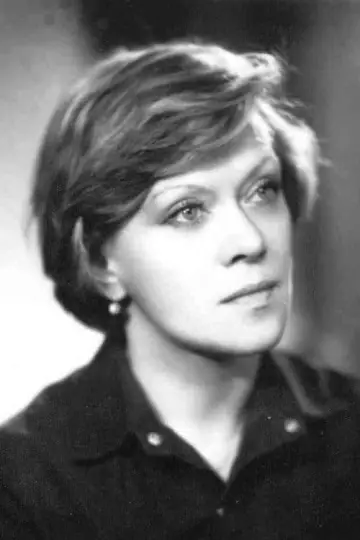
Alisa Freyndlikh
Vyrubova
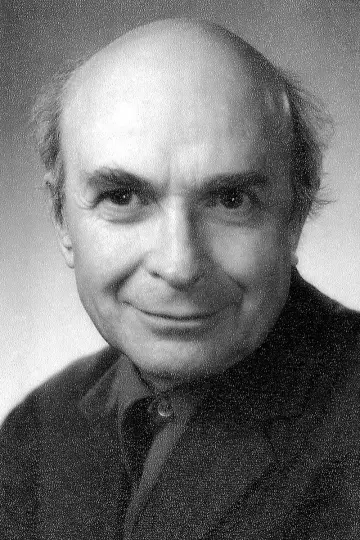
Yuri Katin-Yartsev
Purishkevich
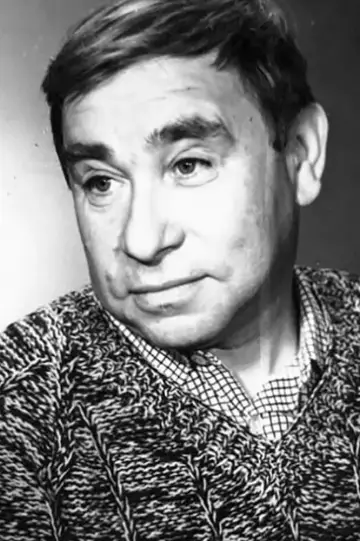
Mikhail Svetin
Terekhov
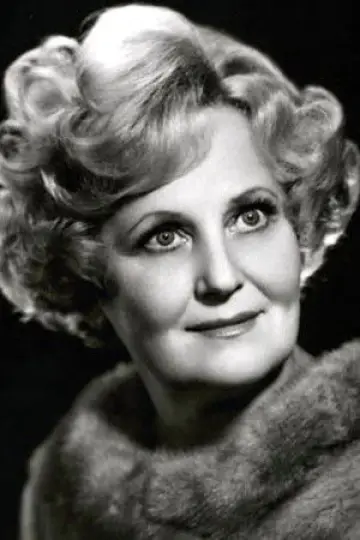
Velta Līne
Aleksandra Fyodorovna
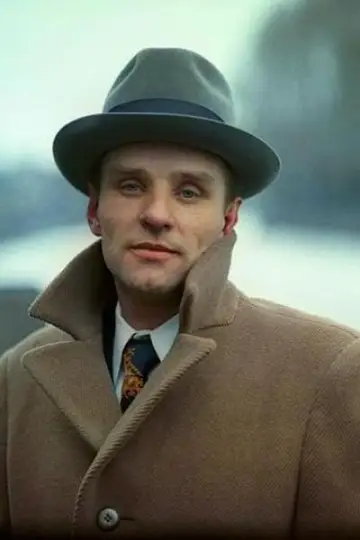
Anatoliy Solonitsyn
Colonel
Short description
As an adviser to the emperor Nicholas II, mystic Grigori Rasputin holds great influence over the empire. However, many in St Petersburg begin to regard Rasputin, with his strange practices and mesmerizing qualities, as a liability and plot his assassination. When Rasputin, known to many as the 'Mad Monk', leads Nicholas to embrace an ill-conceived military strategy, a group of determined conspirators set down a plan to eliminate him.
What's left behind the scenes
- Throughout the film, Anna Vyrubova strides about with a sweeping, majestic gait, and at one point even pushes the Empress in a wheelchair. In reality, in 1916, Vyrubova herself was wheeled in a chair, and could only move independently using crutches; a year earlier, in 1915, she had been in a major railway accident and sustained injuries so severe that everyone expected her to die soon. She survived, but used crutches and a cane for the rest of her life.
- In the scene of Rasputin's funeral, Tsarevich Alexei is clearly visible with his "uncle." However, according to eyewitness accounts, the heir to the throne was not present at the funeral.
- On the uniform of War Minister A.A. Polivanov, attending a report at the Stavka, are two orders—the Order of St. Stanislaus 3rd Class and the Order of St. Anna 3rd Class; another general wears only the Order of St. Anna 3rd Class. However, such awards in the Russian army were held by lieutenants and staff captains. According to the rules, lower classes of an order were not worn if higher classes were held, and generals were required to have higher classes by definition.
- The episode where clergymen lured Rasputin for 'repentance' and subsequently beat him took place five years before the events of the film—in 1911.
- At the end of the film, a grave is shown filled with murky water. When the coffin containing Rasputin is lowered into the grave, a loud splash is heard. In reality, Rasputin was buried in the middle of a freezing winter—at the end of December (early January by the New Style calendar)—and according to Nicholas II's diary entry, the temperature that day was minus 12 degrees. At night and in the morning (the time of the funeral), the frost is usually even more severe than during the day. In such cold, there could not have been water in the grave, let alone in such quantities.
- At the beginning of the film, a voice-over refers to the Russian Empire as the 'largest monarchy in the world.' This is not entirely accurate, as in 1916 (the time the film is set), the British Empire surpassed Russia in both area and population.
- The film claims that Russia's losses in the Russo-Japanese War amounted to 'more than 400,000 people.' In reality, Russia's total losses were slightly over 250,000 people (of which approximately 80,000 were killed or died).
- The film contains an inaccurate caption stating that Russia lost over 3 million killed and wounded on the fronts of World War I during 1914-15. In reality, Russia's losses amounted to 3,850,000 killed and wounded (plus 1,070,000 deceased and dead civilians)—but over the entire period of the war, from August 1914 to March 1918.
- For some reason, in 1916, Nicholas II is not wearing the Order of St. George 4th Class on his tunic, which he received in 1915. In reality, this award was always worn on the uniform under all circumstances, and the Emperor was moreover very proud of it.
- The film shows the famous 'Kuvaka' mineral water being scooped from some dubious pit by a person in a gas mask. When poured into a glass, the water appears clearly cloudy and possesses a repulsive smell. However, in 1915, mining engineer A. I. Dreyer described this water in the most enthusiastic terms: 'Kuvaka "Gremuchy Rodnik" water is not only excellent in physical terms, but impeccable in chemical, sanitary, and all other respects, being crystallinely transparent, absolutely colorless, without the slightest smell, with a pleasant refreshing taste, devoid of any bacteria and with a mineral composition minimal for the best drinking waters.' The film also shows the water being extracted somewhere in the suburbs of Petrograd, although it was actually from the Penza estate of V. N. Voeykov.
- Valeriya Zaklunna auditioned for the role of the Baroness.
- Alexander Kalyagin auditioned for the role of Alexei Nikolayevich Khvostov.
- Boris Khimichev auditioned for the role of the gendarmerie colonel.
- Filming began in 1966—to mark the 50th anniversary of the October Revolution—directed by A. Efros and based on A. N. Tolstoy's play "The Empress's Conspiracy." However, I. Pyryev, head of the "Luch" production unit (Mosfilm), later handed the film over to E. Klimov for completion. Klimov decided to abandon the adaptation of Tolstoy's play, considering it a "cardboard thing," and asked A. Volodin to write a new screenplay. Volodin refused, so Klimov approached I. Nusinov and S. Lungin (the screenwriters of one of his previous films, "Welcome, or No Trespassing") with the same request.
- The film began production for a third time in 1973 with the permission of the new head of Goskino, F. Yermash. During filming, the movie grew in length and became a two-part series. Filming concluded in 1974, and the final edit was completed in 1975. However, the film was not cleared for release and was returned to Klimov for further refinement in 1978.
- Rasputin, as portrayed by Petrenko, is a robust "giant" who inspires awe in those around him by his sheer massive presence. In reality, according to the recollections of contemporaries, Rasputin was "below average height," rather frail in build, with a haggard face, and did not possess great physical strength. The opposite can be said of Alisa Freindlich in the role of Vyrubova: photographs attest to her stout build.
- Natalya Gundareva, Eleonora Shashkova, and Evgeniya Uralova auditioned for the role of Anna Vyrubova.
- Antonina Shuranova auditioned for the role of Alexandra Fyodorovna.
- Georgiy Burkov auditioned for the role of Terekhov.
- Alexander Kaidanovsky auditioned for the role of Dmitry Pavlovich.
- Striving for greater authenticity, the director incorporates a large amount of black-and-white archival footage into the film.
- The film received its distribution permit on May 27, 1975, but the final cut was completed in 1981. After being screened at the Venice Film Festival in 1982, the film was offered for sale to Western countries. However, it was not released in Soviet cinemas until 1985.
- Leonid Markov, Mikhail Ulyanov, Evgeny Lebedev, Vladimir Samoylov, Anatoly Papanov, Evgeny Evstigneev, and Innokenty Smoktunovsky all auditioned for the role of Rasputin.
- Kirill Lavrov, Yuri Puzyryov, Nikolai Zasukhin, and Innokenty Smoktunovsky auditioned for the role of Nicholas II. Lavrov's candidacy was rejected by Goskino officials, who argued that a single actor could not play both Lenin and the Tsar.






 Auditions in India
 Casting calls in USA
 Castingi w Polsce
 Кастинги в Україні

