Monsters University




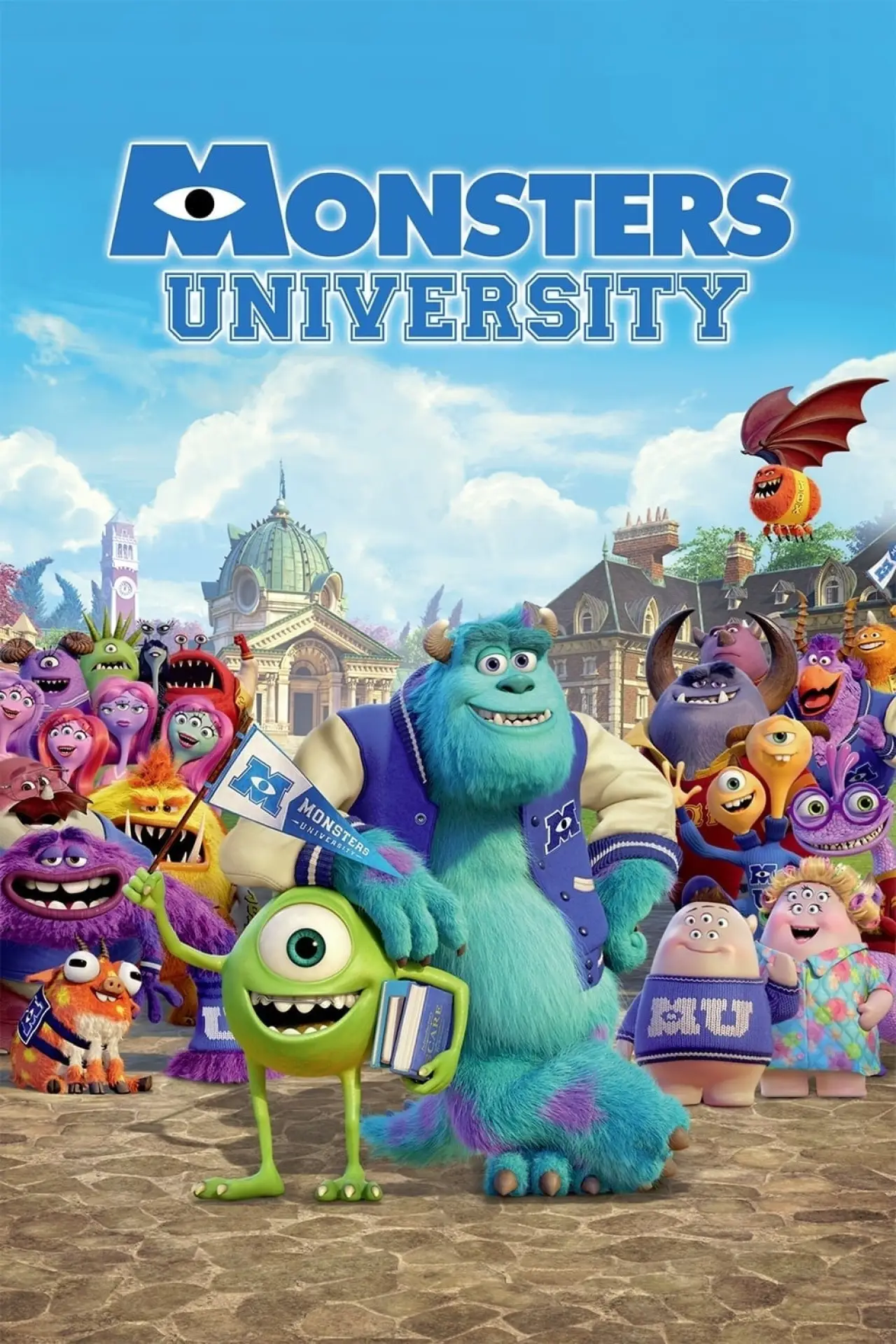
All team (404)
Short description
Monsters University is a prequel to Monsters, Inc. that goes back to the college years of Mike Wazowski and James P. Sullivan, long before they became a scare team. Mike has wanted to be a scarer since childhood, and he enrolls at the prestigious Monsters University to study the subject. There he meets Sulley, a confident monster who relies on natural talent rather than hard work. The two clash almost immediately, and their rivalry costs them their place in the scare program. To earn a way back in, they have to join forces, along with a group of monsters who do not fit in, and learn to cooperate.
The film is directed by Dan Scanlon, the first of the two features he has directed, followed by Onward in 2020. Daniel Gerson, Robert L. Baird and Scanlon wrote the screenplay, and Kori Rae produced it for Pixar and Walt Disney Pictures. Billy Crystal and John Goodman return as the voices of Mike and Sulley, with Steve Buscemi, Helen Mirren, Peter Sohn and Joel Murray also in the cast. It was released in June 2013 and runs 104 minutes.
Made for about 200 million USD, it took roughly 744 million USD worldwide. On IMDb it holds 7.2 out of 10 from around 422,000 votes, and on TMDB 7.1 out of 10 from about 11,500 votes. A critics' rating of 6.9 out of 10 from 201 reviews puts it close to the audience scores.
What's left behind the scenes
- To understand what a de-aged Mike should look like, the filmmakers studied the aging process in frogs. Then, artist Ricky Nierva, lead animator Jason Dimmer, and some other members of the film crew applied the knowledge they gained to the work on the younger versions of Mike and Sally. “We made them a little leaner, reduced their horns, erased some wrinkles, made their eyes brighter, and the colors more saturated,” Dimmer said.
- It was decided to give each of the three returning characters a new individual trait, or a visual cue, to use the jargon of the film crew. Mike was given braces. Sully got unruly teenage hair, reflecting his somewhat relaxed approach to life. Randall, who is called Randy in 'Monsters University,' is equipped with glasses that occasionally give him away when he tries to perform his still-imperfect disappearing trick.
- "It was very difficult to draw fur for the first film," said artist Ricky Nierva. "We had a limitation: only one furry character was allowed in each scene. Since then, there has been unprecedented progress, and in 'Monsters University' we could place furry characters anywhere, without any restrictions. However, at some point, director Dan Scanlon had to rein us in: the difference from the first film, where having fur was a luxury allowed to a select few monsters, was too noticeable. As a result, we had to shave the fur from some of the new generation of monsters."
- The cartoon features 500 characters, with an average of 25 characters per frame, twice as many as in any previous Pixar film. Artists modeled and developed many of the more than four hundred background characters early in the film's production, while the writing team finalized the details of Mike and Sully's adventures.
- Twelve people worked on a character named Terzaales. The heroine needed to be scary and repulsive, but also beautiful and graceful. The artists drew inspiration from the rare centipede Scolopendra Gigantea, also known as the giant Amazonian centipede.
- Producer Kori Rae participated in a trip to universities in search of information and inspiration. This was during the early stages of script development. "First, we went to the East Coast of the United States, where we visited several leading universities, including Harvard and the Massachusetts Institute of Technology (MIT)," says Rae. "It was impressive. On the first day, we were amazed by the size of the university campuses and how much was happening there. We couldn't believe our eyes. We went into classrooms, listened to lectures, and instantly became immersed in student life."
- The film crew visited universities in their native Southern California, including Stanford and Berkeley. The filmmakers were interested in the most exciting aspects of student life. Some of the crew were even lucky enough to witness a fireworks display in Berkeley, timed to coincide with an important football game against Stanford. This experience was reflected in the film as a rivalry between Monsters University and ScareTech.
- The film crew decided to add some fun visual effects to the scene where university clubs advertise their merits to freshmen. Mike walks from booth to booth at this time. “For the art club,” recalls Nierva, “we came up with a character whose head is one dense mass of wool. He dips his woolly head into paint and slams it onto the canvas with force. The guys preparing the special effects had a lot of fun developing this scene. One of them put on a paint-soaked wig and ran his head over the canvas several times.”
- Creating a university for monsters is a colossal task. “When we started working, I didn’t yet have a clear idea of what our college should look like,” said director Dan Scanlon. “But as our field research progressed, as we got to know different real universities, we increasingly understood that we were interested in elongated buildings in a classic style. We wanted the building to indicate that the university had a long history, but without looking too dusty. On the one hand, it should be an elite educational institution, we thought, and on the other hand, it should be fun to study there. We decided to locate the university campus in a hilly area, drew other buildings behind each building, and covered all the lawns with paths to give the impression that wherever you go, there is something interesting. Because that’s what student life is like. That’s how one of the cornerstones of our university emerged.”
- Lead artist Ricky Nierva claims that the main task when designing the campus buildings was to convey the spirit of learning and science, but the artists were not forbidden to have a little fun. “We subjected our buildings to careful monsterization, adding fangs, claws, horns, teeth, spikes, tentacles, and creepy faces wherever possible. Also, pipes resembling plumbing are visible in all the rooms. Roars and screams are supplied through them, because all the buildings on campus are heated by the energy of roars and screams.”
- One of the main innovations in the creation of "Monsters University" is Pixar's new lighting development, called global illumination (GI). This is a revolutionary approach to lighting. Global illumination allows filmmakers to receive light directly from a single volumetric source, rather than hundreds of individual light sources. As a result, the image looks much more realistic. A major advantage of this method is that the filming crew can understand how the final lighting will look at an early stage. Previously, this always required waiting for the filming process to be completed.
- "The number and diversity of characters presented a great difficulty for us," says Technical Director Sanjay Bakshi. "This is a film about a university. The events take place in a huge university complex, so we had to create a whole bunch of diverse students to resemble a real university, only for monsters. The teams responsible for modeling and rigging needed to figure out how to cope with all this diversity. It was easier with the first film. Then we designed hands and tentacles separately from the bodies. But in "Monsters University," all the characters had to look lively and organic. We knew we were going to create hundreds of characters, so we developed several basic types. Based on them, we could construct more complex characters, giving them various additional properties."
- "For the secondary characters, we developed six basic models," said Christian Hoffmann, head of character creation. "Then we lengthened, stretched them, and added horns, spikes, hair, and other objects to them. Each group has its own name. All the Charlies (the name was chosen in honor of a similar monster from the film "Monsters, Inc.", 2001) have eyes set on thin stalks, and tentacles instead of arms and legs. Spiffs look more like humans, but have a horn instead of a nose. Pills resemble a small castle with three eyes and thin limbs. Blocks look like wrestlers with square bodies. Fungus monsters look like slugs. They slide on the ground. They have two large eyes, like insects, a small round body, and thin limbs." "Systems for controlling animation, or AVAR, were a great help in working on this film," Hoffmann shared. "There is currently nothing equal to them in terms of technical advancement. With their help, we could create absolutely phenomenal facial expressions. For example, we could now allow a character to move the corners of their mouth or cheek with an expressiveness that the world of animation had not yet known."
- To make the film look convincing, it was necessary to skillfully draw a crowd of monsters for scenes in auditoriums, on campus, and during the Scare Games. "There are a very, very large number of mass scenes in this picture," said J.D. Northrup (head of the team that worked on creating the crowd), who led the technical team for mass scenes. "One episode takes place in a football stadium, where there are up to 5,000 monsters in the frame. In many other scenes, we have medium-sized groups of monsters, 200–400 individuals. This film has a very high density of monsters per square centimeter of screen. In this regard, we surpassed all films ever shot at Pixar."
- "This film has far more characters with fur than any other film," said Head of Modeling Christine Waggoner. "Basically, in "Monsters, Inc." (2001), we had only one character that was properly covered in fur, because the technology at the time did not allow us to cope with a large number of such characters on the screen. In "Monsters University," 15–20% of all monsters are covered in fur. The technology for processing hair and fur has been significantly simplified. Consequently, modeling capabilities have also expanded. Our current graphics programs allow animators to see the character's hair during animation. Moreover, these are not modeled hairs, but the result of visualization, carried out so quickly that the whole process can be called interactive. As a result, animators have the opportunity to better calculate the composition of each frame and more accurately calculate the required amount of fur."
- The first prequel to a Pixar film.
- Doug Sweetland was initially considered as director, having directed the animated film 'Prep & Landing' (2008).
- Originally, the plot was to include Mike's parents, who were supposed to drive Mike to university on his first day. However, director Dan Scanlon decided to abandon this idea to make Mike seem much more vulnerable.
- Lecture hall A-113 is a reference to a real classroom at the California Institute of the Arts, where animation classes are held. A reference to this room appears in every Pixar film.
- The ball from the cartoon "Luxo Jr." (1986) can be noticed as a drawing on a stone wall.
- A scene from the trailer where Mike is turned into a disco ball was not included in the final version of the film.
- In the German version of the cartoon, the character Frank McCay was voiced by the goalkeeper of the German national football team, Manuel Neuer.
- In the new film, a very young Mike visits the factory on a school excursion 20 years before the events of the first film begin. Ten years later, the members of "Roar Omega Roar" pay Monsters, Inc. another very unexpected visit. For these episodes, the artists had to develop two retro versions of the corporation. “We couldn’t use the drawings left over from the first film,” explains Nierwa. “Technology had come too far. We had to rebuild everything from scratch, while simultaneously figuring out how to make our enterprise look 10 and 20 years younger.” For example, the team of artists had to redo the scoreboard displaying the leading workers. “In the first film, the results of the employees’ work are displayed on several TV screens,” says Nierwa. “We decided that earlier, the results were probably displayed on a fossilized train station scoreboard, with the letters running with a characteristic crackle. In the new film, the corporation looks different, but the connection to what was in the first picture is obvious. We also took into account the evolution of mobile phones, which have transformed from huge bricks into gadgets of modest size. Our door control stations have also been aged. They look much more massive, as they were at an earlier stage of scientific and technological progress.”
- When Mike and Sully are first shown their room in the fraternity house, the light switch is located on the wall under the bunk bed. In subsequent shots, it moves closer to the door.
- It took 100 million hours of processor time to create "Monsters University." If the film had been made on a single computer, it would have taken 10,000 years. This is a record for Pixar. On average, 29 hours of work went into each frame. The computer network used to create this film was approximately twice the size of the one used for "Brave." In addition, each computer was converted into a multiprocessor (12 processors each). This allowed frames to be broken down into several parts and processed simultaneously on multiple computers using multithreading.
- The second college-themed film to receive a 'G' rating. The first film was "Daddy Day Camp" (2008).
- In the previous installment of the "Monsters, Inc." (2001) animated film, during a conversation between Sully and Mike, we learn that they have known each other since the 4th grade, but in "Monsters University" (2013) they only meet in college.
Similar movies





 Auditions in India
 Casting calls in USA
 Castingi w Polsce
 Кастинги в Україні
