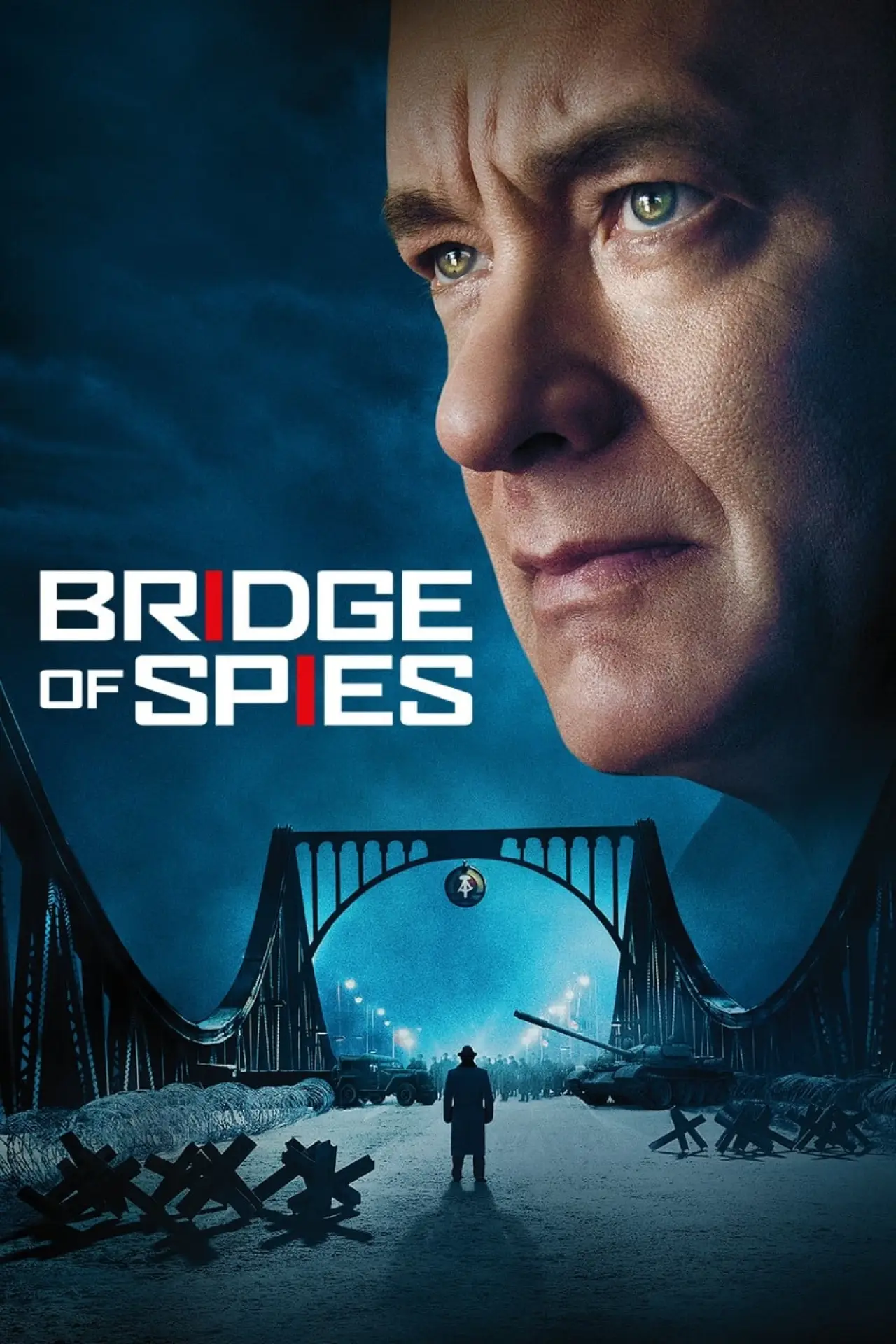
Bridge of Spies
In the shadow of war, one man showed the world what we stand for.




Country
Production
Budget
$40 000 000
Revenue
$165 478 348
Director
Actors
Tom Hanks, Mark Rylance, Amy Ryan, Alan Alda, Sebastian Koch, Austin Stowell, Billy Magnussen, Michael Simon Hall, Edward James Hyland, Stephen Kunken
All actors and roles (10)
All actors and roles (10)
Scenario
Producer
Steven Spielberg, Marc Platt, Kristie Macosko Krieger, Daniel Lupi, Jonathan King, Jeff Skoll, Adam Somner
Operator
Composer
Artist
Adam Stockhausen, Nafisah Mohamed, Walter Goh
Audition
Ellen Lewis, Lucky Englander, Fritz Fleischhacker
Editing
Short description
During the Cold War, the Soviet Union captures U.S. pilot Francis Gary Powers after shooting down his U-2 spy plane. Sentenced to 10 years in prison, Powers' only hope is New York lawyer James Donovan, recruited by a CIA operative to negotiate his release. Donovan boards a plane to Berlin, hoping to win the young man's freedom through a prisoner exchange. If all goes well, the Russians would get Rudolf Abel, the convicted spy who Donovan defended in court.
What's left behind the scenes
- One episode depicts the construction of the famous wall in East Berlin. The plot suggests it is wintertime. In reality, the wall was erected almost overnight in August 1961.
- By the time East Germany erected the wall, the government and law enforcement’s control over the population was already complete. There was no question of anyone being able to walk along the wall looking for a loophole to the other side.
- According to a statement by Tom Hanks at a press conference, Donovan’s speech in the film during the Supreme Court hearing exactly replicated the words actually spoken in defense of Abel in the Supreme Court many years ago.
- In the film, Abel speaks with an accent that seems somewhat inappropriate. In reality, he was born into a Russian family in Newcastle upon Tyne, UK, and attended school in Scotland for several years. As a young man, Abel returned to Moscow, but spoke English with a noticeable accent for the rest of his life.
- The Parisian premiere of the film was scheduled for November 15, 2015, but was canceled in light of a series of terrorist attacks in the French capital that claimed the lives of over 120 people.
- On the Donovan's dining table is ceramic tableware with a stylized depiction of sunflowers. This tableware only appeared in 1958, a year after the events depicted in the film began. (On the other hand, it is not entirely clear when exactly this dinner takes place within the narrative.)
- Mrs. Donovan knew where her husband worked even before she heard it on television after his return.
- Colonel Abel gave Donovan a seascape, not a portrait.
- Initially, photographers near the courtroom were instructed to put their used flashbulbs in their pockets. One of the extras turned out to be a member of the New York Press Photographers Association. He informed the producer and assistant director Adam Somner that photographers at the time simply threw used flashbulbs on the floor. That's what was done. After a few takes, Steven Spielberg ordered the camera angle to be changed and filmed the floor, literally littered with spent flashbulbs.
- At the end of the film, the audience learns from the credits that Donovan played a significant role in the negotiations following the Bay of Pigs incident, which occurred shortly after the events depicted in the film. Donovan was approached to negotiate the release of Cubans and Americans taken prisoner during the failed invasion of Cuba in 1961. Over several trips to the island, Donovan gained the trust of the leader of the Cuban Revolution, Fidel Castro. Through his efforts, over 1100 people who participated in the invasion and 8500 political prisoners were eventually released.
- During their first conversation, Vogel proposes to Donovan an exchange of Abel for American student Frederic Pryor, who had been detained by East German troops, and hands him a photograph with a clear MI-5 British intelligence stamp on the back. Diplomatic relations between East Germany and Great Britain began only in 1973.
- In one episode of the film, a television is switched off, and the picture on the screen disappears instantly. In reality, when televisions of that era were switched off, the picture would shrink into a white dot that remained on the screen for several minutes.
- In the courtroom scenes, which take place in 1957, US flags are placed near the judge's seat, but this practice was not introduced until 1960. At that time, the United States consisted of only 48 states, but the flags feature 50 stars.
- Donovan calls his wife from a phone booth in West Berlin. He drops a few coins into the coin slot, and a connection is immediately established. Both of these things were practically impossible in the 1960s. Establishing a connection took several hours, and the cost of a call from the US to Europe was $10 for 3 minutes. Calls from Europe to the US were, apparently, even more expensive.
- Modern television distribution devices are visible in scenes filmed in Brooklyn.
- When Donovan is riding the subway, satellite dishes can be seen on the roofs of the houses whizzing by.
- A modern vehicle inspection sticker is visible on the windshield of the black car in Brooklyn, behind which Donovan is hiding.
- When Donovan arrives in Berlin for the prisoner exchange, it is clearly cold weather. When he returns home and meets his wife on the porch, the trees are full of leaves and it is summer.
- Donovan was offered a drink in East Germany and given a bottle with an aluminum screw-cap. In 1960, such bottles were sealed with corks.
- When Powers' U-2 crashes, the sound of a propeller is heard, although the U-2 was a jet aircraft.
- To the right of the Brooklyn Bridge in one of the opening shots of the film, which takes place in 1957, the building at 60 Wall Street, built in 1989, is clearly visible.
- As Steven Spielberg stated at a press conference dedicated to the film's release, Gregory Peck expressed a desire to star in the film as early as 1965. Alec Guinness was to play Abel, Peck was to play Donovan, and Stirling Silliphant was chosen as the screenwriter. However, MGM rejected the film idea. It was 1965, and the Cold War was at its height. The world had just recovered from the Bay of Pigs conflict and the Cuban Missile Crisis, and MGM believed it wasn't the time to get involved in politics.
- Steven Spielberg decided to invite Mark Rylance to one of the roles after seeing his performance in *Twelfth Night*, for which the actor received his third Tony Award (presented annually for achievements in American theater).
- At the beginning of the film, Rudolf Abel paints a self-portrait, and this scene is clearly inspired by Norman Rockwell's *Triple Self-Portrait*. Steven Spielberg and George Lucas have long been admirers of the artist and collect his work.
- The film depicts Francis Gary Powers as an active member of the US Air Force with the rank of lieutenant. In reality, Powers resigned from the army in 1956 with the rank of captain. After that, as a civilian, he became involved in the CIA's 'U-2' program and continued to work for the agency until May 1, 1960, when his plane was shot down over Soviet territory.
- The film depicts Soviet intelligence officer Rudolf Abel receiving cipher messages hidden in ten-cent coins from his KGB handlers. The FBI first took notice of Abel in 1953 when one of the Soviet agents mistakenly paid with such a coin when buying a newspaper. The newspaper carrier found the coin suspiciously light. He dropped it on the asphalt, and the coin broke into two parts, with a microfilm falling out. FBI cryptographers struggled unsuccessfully with the cipher until 1957, when Reino Häyhänen defected from the USSR to the West with the key to the cipher. He also identified Abel to the Americans. The episode with the hollow coin is featured in the film “The FBI Story” (1959) starring James Stewart.
- Steven Spielberg’s father, an engineer by profession, spent some time in the Soviet Union during the height of the “Cold War” as part of an exchange program. This happened shortly after the Powers U-2 spy plane was shot down, when relations between the US and the USSR were reduced to mutual suspicion and fear. Spielberg’s father later recalled how Soviet citizens lined up to look at the wreckage of the Powers plane. Upon seeing the American engineers, some of them said, “Look what your country is doing.” This served as a vivid illustration of the feelings that the peoples of the two countries had for each other.
- Filming of “Bridge of Spies” began in September 2014 and lasted 12 weeks. Filming took place in New York, as well as in Germany and Poland, in the very places where the events on which the film is based occurred. The exchange of Powers for Abel was filmed in Berlin, where it actually happened many years ago. Berlin in 1961 was filmed in Wrocław, Poland. This city resembles Berlin in the mid-20th century more than Berlin itself.
- The final scenes of the film, where the exchange of Rudolf Abel for Francis Gary Powers takes place, were filmed on the Glienicke Bridge in Berlin. It was there in 1962 that the exchange of Abel for Powers actually occurred. The exchange of many other Soviet and American intelligence officers during the “Cold War” also took place on this bridge, for which the press dubbed it the “spy bridge.”
- In the footage preceding the U-2’s takeoff, it can be seen that the auxiliary landing gear strut detaches from its right wing. The U-2 was deliberately made extremely lightweight to increase its range and flight ceiling. Detaching the auxiliary landing gear struts was necessary to reduce the aircraft’s weight. During landing, the pilot landed the aircraft simultaneously on the nose and tail landing gear and balanced with ailerons until complete loss of speed. The aircraft would settle onto the wingtip, the end of which was a small titanium runner – the so-called ‘ski.’
- A green sphere is shown at the entrance to the subway at the beginning of the film. Colored spheres began to be installed only in 1982. A green sphere indicated that the station was open 24 hours a day, a red one – that it was closed at certain times. Before 1982, all spheres were exclusively white. Hanks and Spielberg made the same mistake in another joint project – in the tragicomic detective story “Catch Me If You Can.”
- An advertisement for the film “One, Two, Three” (directed by Billy Wilder, 1961) is visible on the building of the cinema behind Donovan and Hoffman. Like the characters in “Bridge of Spies,” the heroes of Wilder’s film repeatedly travel between East Berlin and West Berlin and back.
Similar movies
8.4/10
8.4/10
8.4/10
8.3/10
8.2/10
8.1/10
8.1/10
8/10
8/10

8/10


 Auditions in India
 Casting calls in USA
 Castingi w Polsce
 Кастинги в Україні
