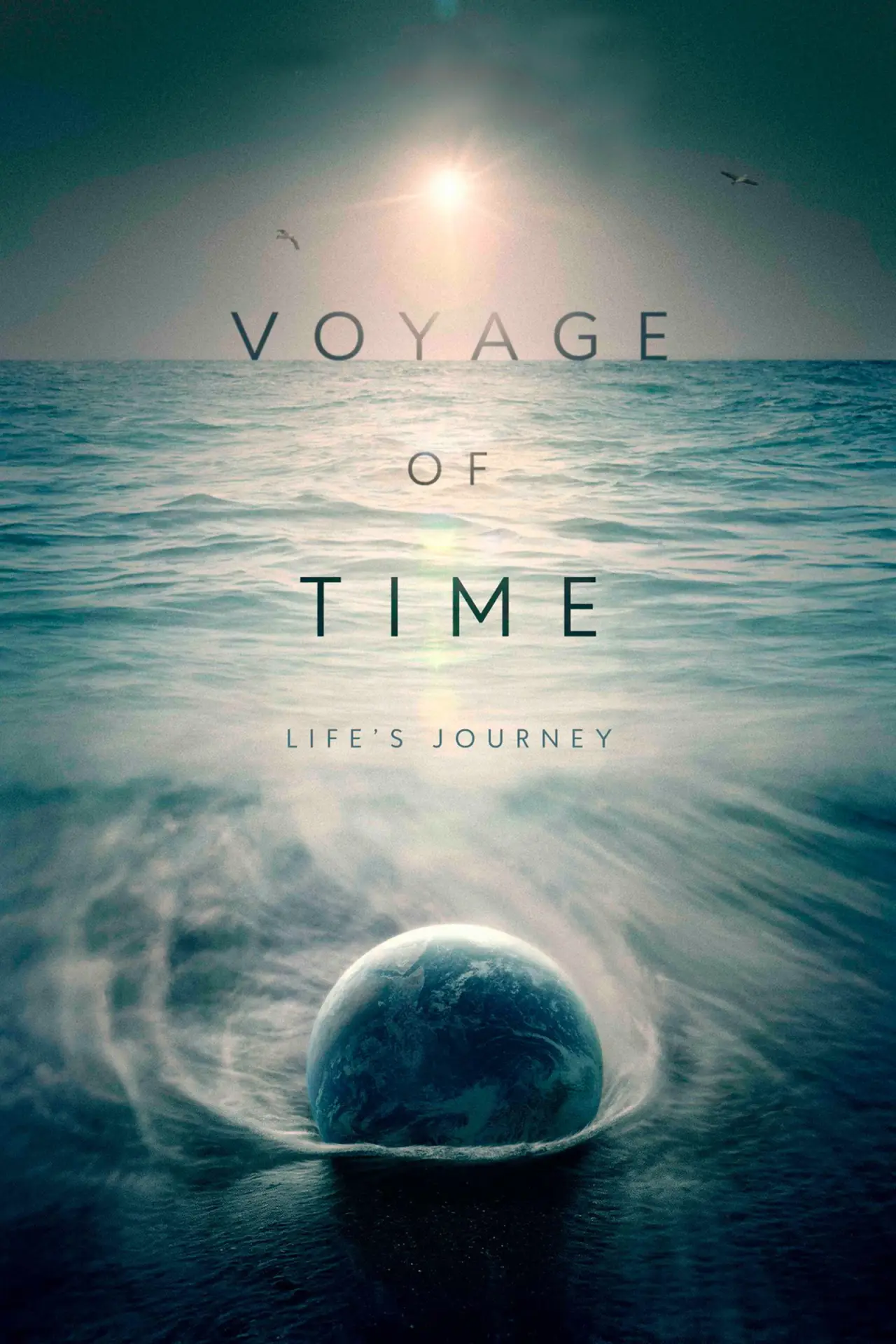
Voyage of Time: Life's Journey
From So Simple a Beginning.
Voyage of Time: Life's Journey (2017)



Production
Director
Scenario
Composer
Hanan Townshend
Producer
Sophokles Tasioulis
Actors

Cate Blanchett
Narrator (voice)
Jamal Cavil
Early Human
Maisha Diatta
Early Human
Yagazie Emezi
Early Human
Daryl James Harris II
Early Human
Sebastian Jackson
Early Human
Keitha Johnson
Early Human
Abraham Kosgei
Early Human
Short description
A celebration of the universe, displaying the whole of time, from its start to its final collapse. This film examines all that occurred to prepare the world that stands before us now: science and spirit, birth and death, the grand cosmos and the minute life systems of our planet.
What's left behind the scenes
- Working on the film took Terrence Malick a total of over 30 years.
- The film was originally conceived as a conceptual project titled Q. The first steps in production were taken as early as the late 1970s, but Terrence Malick left the project in 1979. Initially, it was intended to be a love story. The action was to take place in the Middle East during World War I, with a brief prehistoric segment serving as a prologue. Over time, however, Malick removed the recent past and made the prologue the main framework of the film. The narrative became more metaphorical, focusing on a god resting in the depths of the waters, dreaming of the birth and formation of the Universe.
- An agreement to participate in the project was initially reached with Emma Thompson, but she was later replaced by Cate Blanchett.
- The visual effects specialists involved in the production faced a daunting task. It was necessary to: 1) show the period before the formation of the Solar System as we know it, and then conceive and convincingly depict the future awaiting our Universe according to the latest scientific theories; 2) depict the protoplanetary disk that later transformed into our Solar System; 3) show in all their glory (and in motion) the single-celled forms that would eventually learn to reproduce and evolve into more complex organisms; 4) convincingly depict animals that no longer exist.
- While working on the visuals, Terrence Malick and Dan Glass, the head of the special effects team, experimented extensively with high-speed filming of various liquids, dyes, and gases. The experiments utilized everything from gels and glass to smoke generators and liquid tanks. The filmmakers drew inspiration, in particular, from the works of Albert Bierstadt (1830-1902), one of the most famous American landscape painters, who skillfully employed the effects of light and shadow.
- Filming began in 2003 when Paul Atkins (a renowned filmmaker who agreed to serve as the cinematographer for this picture) informed Terrence Malick about volcanic eruptions in Hawaii. The film crew immediately flew to the islands. One of the camera operators got so close to the molten magma that his boots melted.
- While preparing to work directly on the film, Terrence Malick read the works of renowned scientists and conversed with them over a period of 40 years.
- The film's scientific consultant was Andrew Knoll, a professor of natural sciences at Harvard University, a NASA consultant, and the author of numerous works.
- One of the film's sponsors was the National Geographic Society.








 Auditions in India
 Casting calls in USA
 Castingi w Polsce
 Кастинги в Україні
