Amélie



![Watch film Amélie — 25th Anniversary | Official UK & IRE Trailer [Subtitled]](https://www.acmodasi.in/amdb/images/posters/r/p/amelie-2001-R76c2.webp)
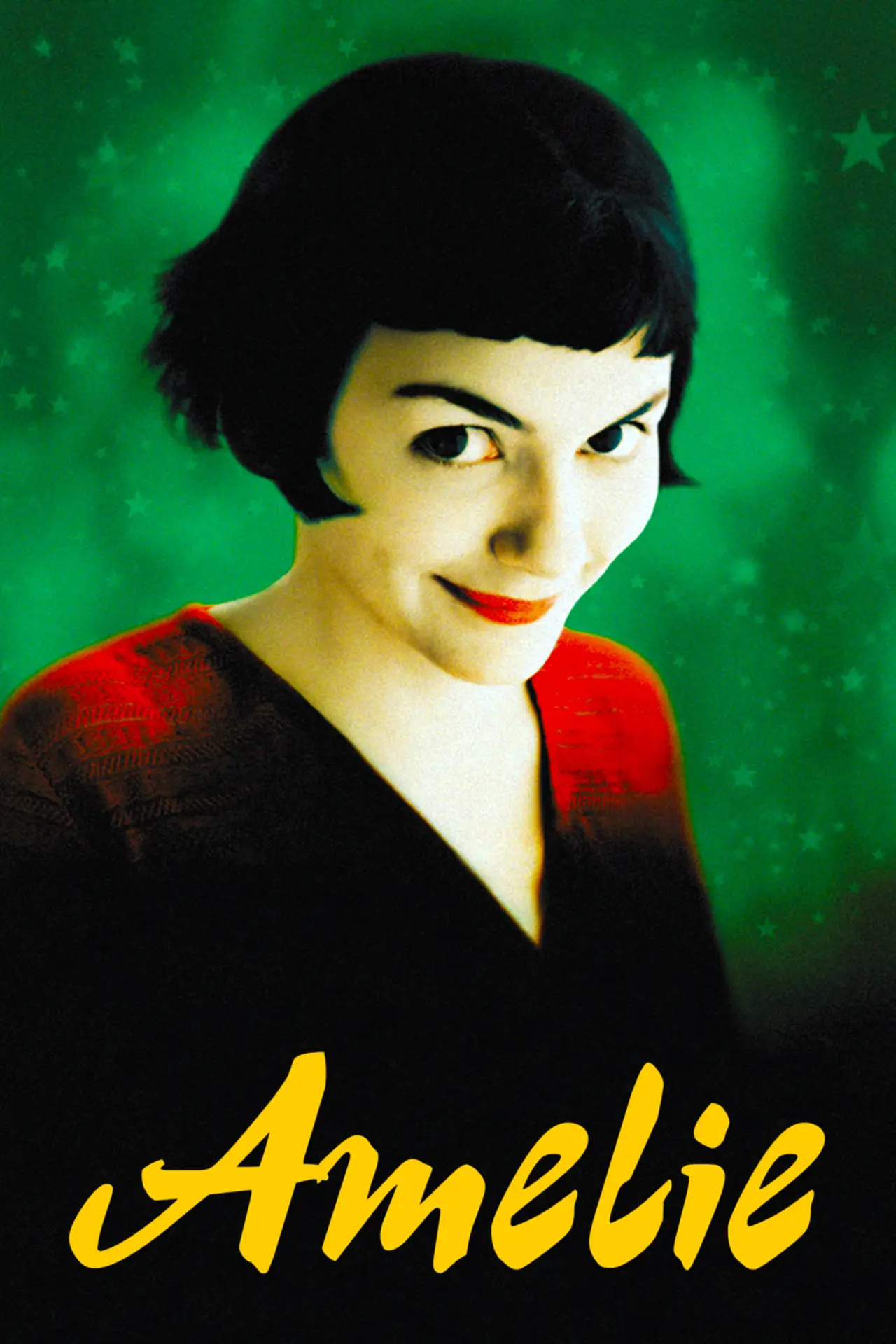
All actors and roles (10)
Short description
Amélie is a young Parisian waitress who keeps largely to herself, observing the people around her and escaping into her own imagination. When she discovers a small box of childhood keepsakes hidden in her apartment, she tracks down its former owner and returns it to him. His reaction sets her on a new path: she begins quietly arranging small interventions in the lives of her neighbours, coworkers and father, using elaborate tricks to bring them happiness without ever revealing herself as the source. Her own romantic life proves a harder problem, especially once she crosses paths with Nino, a collector of discarded photobooth pictures.
Jean-Pierre Jeunet directed and co-wrote the film with Guillaume Laurant, following Delicatessen, The City of Lost Children and Alien Resurrection; it was his fourth feature as director. Claudie Ossard produced, with Arne Meerkamp van Embden, for a production that cost around 10 million dollars and went on to take roughly 174 million dollars worldwide. Audrey Tautou plays Amélie, with Mathieu Kassovitz as Nino, Rufus as her father Raphaël, Serge Merlin as her reclusive neighbour Raymond Dufayel, Jamel Debbouze as Lucien and Clotilde Mollet as Gina.
Made in France and Germany, the film runs 122 minutes. On IMDb it holds 8.3 out of 10 from around 837,000 votes, while on TMDB it has 7.9 from roughly 12,700 votes, indicating that it remains widely seen and well received by audiences. A critics' rating of 8.6 from 231 reviews places it somewhat higher with reviewers than with the general public.
What's left behind the scenes
- The dark-skinned guitarist singing gospel in the television fragment is Sister Rosetta Tharpe.
- The one-legged man dancing in the television fragment – Sam “Peg Leg” Jackson – is a blues singer.
- The film is full of stories and memories from the director's collection, which he began to gather back in 1974.
- The name Hippolyte is a reference to the minor character Hippolyte Terentyev, the unlucky philosopher from Fyodor Dostoevsky’s novel "The Idiot" (1869).
- Audrey Tautou received the role of Amélie Poulain after the film’s director saw her portrait on a poster.
- The paintings we see in Amélie's room, as well as the imaginary crocodile that the heroine befriends, were invented and painted by artist Michael Sowa.
- In the scene where Amélie's father talks about flowers, he quotes the song Le poinçonneur des Lilas by Serge Gainsbourg.
- Jean-Pierre Jeunet dreamed of casting Emily Watson in the lead role (hence the French name of the main character, Amélie). The actress also wanted to play Amélie, but it didn’t happen for two reasons – she didn’t speak French and, moreover, she had already agreed to star in Robert Altman’s "Gosford Park" (2001).
- The original title of the film translates as "The Fabulous Destiny of Amélie Poulain."
- In the places in Paris where the main scenes of the film were shot, artists and decorators had to work hard to clean the walls of houses from all sorts of graffiti.
- Factual error: Princess Diana died in the morning of August 31, 1997, not August 30. Also, the day of April 7, 1980, mentioned in the film, was a Monday, not a Friday.
- The traveling gnome was the subject of pranks in England and France in the 90s. In 1997, the leader of the "Garden Gnome Liberation Front" (French: Front de Liberation des Nains de Jardins) was accused of stealing 150 such gnomes. This idea later formed the basis of an advertising campaign for a travel internet agency.
- The photo collection that Nino collects actually exists and belongs to the director's friend, Michel Folco (he is thanked in the end credits).
- The style that the film is rich in was borrowed by the director from French poet Jacques Prévert and director Jean Renoir.
- Yann Tiersen might not have become the film's composer if Jean-Pierre Jeunet hadn't accidentally heard his music.
- In the cinema, Amélie watches two films: "Jules and Jim" by François Truffaut (the episode where Amélie turns to face the audience) and "The Shop Around the Corner" by Vincente Minnelli (the episode when Amélie says she doesn't like it when drivers don't look at the road in American films).
- It was not possible to show the real photo collection in the film (French law prohibits showing random people in a film without their consent), so the photo collection had to be recreated using photographs of actors in minor roles. For this, the actors were seated in front of the camera and asked to portray a particular facial expression, and often they were simply told, "Oh, you have chalk on your shoe" or "What's that on your forehead," and the camera was clicked at that moment.
Similar movies







 Auditions in India
 Casting calls in USA
 Castingi w Polsce
 Кастинги в Україні
